Why In News?
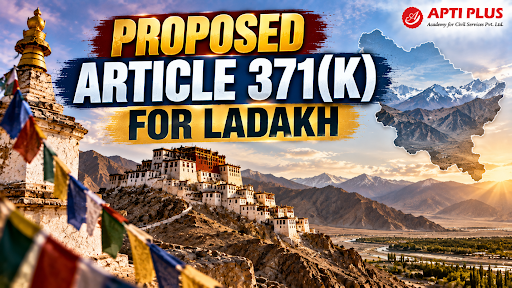
The Union Ministry of Home Affairs (MHA) has proposed establishing a directly elected governing body for the Union Territory (UT) of Ladakh by introducing a new constitutional provision under Article 371 in a proposed Chapter K (Article 371K).
What is Article 371?
Special Constitutional Provisions Under Part XXI: Article 371 and its associated clauses (Articles 371A to 371J) form an integral component of Part XXI of the Constitution, titled "Temporary, Transitional and Special Provisions".
Asymmetric Federal Architecture: It operationalizes differentiated federalism, granting bespoke economic, administrative, developmental, and cultural protections to specific states or backward sub-regions.
Geographical Coverage Across 12 States: It currently applies across 12 states: Maharashtra and Gujarat (Art. 371), Nagaland (Art. 371A), Assam (Art. 371B), Manipur (Art. 371C), Andhra Pradesh and Telangana (Art. 371D & 371E), Sikkim (Art. 371F), Mizoram (Art. 371G), Arunachal Pradesh (Art. 371H), Goa (Art. 371I), and Karnataka (Art. 371J).
Core Purpose of the Article 371: Accommodate regional historical treaties (e.g., 16-point agreement for Nagaland), protect indigenous customary laws and religious practices, ensure balanced regional development via development boards, and safeguard local employment and educational reservations.
Distinction Between Existing Article 371 Provisions and Proposed Article 371(K): While existing provisions from 371A to 371J apply exclusively to full-fledged States within the Indian Union, the proposed Article 371(K) would introduce an unprecedented constitutional model designed specifically for a Union Territory without an existing legislative assembly.
What is the Proposed Article 371(K)?
Proposed Chapter K for Ladakh: The MHA suggests amending Article 371 to add a dedicated "Chapter K" specifically delineating the administrative structure and legislative jurisdiction for the Union Territory of Ladakh.
Directly Elected Governing Body: It proposes constituting a centralized, directly elected apex legislative council or territorial body representing both Leh and Kargil districts, bridging the democratic deficit created after 2019.
Substantive Legislative Competence: The proposed body would possess delegated legislative powers over vital regional subjects: transfer and ownership of land, preservation of cultural and linguistic identity, management of unclassed forests, environmental regulations, mineral rights, and local commercial development.
Jurisdiction Under Article 240 Alignment: The legislative powers would be harmonized with presidential regulatory powers under Article 240, granting statutory teeth to local legislation subject to presidential assent.
Sui Generis Governance Model: Described by the administration as a tailored, unprecedented constitutional arrangement aimed at deepening grassroots democracy in a sensitive border UT without requiring full-fledged statehood.
Why Ladakh Need Special Constitutional Protection?
Protection of Fragile Land Rights: With a sparse population spread across 59,146 sq km, unregulated land alienation to external commercial entities risks altering demographic patterns and displacing indigenous agro-pastoral communities.
Safeguarding Distinct Cultural and Linguistic Identities: Over 97% of Ladakh’s population belongs to Scheduled Tribes (Balti, Beda, Bot/Boto, Brokpa, Changpa, Drokpa, Garra, and Mon), requiring constitutional preservation of unique languages (Ladakhi/Bhoti, Purgi, Shina) and monastic heritages.
Extreme Ecological Fragility of High-Altitude Cold Deserts: The Himalayan cryosphere of Ladakh is vulnerable to glacial retreat, flash floods, water scarcity, and unregulated mass tourism, demanding local environmental governance.
Conservation of Critical Natural and Pasture Resources: The vast grazing rangelands of Changthang—essential for world-renowned Pashmina (Cashmere) wool production—face pressures from unchecked infrastructure expansion, mega-solar projects, and border friction.
Safeguarding Local Employment and Economic Opportunities: The absence of local domicile and reservation policies post-2019 has stoked deep anxiety among Ladakhi youth regarding government job recruitments and business enterprise ownership.
What are the Major Challenges?
Civil Society Scepticism and Trust Deficit: Ladakhi leaders have expressed disappointment that the Centre presented only a PowerPoint concept rather than a legally binding white paper or draft bill, citing unfulfilled past promises.
Rigid Demand for Full Statehood: Civil bodies argue that any intermediate council model falls short of the democratic equality enjoyed by other Indian citizens who elect sovereign state assemblies.
Inter-District Parity Between Leh and Kargil: Maintaining an equitable balance in legislative seat-sharing, power distribution, and executive portfolios between the Buddhist-majority Leh and Muslim-majority Kargil districts.
Administrative Resistance to Power Devolution: Central bureaucracy and security establishments may hesitate to transfer policing, land acquisition, and administrative postings to a regional political body in a sensitive border zone.
Way Forward
Publishing a Transparent Legal Draft: The Ministry of Home Affairs must formulate and table a comprehensive white paper containing the precise draft clauses of the proposed Article 371(K) before Parliament's Winter Session, ending ambiguous PowerPoint diplomacy.
Conferring Genuine Legislative Legislative Powers: The proposed territorial body must be vested with exclusive legislative and rulemaking authority over land transfer, residential tenancy, local jobs, and environmental clearances, with limited presidential veto.
-
Example: Bodoland Territorial Council (BTC) Sixth Schedule Model under the 2020 Bodo Peace Accord expanded executive and legislative powers over 40 subjects while maintaining territorial integrity.
Establishing Strict Domicile and Employment Safeguards: Enact clear domicile regulations modeled after Himachal Pradesh's Tenancy and Land Reforms Act and Article 371F of Sikkim, barring non-residents from purchasing agricultural and pastoral lands.
Institutionalizing an Equitable Leh-Kargil Power-Sharing Formula: Structure the governing body with equal bicameral or committee representation for Leh and Kargil, rotating the Chief Executive / Presiding Officer post to prevent inter-regional friction.
Curbing Bureaucratic Overreach and Strengthening Local Accountability: Limit the discretionary interference of the Lieutenant Governor's office to matters of national defense, external security, and strategic border transit, leaving domestic civil administration to elected representatives.
-
Example: Supreme Court Judgment in Government of NCT of Delhi vs Union of India (2023), establishing that in a representative democracy, the real administrative power must rest with the elected arm of government.
Conclusion
The proposed Article 371(K) offers a constitutional path to resolve Ladakh’s political impasse. By bridging the gap between an unelected UT administration and statehood demands, its success hinges on mutual trust and genuine power devolution.
Source: THEHINDU
|
PRACTICE QUESTION Q. Consider the following statements regarding the administration of Union Territories in India: 1. Under Article 239 of the Constitution, every Union Territory is administered directly by the President acting through an Administrator or Lieutenant Governor. 2. Parliament has the constitutional power under Article 246(4) to make laws on any subject in any of the three legislative lists for a Union Territory. 3. The Sixth Schedule of the Indian Constitution can currently be extended to any Union Territory through a notification issued solely by the Lieutenant Governor. Which of the statements given above is/are correct? A) 1 and 2 only B) 2 only C) 1 and 3 only D) 1, 2, and 3 Answer: A Explanation: - Statement 1 is correct: Under Article 239(1), every UT is administered by the President through an administrator appointed by him with designated titles like Lieutenant Governor. - Statement 2 is correct: Article 246(4) gives Parliament plenary constituent power to make laws with respect to any matter for any part of the territory of India not included in a State, including State List subjects. - Statement 3 is incorrect: The Sixth Schedule applies strictly to designated tribal areas in four specified northeastern States (Assam, Meghalaya, Tripura, and Mizoram) under Article 244(2). Extending Sixth Schedule provisions to a non-contiguous Union Territory like Ladakh requires a constitutional amendment passed by Parliament under Article 368. |