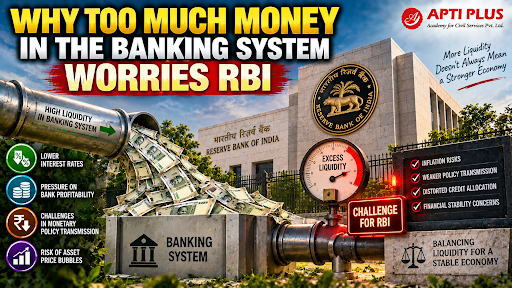
Why In News?
The Reserve Bank of India deployed long-tenor liquidity absorption tools after massive dollar inflows from special deposit schemes flooded the banking system with excess rupees.
What is Liquidity?
Liquidity refers to the ready cash and central bank (RBI) reserves held by commercial banks. It serves as the essential funding needed for everyday lending and interbank clearing, acting as a direct catalyst for the credit supply and the fuel for money markets.
Liquidity |
Excess Liquidity |
|
|
Definition |
The baseline pool of cash and RBI reserves required for daily operations. |
The surplus cash available after meeting all legal and regulatory mandates. |
|
Regulatory Status |
Includes funds used to meet statutory requirements like CRR (Cash Reserve Ratio) and SLR (Statutory Liquidity Ratio). |
Exceeds statutory mandates; these funds are completely free to be deployed. |
|
Primary Cause |
Standard banking operations, deposit inflows, and regular central bank funding. |
Occurs when deposit growth outpaces credit demand, leading to cash accumulation. |
|
Market Impact |
Stabilizes the financial system and keeps money markets functioning smoothly. |
Drives down money market yields and results in persistent cash parking at the RBI. |
Why Has Liquidity Increased?
-
Unprecedented Foreign Currency Inflows: Special foreign-currency non-resident deposit facilities (FCNR) attracted a staggering $127.23 billion into domestic commercial bank books.
-
RBI Forex Market Sterilization Interventions: The RBI bought incoming US dollars to curb rapid Rupee appreciation, injecting equivalent Rupee liquidity into commercial bank reserves.
-
Record Surge in Forex Reserves: India's foreign exchange reserves reached an all-time record peak of $729.3 billion, creating a domestic liquidity deluge.
-
Post-Harvest Government Expenditure Releases: Substantial central and state government development spending emptied treasury balances at the RBI into commercial bank accounts.
Why is Excess Liquidity a Challenge for the RBI?
Excess liquidity is a challenge for the Reserve Bank of India because it weakens monetary control, drives down short-term interest rates, and creates inflationary risks.
-
Threatens Macroeconomic Price Stability: Surging bank cash reserves risk fueling secondary demand-side price pressures across food, transport, and consumer services.
-
Sparks Asset Price Bubbles: Excess cheap bank funds migrate into speculative equity markets, corporate debt, and luxury urban real estate assets.
-
Erodes Monetary Policy Transmission: Commercial banks reduce lending rates prematurely without any formal reduction in the policy repo rate by the Monetary Policy Committee.
-
Encourages Reckless Underwriting Standards: Flush with unlent funds, financial institutions risk expanding unsecured personal loans without adequate collateral scrutiny.
How Does the RBI Manage Liquidity?
-
Variable Rate Reverse Repo (VRRR): Conducts variable-rate auctions to lock up commercial bank surplus cash for periods ranging from 3 days to 30 days.
-
Standing Deposit Facility (SDF): Provides an uncollateralized overnight absorption facility priced 25 basis points below the benchmark repo rate.
-
Open Market Operations (OMO) Sales: Sells government securities directly in the secondary market to suck out durable liquidity permanently from bank balances.
-
Cash Reserve Ratio (CRR) Adjustments: Mandates commercial lenders to impound a higher statutory percentage of their net demand and time liabilities with the central bank.
-
Market Stabilization Scheme (MSS) Bonds: Issues special dated government debt bonds specifically to sterilize persistent, structural foreign exchange inflows.
What is VRRR?
|
How Does Excess Liquidity Affect Inflation?
-
Accelerates Broad Money Velocity: Surplus liquidity swells M3 money stock, causing excessive chasing of limited consumer goods and industrial raw materials.
-
Elevates Retail Inflation Expectations: Unanchored cash surpluses cause households and businesses to anticipate higher future prices, leading to preventive hoarding.
-
Transmission to Core Non-Food Services: Drives up non-volatile core inflation across healthcare, private schooling, and domestic manufacturing wages.
-
Weakens Central Bank Inflation Credibility: Undermines the Monetary Policy Committee's commitment to anchoring headline Consumer Price Index (CPI) at 4%.

Way Forward
Deploy Longer-Tenor 30-Day & 56-Day VRRR Auctions: Lock up durable surplus cash reserves over extended tenors to prevent liquidity from destabilizing call money markets.
Reactivate the Market Stabilization Scheme (MSS): Coordinate with the Ministry of Finance to issue dedicated MSS bonds to sterilize massive foreign deposit inflows.
Strategic Secondary Market OMO Bond Sales: Sell sovereign government bonds in calibrated open-market auctions to absorb durable surplus liquidity permanently.
Align Forex Swaps with Domestic Money Conditions: Execute offsetting foreign exchange sell-buy swaps to neutralize the domestic rupee impact of central bank dollar acquisitions.
Implement Targeted Incremental CRR (I-CRR): Temporarily impound 10% of incremental bank deposits during extreme foreign inflow surges to protect financial stability.
Conclusion
Proactive sterilization through longer-tenor VRRR and Market Stabilization Scheme bonds enables the RBI to harness foreign capital while insulating domestic price stability and the monetary policy stance.
Source: INDIANEXPRESS.
|
PRACTICE QUESTION Q. Critically examine how large-scale foreign capital inflows complicate domestic liquidity management and monetary policy transmission for the Reserve Bank of India. (10 Marks, 150 Words) |