Why In News?
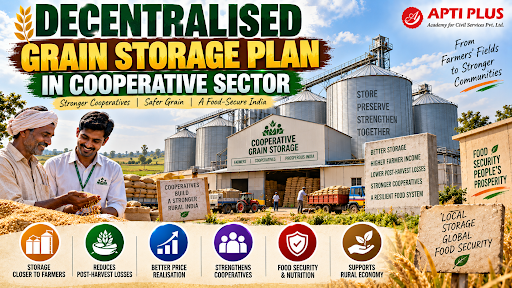
The Decentralised Grain Storage Plan expands local storage and strengthens nationwide agricultural infrastructure through cooperatives.
What is the Decentralised Grain Storage Plan?
Origin: Approved by the Union Cabinet on 31 May 2023 under the Ministry of Cooperation to address the severe national deficit in scientific foodgrain storage capacity.
Institutional Anchor: Utilizes Primary Agricultural Credit Societies (PACS) as village-level multi-service delivery hubs, expanding their core mandate from short-term crop credit to post-harvest storage, processing, and farm-gate marketing.
National Implementing Agency: The National Cooperative Development Corporation (NCDC) spearheads project execution, guided by an Inter-Ministerial Committee (IMC) and coordinated via State and District Cooperative Development Committees (SCDCs and DCDCs).
How Does the Scheme Work?
The initiative creates integrated rural storage hubs by converging existing schemes of the Government of India:
-
Agriculture Infrastructure Fund (AIF): Provides post-harvest debt financing with a 3% interest subvention and credit guarantee coverage for loans up to ₹2 crore.
-
Agricultural Marketing Infrastructure (AMI): Provides enhanced back-ended capital subsidies—raised from 25% to 33.33% for PACS—while the mandatory margin money contribution is slashed from 20% to just 10%. (Source: PIB)
-
Sub-Mission on Agricultural Mechanization (SMAM): Financial assistance to set up Custom Hiring Centres (CHCs) alongside godowns, providing smallholders access to modern harvesters, tractors, and seed drills.
-
PM Formalisation of Micro Food Processing Enterprises (PMFME): Capital and technical subsidies to establish village-level mini-mills for dal, oil, and grain grading.
-
NABARD Concessional Refinance: Delivers dedicated refinancing facilities that lower the net effective loan interest rate for participating PACS to an unprecedented 1%.
-
Assured FCI Procurement Linkage: The Food Corporation of India (FCI) guarantees a 9-year lease/hiring agreement for accredited PACS godowns, ensuring stable rental income.
-
WDRA Certification & Electronic Receipts: Warehouses are registered under the Warehousing Development and Regulatory Authority (WDRA), allowing them to issue electronic Negotiable Warehouse Receipts (e-NWRs) that commercial banks recognize for post-harvest pledge financing.
What are the Strategic Objectives and Benefits of the Plan?
Mitigating Post-Harvest Wastage: Scientific silos and warehouses drastically cut storage losses caused by dampness, rodents, and open-plinth exposure.
Eliminating Distress Sales: Allows farmers to store produce post-harvest and sell during favorable price cycles rather than offloading grains during peak harvest market gluts.
Slashing Food Supply-Chain Freight Costs: Storing grains at the farm gate eliminates circular transit loops—moving grains from villages to district godowns and back to village Fair Price Shops (FPS).
Strengthening the National Food Security Act (NFSA): Creates a resilient, community-anchored buffer stock to sustain the Public Distribution System (PDS) during local climate disruptions.
Economic Diversification of PACS: Transforms credit-dependent PACS into financially viable agribusiness centres earning recurring revenues from storage fees, machinery rentals, and primary processing.
What are the Major Operational and Governance Challenges?
Financial Viability of Marginal PACS: PACS in low-surplus or monocropping regions struggle with godown occupancy during non-procurement seasons, risking loan defaults.
Professional Management and Digital Skill Deficit: Most PACS secretaries lack training in scientific grain preservation (fumigation, moisture testing), double-entry accounting, and e-NWR compliance.
Rural Infrastructure Deficits: Widespread shortages of continuous three-phase electrical power for grain dryers and lack of all-weather approach roads for large multi-axle grain trucks.
Bank Reluctance in e-NWR Pledge Financing: Rural bank branches remain hesitant to extend credit against electronic warehouse receipts due to fears of produce deterioration or lack of physical audit mechanisms.
Regional Cooperative Disparities: Marked institutional imbalances between cooperative-strong states (Maharashtra, Gujarat, Madhya Pradesh) and lagging eastern states (Bihar, West Bengal, Jharkhand) where PACS infrastructure is moribund.
Market Linkage Disconnect: Warehousing without immediate integration into digital trading networks (e-NAM) leaves stored commodities vulnerable to local trader cartels once government procurement concludes.
Way Forward
Cluster-Based Commodity Planning: Map warehouse capacity to local agro-climatic cropping patterns (e.g., specialized storage for millets, pulses, and oilseeds rather than uniform wheat/paddy designs).
Mandatory WDRA Accreditation: Implement a time-bound, subsidized campaign to accredit every PACS godown under WDRA standards to unlock institutional pledge credit.
Scale e-NWR Pledge Financing: Mandate priority sector lending (PSL) sub-targets for rural bank branches to advance post-harvest liquidity against digital warehouse receipts.
Solarization & Micro-Processing Addition: Integrate rooftop solar panels and small-scale cleaning, sorting, and grading machines with each godown to prevent grain spoilage.
Full Integration with e-NAM and ONDC: Link PACS godowns directly as registered delivery points on e-NAM and the Open Network for Digital Commerce (ONDC) to enable pan-India bidding.
Professional Cadre Training & ERP Digitization: Roll out specialized cooperative management diplomas and deploy standardized ERP software across all functional PACS.
Long-Term Procurement Guarantees: Mandate that State Civil Supplies Departments and the Food Corporation of India lease PACS godowns on minimum 9-year rolling contracts.
Transform PACS into Rural Multi-Service Hubs: Integrate fertilizer distribution, drone-spraying services, soil-testing labs, and banking correspondent (BC) outlets within the warehouse premises.
Conclusion
The Decentralised Grain Storage Plan marks a shift from centralized foodgrain management to community-led agrarian infrastructure, ensuring price stabilization, waste reduction, and rural economic empowerment.
Source: PIB
|
PRACTICE QUESTION Q. Discuss the operational and governance challenges faced by agricultural cooperatives in implementing technology-driven post-harvest warehousing infrastructure. (10 Marks, 150 Words) |