Why In News?
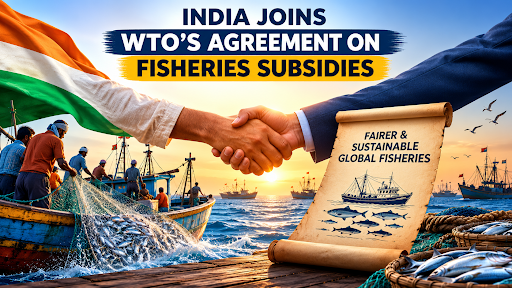
India deposits its Instrument of Acceptance to the World Trade Organization (WTO), officially becoming the 123rd Member to join WTO Agreement on Fisheries Subsidies.
What is the WTO Agreement on Fisheries Subsidies?
Global Trade Law: The 12th WTO Ministerial Conference (MC12) adopts this treaty in 2022 as a binding multilateral framework to regulate marine subsidies.
Subsidy Prohibition: The agreement bans governments from providing harmful financial subsidies, including free resources or capital, to vessels engaged in destructive wild-capture fishing.
Environmental Sustainability: The treaty targets the depletion of global fish stocks to restore marine ecosystems and ensure long-term ocean health.
SDG Alignment: The framework directly fulfills Sustainable Development Goal (SDG) 14.6, which mandates the elimination of harmful fisheries subsidies.
Scope Exclusions: The rules exclude aquaculture (fish farming) and inland fisheries from any subsidy prohibitions.
Historic Milestone: This pact represents the first multilateral WTO agreement centered primarily on environmental sustainability.
Key Provisions of the Agreement
IUU Fishing Ban: The agreement prohibits subsidies to any vessel or operator engaged in Illegal, Unreported, and Unregulated (IUU) fishing.
Enforcement Authority: Coastal nations and Regional Fisheries Management Organizations (RFMOs) hold the responsibility to identify and report illegal vessels.
Overfished Stocks Protection: Governments must halt funding for the harvest of species recognized as overfished based on scientific data.
Rebuilding Exception: The treaty permits subsidies only if the financial support directly aids the rebuilding of fish stocks to healthy levels.
High Seas Regulation: The rules ban subsidies for vessels operating in unregulated deep-sea areas (the High Seas) outside the jurisdiction of any management body.
Special and Differential Treatment (S&DT): The pact grants Developing and Least Developed Countries (LDCs) a two-year exemption to utilize subsidies within their Exclusive Economic Zone (EEZ) up to 200 nautical miles from their coastlines.
Transparency Mandates: Member nations must submit annual reports to the WTO detailing their subsidy programs and specific catch data.
Capacity Building Fund: A voluntary trust fund provides technical assistance and resources to poorer nations to enhance ocean management capabilities.
Significance of India's Accession
Sustainable Marine Fisheries: India commits to halting ocean over-exploitation, ensuring long-term fish stock survival for future generations.
Livelihood Protection: The pact restricts large foreign industrial vessels from depleting local waters, securing food and economic security for over 9 million Indian fisher families.
Global Trade Leadership: The accession elevates India's standing as a responsible seafood exporter, unlocking access to premium, eco-conscious global markets.
Blue Economy Alignment: The treaty strengthens India's Blue Economy initiatives across its extensive 7,500-kilometer coastline.
Export Revenue Safeguards: The agreement completely exempts aquaculture-based shrimp—India's primary seafood export—thereby protecting vital national trade revenues.
India's Key Concerns in Fisheries Subsidy Negotiations
Small-Scale Fisher Livelihoods: Indian fishers receive minimal subsidies averaging just $15 per family annually (primarily for fuel), which remains critical for basic survival.
Policy Space Demands: India advocates for a 25-year transition period for developing nations to expand their domestic fishing sectors before facing strict Phase 2 disciplines.
Historical Imbalances: Wealthy nations provide up to $75,000 per fisherman to massive industrial fleets, driving global overfishing; India demands that developed countries eliminate these subsidies first.
Equitable Negotiations: India insists that future WTO rules strictly follow the principle of Common But Differentiated Responsibilities and Respective Capabilities (CBDR-RC).
Distant-Water Fishing Restrictions: India demands a comprehensive ban on industrial fleets from developed nations operating in the waters of developing countries.
Challenges in Implementation
Monitoring Deficits: India and other developing nations face immense logistical hurdles in physically monitoring vast maritime zones to detect IUU fishing.
Compliance Enforcement: Enforcing compliance on wealthy nations to dismantle deep-seated subsidy structures for large corporations remains highly challenging.
Socio-Economic Trade-offs: Fuel subsidies (diesel and kerosene) constitute up to 75% of operating costs for fishers in several Indian states; rapid cuts threaten vulnerable coastal livelihoods.
Incomplete Disciplines: The current Phase 1 agreement lacks rules on Overcapacity and Overfishing (OCOF), which remain under negotiation in Phase 2.
Data and Surveillance Gaps: Accurate fish stock assessments require advanced, high-cost scientific technologies and surveillance infrastructure.
The Termination Clause: The treaty contains a sunset clause stating that if members fail to reach a consensus on Phase 2 rules within four years, the entire agreement terminates.
Measures to Strengthen Sustainable Fisheries
Advanced Surveillance: Governments deploy modern technologies, including GPS trackers and satellite monitoring, to eliminate IUU fishing.
Sustainable Fisher Support: States transition away from fossil fuel subsidies by introducing cleaner alternatives, such as LPG conversion kits and electric boat engines pioneered in Kerala.
Scientific Stock Assessments: Authorities commission regular scientific assessments to monitor fish populations and prevent overexploitation.
International Cooperation: Nations share critical vessel and catch data with the WTO and FAO to track and penalize non-compliant ships.
Blue Economy Expansion: India prioritizes aquaculture development to meet food security and export demands without depleting wild marine stocks.
Technical Assistance Delivery: Developed nations must fulfill their commitments to fund and transfer modern fisheries infrastructure to developing countries.
Conclusion
By joining the WTO Agreement on Fisheries Subsidies, India champions global marine conservation while strategically safeguarding its millions of small-scale fishers and securing its lucrative aquaculture export sector.
Source: THEHINDU
|
PRACTICE QUESTION Q. Consider the following statements regarding the WTO Agreement on Fisheries Subsidies: 1. It strictly prohibits all forms of government subsidies provided to aquaculture and inland fisheries. 2. It grants developing countries a two-year exemption to maintain subsidies within their Exclusive Economic Zones (EEZ). Which of the statements given above is/are correct? A) 1 only B) 2 only C) Both 1 and 2 D) Neither 1 nor 2 Answer: B Explanation: Statement 1 is incorrect: The WTO Agreement on Fisheries Subsidies applies strictly to marine wild capture fishing and related activities at sea. Subsidies provided to aquaculture and inland fisheries are completely excluded from the scope of the agreement. Statement 2 is correct: The agreement contains special and differential treatment (S&DT) provisions for developing and least-developed country (LDC) members. Specifically, it grants these countries a two-year exemption from subsidy prohibitions for fishing activities up to and within their Exclusive Economic Zones (EEZ). |