Why In News?
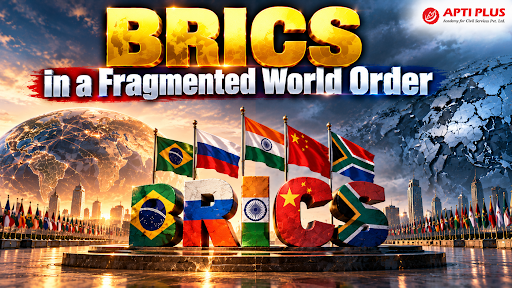
The 18th BRICS Summit (New Delhi, September 2026) under India’s Presidency adopted the New Delhi Declaration, emphasizing the expanded 11-member BRICS+ bloc's drive for global governance reform, local-currency trade, and multipolar stability.
What Is BRICS?
Origin: British economist Jim O'Neill initially coined the acronym BRIC in 2001 to highlight the emerging economic growth trajectories of Brazil, Russia, India, and China.
First BRIC Summit: The inaugural BRIC Summit took place in Yekaterinburg, Russia, in 2009, formalizing diplomatic and economic coordination among emerging economies.
South Africa formally joined the bloc in 2010 (attending its first summit in 2011), transforming the acronym into BRICS and expanding its geographical footprint into Africa.
Expansion of Membership:
-
Egypt, Ethiopia, Iran, Saudi Arabia and the United Arab Emirates (UAE) formally joined as full members in 2024.
-
Indonesia joined as the 11th full member in 2025.
-
Partner Country Category: Ten nations—including Belarus, Bolivia, Kazakhstan, Cuba, Nigeria, Malaysia, Thailand, Vietnam, Uganda, and Uzbekistan—were designated as official BRICS+ partner countries to deepen engagement without fragmenting decision-making.
BRICS as a Platform for Emerging Economies: The expanded BRICS+ represents over 45% of the world's population, roughly 41% of global GDP in Purchasing Power Parity (PPP) terms, 52% of global manufacturing output, and 43.6% of global crude oil production, serving as a primary counterweight and reformist platform for the Global Majority.

What Are The Major Objectives Of BRICS?
-
Reform of the United Nations Security Council: Securing permanent and non-permanent representation for developing states from Africa, Asia, and Latin America under UN Charter Article 2.
-
Reform of International Financial Institutions: Rebalancing voting power within the IMF and World Bank to match the actual economic output of emerging markets.
-
Strengthening Multilateralism: Upholding a rules-based, non-hegemonic international order centered on the UN and international law.
-
Increasing Trade and Investment: Implementing the BRICS Economic Partnership Strategy 2030 and the Global Value Chain Action Plan 2026–2030 to lower non-tariff barriers.
-
Promoting Sustainable Development: Aligning economic growth with the UN 2030 Agenda, poverty alleviation, and inclusive development goals.
-
Enhancing Financial Cooperation: Expanding local-currency invoice settlements, currency swap arrangements, and cross-border payment interoperability.
-
Strengthening Energy and Food Security: Leveraging member resources in crude oil, natural gas, critical minerals, and agriculture via initiatives like the BRICS Agricultural Research Platform and proposed grain exchanges.
-
Improving Technology Cooperation: Jointly advancing Artificial Intelligence (AI) governance, digital infrastructure, computing resources, and the BRICS Remote Sensing Satellite Constellation.
-
Addressing Climate Change: Supporting just energy transitions based on Equity and Common But Differentiated Responsibilities and Respective Capabilities (CBDR-RC) under the Paris Agreement.
What Are The Key Institutional Mechanisms Of BRICS?
-
New Development Bank (NDB): Established in 2014 with an initial subscribed capital of $50 billion ($100 billion authorized capital) divided equally among founding members; has approved over 120 projects worth $39 billion, targeting 30% of total lending in member local currencies.
-
Contingent Reserve Arrangement (CRA): A $100 billion financial safety net established in 2014 to provide short-term liquidity support and shield member states against balance-of-payments shocks.
-
BRICS Business Council: Coordinates private-sector engagement, trade facilitation, infrastructure investment, and MSME integration across member markets.
-
BRICS Interbank Cooperation Mechanism (ICM): Facilitates credit lines, local-currency bond issuance, and financial coordination among member state development banks.
-
BRICS Pay and Local Currency Cooperation Discussions: Technical dialogues exploring decentralized payment messaging frameworks, cross-border Central Bank Digital Currency (CBDC) interoperability (BRICS Bridge), and linkages between national platforms (e.g., India's UPI, UAE's LIP, China's CIPS, Russia's SPFS).
-
BRICS Parliamentary Forum: Enhances inter-parliamentary dialogue, legislative synchronization, and institutional transparency.
-
BRICS Academic and Research Cooperation: Drives joint scientific innovation, university networks (BRICS Network University), and policy research hubs such as the BRICS Vaccine R&D Centre.
What Is A Fragmented World Order?
Decline of Unipolarity: The post-Cold War era of American unipolar dominance is giving way to a more decentralized international system.
Rise of Multipolarity: Emerging middle and regional powers across Asia, Africa, and Latin America are demanding greater strategic autonomy and a "multiplex world order" characterized by overlapping, non-exclusive networks of cooperation.
Intensifying US-China Rivalry: Escalating geopolitical and economic competition between Washington and Beijing has disrupted global value chains and generated tariff pressures on developing economies.
Russia-West Tensions: The conflict in Ukraine and subsequent Western sanctions have accelerated economic decoupling and pushed affected nations toward alternative trade and clearing mechanisms.
Regional Conflicts and Wars: Persistent destabilization across Eastern Europe, West Asia (Gaza/Lebanon), and the Horn of Africa underscores the limitations of unilateral security frameworks.
Trade Protectionism and Economic Sanctions: Unilateral tariffs, export controls, weaponized supply chains, and financial exclusions (e.g., SWIFT decoupling) have heightened economic vulnerabilities across developing states.
Weakening of Multilateral Institutions: Inefficiencies and structural deadlocks within the United Nations (UN), World Trade Organization (WTO), and Bretton Woods institutions (IMF and World Bank) have diminished their ability to address contemporary crises.
Competing National Interests: Ideological and geopolitical divergences among major states hinder universal consensus, favoring "variable geometry" and flexible, issue-based plurilateral coalitions over rigid alliances.
Why Is BRICS Important In The Changing World Order?
Voice of the Global South: BRICS+ amplifies the priorities of emerging economies, challenging Western-centric narratives without operating as an explicitly anti-Western military alliance.
Reform of Global Governance: The bloc pushes for structural democratisation across multilateral security and economic bodies to reflect 21st-century realities.
Greater Representation in International Institutions: BRICS campaigns for realigning IMF quota allocations, expanding UN Security Council (UNSC) seats, and restoring the two-tier dispute settlement mechanism of the WTO.
Economic Cooperation among Emerging Economies: Intra-BRICS trade has grown rapidly—surpassing trade between BRICS and G7 nations—driven by supply chain diversification and local currency settlement frameworks.
Alternative Development Financing: Through the New Development Bank (NDB) and the Contingent Reserve Arrangement (CRA), BRICS provides non-conditional infrastructure capital and balance-of-payments buffers without Western policy mandates.
Strategic Autonomy: Membership allows sovereign states to diversify economic and diplomatic partnerships, hedging against great-power coercion while avoiding rigid bloc commitments.
Multipolar International System: By decentralizing financial and geopolitical weight, BRICS acts as an anchor for a polycentric international architecture.
South-South Cooperation: It facilitates technology transfer, capacity building, and knowledge sharing in agriculture, healthcare, and digital governance across developing nations.
What Are The Major Challenges Facing BRICS?
China-India Strategic Rivalry: Persistent geopolitical mistrust and border friction along the Line of Actual Control (LAC) constrain intra-bloc cohesion and limit deep institutional integration.
Russia-West Confrontation: Aggressive anti-Western stances from heavily sanctioned members risk polarizing the grouping, creating friction with members seeking multi-alignment.

Differences in Economic Systems: Diversity ranging from state-led capital economies to market democracies complicates regulatory harmonization and monetary coordination.
Unequal Economic and Military Power: China's economic output constitutes over 50% of the total aggregate BRICS GDP, creating economic asymmetry and structural trade deficits for smaller members.
Divergent Foreign Policy Priorities: Newer entrants introduce acute regional rivalries (e.g., Egypt-Ethiopia dam dispute over Grand Ethiopian Renaissance Dam (GERD), Iran-UAE regional security tensions).
Consensus-based Decision-making: The mandate for unanimous consent ensures equal voice but frequently dilutes summit outcomes to lowest-common-denominator declarations.
Limited Enforcement Mechanisms: As an informal grouping without a charter or permanent secretariat, turning joint declarations into legally binding policy remains difficult.
Differences over the Role of the US Dollar: While sanctioned members advocate radical de-dollarization, nations like India, Brazil, and UAE reject an anti-dollar stance, preferring pragmatic local-currency trade alongside standard reserve assets.
Absence of a Common Security Policy: BRICS explicitly operates as an economic and developmental platform rather than a mutual defense architecture.
Difficulty in Converting Declarations into Action: A persistent gap remains between ambitious summit communiqués and actual structural reforms across global financial institutions.
What Should Be India’s Approach To BRICS?
Protecting Strategic Autonomy: Upholding India’s independent decision-making via Multi-Alignment / Non-Alignment 2.0, avoiding alignment with any single ideological or power bloc.
Promoting Issue-based Cooperation: Engaging pragmatically on trade facilitation, digital public infrastructure, and climate finance while rejecting rigid geopolitical alignments.
Maintaining Balanced Relations with Major Powers: Preserving India’s conceptual framing of BRICS as "Non-West, not Anti-West", balancing participation in BRICS+ and SCO with deep strategic ties in Quad, G20, and Western partnerships.
Strengthening India-China Dialogue: Utilizing BRICS summits to maintain high-level diplomatic contact, as demonstrated by the October 2024 Kazan LAC patrolling breakthrough between PM Modi and President Xi.
Advancing Global South Priorities: Positioning India as the constructive "bridge power" advocating for health security, digital inclusion, and climate finance for developing states.
Supporting Institutional Reforms: Driving consensus for democratic governance in the UNSC, IMF, World Bank, and WTO without subverting the international rules-based framework.
Expanding Development Partnerships: Exporting modular Digital Public Infrastructure (DPI)—such as UPI, Aadhaar, and DigiLocker—to member nations to support financial inclusion and MSME growth.
Promoting Transparent Financial Cooperation: Supporting voluntary local-currency settlement mechanisms (e.g., UPI-LIP link with UAE) while blocking attempts to create a confrontational supranational BRICS currency.
What Is The Way Forward For BRICS?
Focus on Practical and Measurable Outcomes: Shift from symbolic declarations toward concrete project implementation under clear timelines.
Strengthen the New Development Bank: Expand the NDB’s capital base, increase local-currency lending toward its 30% target, and enhance project execution in developing economies.
Improve Institutional Coordination: Harmonize regulatory standards, payment switches, and trade customs mechanisms via the BRICS Interbank Cooperation Mechanism.
Respect National Sovereignty: Maintain the foundational commitment to non-interference, sovereign equality, and mutual respect among diverse political systems.
Build Consensus on Shared Interests: Deprioritize divisive geopolitical rhetoric in favor of universal developmental priorities like food, energy, and health security.
Reform Global Governance Institutions: Coordinate joint proposals within the G20 and UN to accelerate IMF quota reviews and UNSC expansion.
Strengthen Intra-BRICS Trade: Reduce non-tariff barriers, integrate MSMEs into global value chains, and expand local-currency trade settlements.
Promote Sustainable Development: Advance green technology transfer, renewable energy projects, and disaster-resilient infrastructure across the Global South.
Improve Crisis Management Cooperation: Establish informal consultation channels to prevent bilateral disputes among member states from obstructing collective goals.
Bridge Differences through Dialogue: Leverage summit diplomacy to foster confidence-building measures between competing regional powers.
Conclusion
The BRICS+ expansion shifts global order toward multipolarity, where India's diplomacy keeps the bloc a reformist platform for the Global South rather than an anti-Western alliance. Operationalizing summit declarations into financial and digital mechanisms remains key to its long-term governance impact.
Source: THEHINDU
|
PRACTICE QUESTION Q. BRICS has the potential to make global governance more representative, but its internal differences limit its effectiveness. Critically Analyze. 250 words |