Why In News?
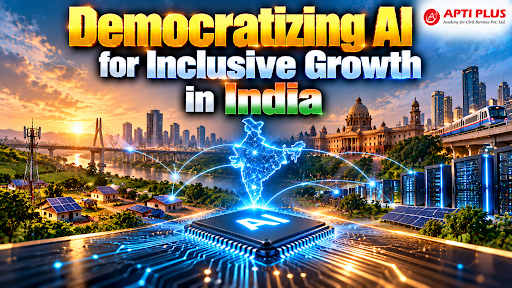
The global Artificial Intelligence discourse is shifting from hardware infrastructure to practical deployments for inclusive growth, with India leveraging its Digital Public Infrastructure (DPI) model under the IndiaAI Mission to democratise technology access across rural and urban economies.
What Is The Meaning Of Democratizing Technology?
Democratization of technology means making advanced digital tools, information, and infrastructure affordable, easy to use, and accessible to the general public rather than restricting them to a small group of experts or elites.
-
Affordability: Reducing the cost of hardware, software, internet data, and cloud computing so low-income populations can participate.
-
Accessibility: Designing user-friendly interfaces, multi-lingual support, and assistive tools for people with diverse abilities or rural backgrounds.
-
Ease of Use: Lowering technical barriers (such as drag-and-drop website builders or AI prompt tools) so non-technical citizens can build solutions.
Significance & Advantages (Why it matters for India)
-
Inclusive Growth & Empowerment: Brings marginalized groups, small businesses, and rural citizens into the formal financial and digital economy.
-
Transparent Governance: Cuts red tape, reduces corruption, and improves last-mile delivery of public services (e.g., Direct Benefit Transfer).
-
Fostering Innovation: Empowers a massive startup ecosystem by giving them open-source software, low-cost cloud space, and shared AI models.
-
Key Indian Initiatives:
-
India Stack (Aadhaar, UPI, DigiLocker) for identity, payments, and paperless/cashless inclusion.
-
Common Service Centres (CSCs) to bring digital government and internet services to rural villages.
-
JAM Trinity (Jan Dhan-Aadhaar-Mobile) for targeted welfare distribution.
-
GeM (Government e-Marketplace) to democratize public procurement for micro and small enterprises.
-
IndiaAI Mission and platforms like Bhashini or AIKosh to democratize artificial intelligence, datasets, and multilingual translation tools.
-
Low data tariffs and open-access digital public infrastructure (DPI) models.

How Is Digital Public Infrastructure Democratising AI Access Across India?
Sovereign Open-Source Tech Rails: Grounded in Constitutional Directives under Article 39(b) for equitable distribution of material resources, India translates its Digital Public Infrastructure (DPI) playbook—comprising Aadhaar, UPI, and ONDC—into open-source AI foundations such as BHASHINI for regional language access.
Public Infrastructure & Institutional Support: Under the IndiaAI Mission, approved with a financial outlay of ₹10,371.92 crore over 5 years, public agencies deploy cloud compute platforms like AIRAWAT and GI Cloud (MeghRaj) while private startups build consumer innovations.
Compute Accessibility & Data Common Rails: National compute grid offers 38,000+ GPUs at subsidized rates of ₹65/hour, backed by 5G coverage across 99.9% of districts. (Source: PIB)
-
The IndiaAI Datasets Platform (AIKosh) hosts 7,500+ datasets and 273 models across 20 industries to democratize training data without Western data bias. (Source: PIB)
What Is The Economic Potential Of Artificial Intelligence In India?
Macroeconomic Value Addition: AI has the potential to add an estimated USD 1.7 trillion to the Indian economy by 2035 by raising productive capabilities across businesses, households, and governance frameworks. (Source: NITI Aayog)
MSME Productivity Enhancement: Under India's unique "AI-cost geography", Micro, Small, and Medium Enterprises (MSMEs) deploy cheap, narrow, and task-specific AI tools for automated bookkeeping, inventory management, and quality control, bridging the historic capital gap with large enterprise conglomerates.
Labor Market Transformation: While disrupting routine tasks, AI is creating novel professional categories including AI conversation designers, ethical AI specialists, AI trainers, and remote robot operators.
-
The National Strategy for Artificial Intelligence and recent workforce assessments project that India could generate up to 4 million deep-tech AI jobs by 2031. (Source: NITI Aayog)
Augmentation of Informal & Frontline Workers: With 490 million informal workers constituting nearly 90% of India's workforce, AI functions as a task-level co-pilot rather than complete job automation, as only 4.5% of developing country jobs face total automation. (Source: IMF)
-
Frontline ASHA workers utilize diagnostic co-pilots like Wadhwani AI's tuberculosis-screening tools.
What Sectoral Initiatives Are Transforming Rural Governance And Livelihoods?
Decentralized Local Governance: Under the e-Panchayat Mission, Panchayati Raj Institutions leverage tools like SabhaSaar—an AI-enabled tool generating structured meeting minutes in 14 Indian languages via BHASHINI—and eGramSwaraj, which has onboarded 2.53 lakh gram panchayats, 6,409 block panchayats, and 650 Zila panchayats. (Source: PIB)
Geospatial & Agricultural Decision Support: The Ministry of Rural Development and IIT Delhi deployed BhuPRAHARI for geospatial asset tracking under MGNREGA and VB-G RAM G, while platforms like Kisan e-Mitra, Bharat VISTAAR, National Pest Surveillance System, and Crop Health Monitoring deliver localized advisories to farmers.
Sovereign Models & Tribal Language Preservation: BharatGen, India's first government-funded sovereign multimodal model supporting 22 Indian languages, operates alongside Adi Vaani to digitize endangered tribal languages and ensure last-mile service delivery.
What Are The Challenges In India's AI Transition?
Labor Pipeline Paralysis & Entry-Level Career Freeze: While experienced senior talent commands high wage premiums, entry-level graduates face shrinking opportunities in basic coding and data processing.
-
Example: Cognizant-Pearson 2026 Survey, revealing that 37% of entry-level tasks in India are already performed by AI (compared to 33% globally), while NITI Aayog estimates over 60% of India's formal-sector jobs face task-level exposure by 2030.
Severe Environmental & Resource Footprint: AI data centers require immense thermal cooling and power grid capacities, creating direct trade-offs with municipal drinking water supplies and agricultural irrigation in ecologically fragile regions.
-
Example: India's data center sector currently consumes 150 billion litres of water annually—projected to reach 358 billion litres by 2030—with over 70% of capacity concentrated in severely water-stressed urban hubs including Chennai, Bengaluru, Mumbai, and Hyderabad.
Technological Monopolies & Over-Automation Quality Rollback: Reliance on foreign hyperscalers for advanced microchips, large foundational compute, and risk capital creates geopolitical vulnerabilities. Aggressive cost-driven automation without human validation leads to severe customer trust breakdowns and operational failures.
-
Example: Klarna Fintech, the Swedish fintech, where an aggressive replacement of 700 full-time agents with an AI assistant handling 2.3 million conversations resulted in severe quality degradation, forcing a complete operational rollback and re-hiring of human agents for complex disputes and trust-building tasks.
What Strategic Policy Interventions Are Needed To Democratise AI Responsibly?
Subsidising Sovereign Compute Infrastructure
-
Operationalising National Compute Grids: Rapidly scale the IndiaAI Mission to provide subsidized computing access and supercomputing infrastructure like AIRAWAT to domestic deep-tech startups and academic institutions.
-
Building Open-Source Public Rails: Adapt the Digital Public Infrastructure (DPI) playbook to provide open protocols and sovereign open-source foundational models (such as BHASHINI for regional languages and BharatGen), preventing technological lock-in by global tech monopolies.
Mandating Ecological Sustainability & Resource Efficiency
-
Carrying-Capacity Evaluations: Condition data centre approvals on regional environmental carrying-capacity assessments.
-
Water & Energy Protection: Mandate Zero Liquid Discharge (ZLD) systems and the use of reclaimed wastewater in data centre operations to prevent resource conflicts over municipal drinking water and agricultural irrigation in water-stressed urban hubs.
Democratising Data via National Data Commons
-
Expanding AIKosh: Scale the IndiaAI Datasets Platform (AIKosh) to host non-personal public datasets across critical sectors like agriculture, health, and e-governance.
-
Reducing Bias: Unlock structured public sector datasets under a consent-based Digital Public Infrastructure framework so domestic developers can train AI models tailored to local needs without Western data bias.
Protecting Workforce & Skilling for Entry-Level Readiness
-
Empowering Informal Workers: Launch targeted national initiatives like Mission Digital ShramSetu to support India’s 490 million informal workers with federated skill credentials, digital trust layers, and task-level AI co-pilots.
-
Decentralised Education & Reskilling: Expand programs like Skilling for AI Readiness (SOAR) and set up Data and AI Labs in Tier-2 and Tier-3 cities through Industrial Training Institutes (ITIs) and NIELIT to mitigate the entry-level career freeze.
-
Portable Social Safety Nets: Construct portable welfare umbrellas (covering health, pension, and unemployment benefits) that move with gig and informal workers during technological transitions.
Sectoral Scaling & Public Procurement Pathways
-
"Adopt, Adapt, Advance" Strategy: Focus on locally adapted, cost-effective narrow AI applications rather than capital-intensive frontier models.
-
Mandatory Public Procurement: Mandate the public health procurement of proven domestic AI tools (such as Cerebra AI for rural tuberculosis detection) and scale voice-first agricultural advisories (like Bharat VISTAAR) to bypass literacy barriers.
Ethical Governance & Catalysing Private R&D
-
Governance Safeguards: Operationalise MeitY's India AI Governance Guidelines and self-assessment ethical checklists, ensuring compliance with the Digital Personal Data Protection (DPDP) Act 2023 and the proposed Digital India Act.
-
Spurring Private R&D: Expand financial mechanisms such as the ₹1 lakh crore Deep-Tech Fund of Funds and the Anusandhan National Research Foundation (ANRF) to boost private sector R&D investments and retain high-skilled talent.
Conclusion
By transitioning from a passive consumer of foreign technologies to an active designer of equitable systems, India can utilize its Digital Public Infrastructure (DPI) framework to guarantee that Artificial Intelligence acts as an engine for widespread social mobility rather than an exclusive privilege.
Source: INDIANEXPRESS
|
PRACTICE QUESTION Q. Discuss how India's Digital Public Infrastructure (DPI) framework can be adapted to democratise Artificial Intelligence and mitigate entry-level workforce disruptions while ensuring ecological sustainability. 150 WORDS |