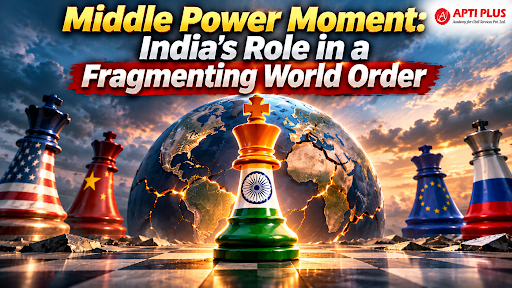
Why In News?
Experts argue that India should ground its foreign policy in its current economic reality as a "middle power in a bi-multipolar world," balancing ties between the U.S. and China while building coalitions with other mid-tier nations.
What A "Bi-Multipolar" World?
Polarity describes how power is distributed among the major states in the international system.
|
Type Of Order |
Meaning |
Historical Example |
|
Unipolar |
One dominant superpower |
US after the Cold War (1991–2008) |
|
Bipolar |
Two rival superpowers |
US–USSR during the Cold War (1947–1991) |
|
Multipolar |
Several great powers of roughly similar strength |
Europe before World War I |
|
Bi-Multipolar |
Two superpowers far ahead, plus several significant middle powers |
Present world order |
Features Of Today's Bi-Multipolar Order
-
Two Clear Leaders: The US and China together account for roughly two-fifths of world GDP and about half of global military spending. No third country comes close on both measures.
-
Intense Rivalry: The two compete in technology, trade, semiconductors, critical minerals and military power, especially in the Indo-Pacific.
-
Space For Others: Unlike the rigid Cold War, many middle powers, such as India, Japan, Germany, France, the UK, Brazil, Indonesia, Turkey, Saudi Arabia and South Korea, can work with both sides on different issues.
-
Fragmenting Institutions: The UN Security Council, WTO and other global institutions are weakened, and countries increasingly rely on smaller groupings.
-
Weaponised Interdependence: Trade, technology, energy and finance are increasingly used as tools of pressure.
Why Not "Multipolar" Yet?
-
Power Gap: Supporters of the "multipolar" view point to the rise of India, the EU and others. However, the gap between the top two and the rest remains very large in economic size, military reach, technology and global influence.
-
Transitional Phase: Many analysts see bi-multipolarity as a transitional stage. It could evolve into a fuller multipolar order as countries like India grow.
What Is A Middle Power?
-
A middle power is a state that is not a superpower but has enough economic, military or diplomatic weight to influence regional and some global outcomes.
-
Classic Examples: Countries such as Canada, Australia and South Korea are often cited, but emerging states like India, Brazil, Indonesia and Turkey are now central to the debate.
-
Core Capabilities: Strong economies, advancing technologies, and active diplomatic roles.
-
Behavior: They typically act as bridge-builders, mediators, and promoters of multilateralism, utilizing multi-alignment rather than rigid Cold War-style blocs.
Key Middle-Power Groupings & Formats
-
MIKTA
-
Members: Mexico, Indonesia, South Korea, Türkiye, and Australia.
-
Role: Launched in 2013 as an informal, cross-regional consultative and cooperative forum to strengthen multilateral governance and address global challenges.
-
Minilateral Coalitions & Flexible Partnerships
-
Nature: Rather than formal, binding defense pacts, contemporary middle powers favor issue-specific "coalitions of the willing" or flexible groupings (such as within the G20 or BRICS+).
-
Objective: De-risking supply chains, managing climate transitions, and creating economic resilience without tying themselves exclusively to Washington or Beijing.
-
Cross-Regional / North-South Proposals
-
Nature: Emerging frameworks (such as proposed alliances linking non-aligned G7/Western middle powers with Global South actors) attempt to bridge the governance divide left by a strained US-China-Russia competition.
Strategic Role in a Multipolar Order
-
Swing States and Agency: In a fragmenting global order, middle powers (including Indonesia, South Africa, Brazil, Türkiye, and South Korea) leverage their strategic autonomy to negotiate terms with traditional and rising superpowers.
-
Multilateral Reform: Many middle-power groupings push back against a Western-centric or paralyzed United Nations framework, advocating for more representative economic and security architectures.
How Strong Is India Today?
India's Strengths
|
Dimension |
India's Position |
|
Population |
World's most populous country (about 1.45 billion) |
|
Economy |
Among the world's four largest economies by nominal GDP |
|
Growth |
Fastest-growing major economy in recent years |
|
Military |
One of the world's largest armed forces; nuclear-armed |
|
Defence spending |
Among the world's top five spenders |
|
Diaspora |
World's largest diaspora (over 3 crore people) |
|
Digital public infrastructure |
UPI, Aadhaar and others, now adopted by several countries |
|
Space |
Chandrayaan-3 landed near the Moon's south pole (2023) |
Why India Is Still A Middle Power
-
Low Per Capita Income: India's per capita income is only about $2,700, placing it among lower-middle-income countries.
-
Economic Gap With China: China's economy is roughly five times larger than India's.
-
Military Gap: China's defence budget is roughly three to four times India's.
-
Defence Import Dependence: India was the world's largest arms importer in 2019–2023.
-
Weak Manufacturing Base: Manufacturing remains around 15–17% of GDP, far below China's share.
-
Technology Dependence: India depends heavily on imports for semiconductors, electronics, solar equipment and critical minerals.
-
Limited Global Institutional Status: India is not a permanent member of the UN Security Council, and its entry into the Nuclear Suppliers Group remains blocked.
How Has India's Foreign Policy Evolved?
From Non-Alignment To Multi-Alignment
|
Phase |
Approach |
Key Feature |
|
1947–1991 |
Non-alignment |
Stayed out of Cold War blocs; led the Non-Aligned Movement (1961) |
|
1991–2014 |
Economic opening and strategic balancing |
Look East Policy; India–US nuclear deal (2008) |
|
2014–present |
Multi-alignment |
Partners with rival powers on different issues |
Strategic Autonomy
-
Core Principle: India values strategic autonomy, the freedom to make its own choices without being bound to any bloc.
-
"India Way": External Affairs Minister S. Jaishankar's book "The India Way" (2020) argues that India should engage all major powers, take calculated risks and pursue its interests pragmatically.
Multi-Alignment In Practice
-
With The West: India is part of the Quad with the US, Japan and Australia, and has close defence and technology ties with the US, France and the UK.
-
With Russia: India maintains a long-standing partnership with Russia on defence and energy.
-
With The Global South: India is a founding member of BRICS and a member of the Shanghai Cooperation Organisation (SCO).
-
With West Asia: India is part of I2U2 (India, Israel, UAE, US) and the proposed India–Middle East–Europe Economic Corridor (IMEC).
How Is India Acting As A Middle Power?
Voice Of The Global South
-
G20 Presidency (2023): Under India's presidency, the African Union was admitted as a permanent member of the G20, giving Africa a stronger global voice.
-
Voice of Global South Summits: India has hosted summits to bring developing countries' concerns to global forums.
-
Vaccine Maitri: During COVID-19, India supplied vaccines to many developing countries.
Bridge-Building Diplomacy
-
Engaging Both Sides: India maintains working relations with the US and Russia, with Israel and the Arab states, and with Iran and the Gulf.
-
Development Partnerships: India provides lines of credit, grants and capacity-building to Africa, South Asia and island nations.
Regional Leadership
-
Neighbourhood First: India prioritises ties with South Asian neighbours.
-
Maritime Vision: India's SAGAR (Security and Growth for All in the Region) vision was expanded to MAHASAGAR in 2025, covering the wider Global South.
-
First Responder: India often provides humanitarian aid in its region.
-
Example: During Sri Lanka's economic crisis in 2022, India provided about $4 billion in assistance, including credit lines and currency support.
Digital And Technology Diplomacy
-
Digital Public Infrastructure: India shares DPI such as UPI with other countries.
-
Example: India's UPI now works in several countries, including France, the UAE, Singapore, Sri Lanka and Mauritius, extending Indian technology influence abroad.
How Does India Compare With Other Middle Powers?
|
Country |
Key Strength |
Key Limitation |
|
India |
Size, growth, demography, strategic autonomy |
Low per capita income, defence imports |
|
Japan |
Advanced technology, wealth |
Ageing population, security dependence on US |
|
Germany |
Industrial strength, EU leadership |
Limited military power, energy vulnerability |
|
France |
Nuclear power, UNSC seat, global reach |
Smaller economy than top two |
|
Brazil |
Resources, Latin American leadership |
Slow growth, political volatility |
|
Indonesia |
ASEAN leadership, large population |
Limited global military reach |
India's Unique Position: India combines a large population, fast growth and strategic independence, a mix few other middle powers have. This is why many analysts believe "India's time will come".
What Opportunities Does A Bi-Multipolar World Offer India?
Strategic Opportunities
-
Courted By Both Sides: The US sees India as a balance to China, while Russia and others see India as an independent pole. This gives India bargaining power.
-
Swing State: India can influence outcomes on issues where the two superpowers disagree.
Economic Opportunities
-
"China Plus One": Global companies seeking to reduce dependence on China are looking to India as an alternative manufacturing base.
-
Example: Apple has steadily expanded iPhone assembly in India through partners such as Foxconn and Tata Electronics, making India a major smartphone export hub.
-
Supply Chain Partnerships: India is part of initiatives such as the Quad Critical Minerals work and the Minerals Security Partnership.
Diplomatic Opportunities
-
Reforming Global Institutions: India can lead calls for reform of the UNSC, the IMF and the World Bank.
-
Coalitions Of The Willing: India can build issue-based partnerships, such as the International Solar Alliance (founded with France in 2015).
What Are The Key Challenges For India?
China Challenge
-
Border Tensions: The unresolved boundary dispute with China remains India's biggest security challenge.
-
Example: The Galwan Valley clash in June 2020 in eastern Ladakh led to the deaths of soldiers on both sides and seriously damaged India–China ties.
-
Trade Imbalance: India's trade deficit with China was about $99 billion in FY 2024–25, reflecting deep dependence on Chinese goods.
-
China–Pakistan Nexus: China's close military and economic ties with Pakistan, including the China–Pakistan Economic Corridor (CPEC), pose a two-front challenge.
Uncertainty In Relations With The US
-
Trade Frictions: Even close partners can impose costs.
-
Example: In 2025, the US imposed tariffs of up to 50% on many Indian goods, partly linked to India's purchases of Russian oil, showing the limits of strategic partnership.
-
Pressure To Choose Sides: The US expects India to align more closely against China, while India values its autonomy.
Russia Factor
-
Balancing Act: India's ties with Russia draw Western criticism, especially after the Ukraine war (2022).
-
Russia–China Closeness: Russia's growing dependence on China could reduce its value as a balancing partner for India.
Unstable Neighbourhood
-
Political Turmoil: India's neighbours have faced repeated political crises.
-
Example: The fall of governments in Sri Lanka (2022), Bangladesh (2024) and Nepal (2025) after mass protests showed how quickly the regional situation can change, affecting India's interests.
-
Chinese Influence: China's growing presence in Sri Lanka, Nepal, the Maldives and Bangladesh competes with India's influence.
Economic And Technological Constraints
-
Jobs And Skills: India must create millions of jobs for its young workforce.
-
Energy Vulnerability: India imports over 85% of its crude oil, which makes it vulnerable to shocks in West Asia.
-
Example: Conflict in West Asia in 2026 pushed crude prices above $100 a barrel, adding to inflation, the trade deficit and pressure on the rupee.
-
Capital Flight: Heavy foreign portfolio investor outflows in 2026 showed India's sensitivity to global financial shifts.
Weak Global Institutional Clout
-
UNSC Reform Stalled: Despite strong claims, India's bid for permanent membership remains blocked.
-
Fragmenting Multilateralism: Weakening global institutions reduce the platforms that middle powers depend on.
Domestic Factors
-
Internal Cohesion: Social tensions, regional imbalances and governance gaps can limit a country's external influence.
-
Human Development: India still ranks low (130th out of 193 countries) on the Human Development Index, which affects its soft power and productivity.
What Is The Way Forward For India?
Build Economic Strength First
-
Sustained High Growth: India needs 7–8% growth for decades to reach Viksit Bharat 2047 and close the gap with the top powers.
-
Manufacturing Push: Expand manufacturing through PLI schemes, logistics reforms and ease of doing business.
-
Human Capital: Invest heavily in education, health and skills to turn the demographic dividend into real power.
Strengthen Defence And Technology
-
Defence Indigenisation: Reduce import dependence and raise defence exports.
-
Example: India's defence exports rose to about ₹23,622 crore in FY 2024–25, a sharp increase over the past decade.
-
Critical Technologies: Invest in semiconductors, AI, quantum, space and critical minerals through missions such as the India Semiconductor Mission and the National Quantum Mission.
Deepen Multi-Alignment
-
Diverse Partnerships: Keep strong ties with the US, Europe, Japan, Russia and the Gulf, while managing tensions with China.
-
Middle-Power Coalitions: Build partnerships with other middle powers.
-
Example: India has built trilateral partnerships such as India–France–UAE and India–Japan–Australia to cooperate on maritime security, supply chains and technology without depending on a single superpower.
Secure The Neighbourhood
-
Neighbourhood First: Use connectivity, trade and development aid to build trust in South Asia.
-
Indian Ocean Leadership: Strengthen India's role as a net security provider through naval capacity and partnerships such as IORA (Indian Ocean Rim Association).
Lead The Global South
-
Represent Developing Countries: Champion the concerns of developing countries on climate finance, debt and technology access.
-
Reform Global Institutions: Push for reform of the UNSC, IMF, World Bank and WTO.
Use Soft Power
-
Culture And Diaspora: Leverage yoga, culture, democracy and the diaspora to build goodwill.
-
Development Model: Share India's digital public infrastructure model with other developing countries.
Patience And Realism
-
Avoid Overreach: India should be realistic about its current power and avoid commitments it cannot sustain.
-
Long-Term Vision: Great power status is built over decades, through steady economic and institutional strength.
Conclusion
In today's bi-multipolar world, India is a significant middle power, larger and more independent than most, but still well behind the US and China in economic and military strength. By building a strong economy, advanced technology, a secure neighbourhood and wide partnerships, while leading the Global South, India can steadily grow from a middle power into a true pole of the emerging world order.
Source: INDIANEXPRESS
|
PRACTICE QUESTION Q. Is India a middle power or a "power in the middle"? Critically examine India's position in a bi-multipolar world and suggest a strategy to expand its global influence. (15 Marks, 250 Words) |