Why In News?
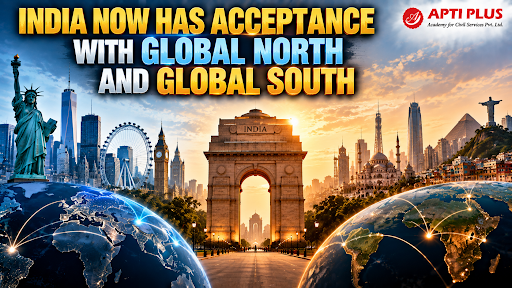
High Commissioner Anil Sooklal highlighted that India has achieved unique global diplomatic acceptance across both the Global North and Global South, positioning New Delhi as a vital bridge in a fragmented geopolitical order.
What is Global North in Contemporary Geopolitics?
Advanced industrialized economies characterized by high per-capita GDP, advanced human development, and intensive capital density.
Geographic concentration predominantly across North America, Western Europe, Japan, South Korea, and Australasia.
Commanding disproportionate structural influence over global financial and regulatory architectures including the IMF, World Bank, and G7.
Dominating high-end research and development, proprietary intellectual property regimes, and critical frontier technologies.
Advocating a rules-based liberal international order founded on open market access, contract enforcement, and democratic governance.
What is Global South?
Diverse developing, emerging, and least developed countries spanning Africa, Latin America, the Caribbean, Asia, and Oceania.
Bound by shared colonial histories, structural economic vulnerabilities, and asymmetric exposure to global financial shocks.
Articulating collective demands for climate justice, predictable loss and damage financing, and equitable atmospheric carbon space.
Demanding sovereign debt restructuring, accessible concessional development finance, and unencumbered technology transfer from advanced states.
Emphasizing South-South cooperation without functioning as an adversarial or anti-Western geopolitical bloc, as highlighted by the Sushma Swaraj Institute.
Why Has India Gained Broad Acceptance Across the Global North?
India provides a massive, demographically expanding domestic consumer market offering immense commercial opportunities for Western capital.
Constitutional democracy, pluralism, and shared commitment to the rule of law create normative alignment with Western institutional values.
An unmatched reservoir of skilled Science, Technology, Engineering and Mathematics (STEM) talent, software engineering expertise, and frugal technology innovation powers global corporations.
India serves as an anchor in Indo-Pacific maritime security, maintaining freedom of navigation and regional strategic equilibrium.
Accelerating trade integration through deep negotiations with the European Union, United Kingdom, and the historic Trade and Economic Partnership Agreement (TEPA) pact with European Free Trade Association (EFTA) nations.
How is India Deepening Institutional Linkages with the Global North?
|
Why is India a Vital Partner and Leader for the Global South?
India offers proven, scalable, and low-cost development solutions tested under complex, resource-constrained domestic conditions.
Democratizing Digital Public Infrastructure (DPI) architectures like UPI, Aadhaar, and DigiLocker as open-source global public goods.
Delivering transparent, demand-driven development assistance and concessional lines of credit free from predatory debt traps.
Championing food, fertilizer, and energy security through global initiatives like Mission LiFE and the International Solar Alliance.
Institutionalizing developing world advocacy through the Voice of Global South process and the Global South Young Diplomats Forum.
India’s Leadership Footprint in the Global South
|
How Does India Act as a Diplomatic Bridge Between the North and South?
Facilitating principled dialogue between competing global power centers through constructive, non-ideological diplomatic engagement.
Steering multilateral climate diplomacy by balancing rapid decarbonization targets with historical equity and differentiated responsibilities.
Forging cross-cutting technology and renewable corridors that connect advanced Western capital with Southern deployment needs.
Serving as a trusted, non-coercive mediator during geopolitical confrontations (eg. Iran-Israel war), food supply shocks, and maritime transit disruptions.
Building consensus on global public goods, as demonstrated by the unanimous adoption of the G20 New Delhi Leaders' Declaration.
India’s Doctrine of Strategic Autonomy and Multi-Alignment
Grounding foreign policy decisions strictly in sovereign national interests rather than ideological alignment or external coercion.
Pursuing issue-based, flexible diplomatic partnerships across divergent power blocs without entering into binding military alliances.
Maintaining diplomatic maneuvering space across platforms like the Quad, BRICS, SCO, G20, and the Voice of Global South.
Directly coupling strategic autonomy with domestic economic transformation to achieve a developed Viksit Bharat by 2047.
Evolving from defensive non-alignment to confident, proactive multi-alignment as a Vishwabandhu (global bridge and problem-solver).
Major Arenas of India’s Global Engagements
|
What are the Major Challenges Confronting India’s Global Bridge-Building Role?
Navigating Secondary Sanctions Risks Amid Persistent Russia-West Polarisation: India faces complex diplomatic friction while maintaining Russian defence and discounted crude imports alongside Western technology pacts.
-
Case Study: Western scrutiny over Indian imports of discounted Russian seaborne crude required intricate diplomacy to avoid CAATSA secondary sanctions.
Sustained Military Stand-offs and Strategic Competition Along the India-China Border: Beijing’s aggressive military deployments along the LAC and infrastructure expansion across the Indian Ocean littoral challenge New Delhi’s regional leadership.
-
Case Study: Chinese strategic docking facilities and dual-use port infrastructure in Hambantota and Gwadar complicate India's maritime security architecture.
Divergent Economic Interests and Fragmented Agendas Within a Heterogeneous Global South: The Global South spans non-aligned democracies, authoritarian regimes, and diverse economic priorities, complicating multilateral consensus.
-
Case Study: African nations and Latin American agricultural exporters diverged sharply over agricultural subsidies and decarbonization timelines during WTO ministerials.
Rising Protectionist Non-Tariff Barriers and Carbon Taxes Imposed by the Global North: Advanced Western economies are erecting unilateral environmental trade barriers that disproportionately penalize emerging nation industrial exports.
-
Case Study: The European Union’s Carbon Border Adjustment Mechanism (CBAM) imposes heavy import levies on Indian steel, aluminium, and cement exports.
Escalating US-China Tech Decoupling Compressing Non-Aligned Maneuvering Space: Heightened geoeconomic competition over critical minerals and semiconductors threatens intermediate technology manufacturing corridors.
-
Case Study: Stringent US export controls on advanced AI microchips and dual-use fabrication technology pressure non-aligned Asian manufacturing supply chains.
Diplomatic Cadre Shortages and Bureaucratic Capacity Gaps in the Ministry of External Affairs: India's diplomatic corps remains numerically modest relative to its expanding international commitments, slowing execution of development assistance.
-
Case Study: The Parliamentary Standing Committee on External Affairs reported severe officer shortages across 42 Indian resident missions in Africa.
Way Forward to Strengthen India’s Global Problem-Solver Status
Accelerating Trade Integration and Value Chain Upgradation: Conclude balanced Comprehensive Economic Partnership Agreements with the EU, and GCC to embed Indian industry in global value chains.
-
Example: India-EFTA Trade and Economic Partnership Agreement (TEPA), anchoring $100 billion in binding European investment commitments.
Democratizing Digital Public Infrastructure as Global Public Goods: Export open-source DPI architectures including UPI, Aadhaar, and DigiLocker to developing partners across Africa, Asia, and Latin America.
Championing Comprehensive Multilateral Institutional Reforms: Mobilize Global South consensus through the L.69 grouping to secure permanent UN Security Council expansion and Bretton Woods quota realignment.
Spearheading Climate Finance and Scalable Clean Tech Transfers: Mobilize concessional climate funding and South-South renewable technology transfers to balance industrial expansion with decarbonization mandates.
-
Example: International Solar Alliance (ISA) Star-C Initiative, establishing solar technology training and incubation centers across developing island nations.
Expanding Demand-Driven Concessional Development Cooperation: Scale grant-backed infrastructure, tele-education, and healthcare capacity-building projects to deliver sustainable South-South cooperation.
Forging Resilient Critical Technology and Manufacturing Corridors: Leverage strategic bilateral technology initiatives to establish domestic semiconductor fabrication, quantum computing, and artificial intelligence ecosystems.
-
Example: US-India Semiconductor Supply Chain and Innovation Partnership, catalyzing commercial semiconductor assembly and fabrication facilities in India.
Institutionalizing Comprehensive Maritime Domain Security: Deploy naval white-shipping agreements, coastal radar networks, and disaster relief air-sea sorties to secure vital Indian Ocean sea lines of communication.
Nurturing Next-Generation Multilateral Diplomatic Talent: Expand specialized foreign-service diplomacy modules at the Sushma Swaraj Institute to train emerging diplomats from developing nations in multilateral negotiation
Conclusion
By harmonizing strategic autonomy with active bridge-building, India transforms from a balancing power into an indispensable global problem-solver, advancing both national development and an equitable world order.
Source: INDIANEXPRESS
|
PRACTICE QUESTION Q. "India’s contemporary foreign policy has successfully transitioned from defensive non-alignment to confident multi-alignment, positioning New Delhi as an indispensable bridge between the Global North and the Global South." Discuss (15 Marks, 250 Words) |