Why In News?
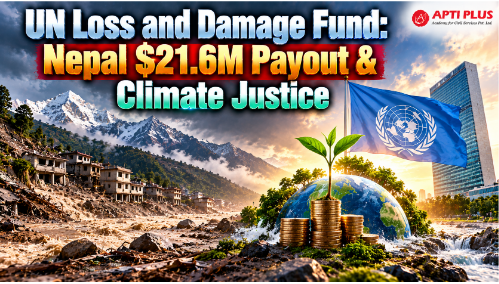
The United Nations Framework Convention on Climate Change (UNFCCC) Fund for Responding to Loss and Damage (FRLD) provisionally approved its first-ever disaster-specific payout to Nepal following August 2026 glacial floods.
What Is The UN Fund For Responding To Loss And Damage (FRLD)?
Origin: Formally established at COP27 in Sharm el-Sheikh in 2022 and operationalized at COP28 in Dubai in 2023, the FRLD serves as a dedicated multilateral climate finance mechanism under the UNFCCC and the Paris Agreement.
Objectives: Compensates vulnerable developing nations for unavoidable economic and non-economic harm resulting from climate-induced extreme weather events and slow-onset phenomena.
Governance Framework: Overseen by an independent 26-member Board comprising 12 representatives from developed nations and 14 from developing countries to ensure balanced representation.
-
The World Bank acts as the financial trustee and host of the secretariat for an initial 4-year period under a Financial Intermediary Fund (FIF) arrangement.
Scope Of Compensation: The fund covers economic loss and damage—including infrastructure destruction, agricultural losses, and income disruption—as well as non-economic loss and damage, such as cultural heritage loss, forced displacement, loss of biodiversity, and psychological trauma.
Resource Architecture: Operates on a voluntary contribution model from donor countries. Total global pledges stand at $822 million to $882 million as of early 2026.
ABOUT UNFCCCThe United Nations Framework Convention on Climate Change (UNFCCC) is an international environmental treaty adopted at the 1992 Rio Earth Summit that entered into force in 1994, with its secretariat based in Bonn, Germany.
|
What Does The 2026 Nepal Disaster Reveal About Climate Vulnerability And Financial Needs?
In August 2026, a massive rock-ice avalanche on Langtang Lirung mountain near the Nepal-China border triggered flash floods across the Bhotekoshi and Trishuli river systems.
-
Human And Economic Loss: Claimed over 1,400 lives, left 5,745 people missing, destroyed 10% of Nepal’s installed hydropower capacity, caused $2.7 billion in direct physical damage, and generated $4.77 billion in long-term reconstruction requirements.
-
Third Pole Paradox: Nepal accounts for barely 0.1% of global greenhouse gas (GHG) emissions. Yet, the Hindu Kush Himalayas (HKH) experience Elevation-Dependent Warming (EDW) at nearly twice the global average, driving glacial melt at 10 times historical norms and causing severe economic distress.
-
Severe Funding Gap: The FRLD's provisionally set aside $21.6 million grant represents less than 0.5% of Nepal’s total recovery and reconstruction needs.
About Hindu Kush Himalayas (HKH)It is a 3,500-kilometer mountain arc spanning eight countries (Afghanistan, Bangladesh, Bhutan, China, India, Nepal, Myanmar, and Pakistan), known as the "Third Pole" and the "Water Tower of Asia" because it holds the largest reserve of permanent ice and snow outside the polar regions.
|
How Does The Climate Justice Framework Align With Common But Differentiated Responsibilities?
Reparations Versus Charity: Climate justice distinguishes climate compensation from traditional humanitarian aid; while disaster relief from the Global North carries no admission of fault, loss and damage finance explicitly enforces accountability for historical pollution.
CBDR-RC Doctrine: Under the UNFCCC framework, the principle of Common But Differentiated Responsibilities and Respective Capabilities (CBDR-RC) asserts that developed nations, having generated the majority of historical cumulative emissions, bear the primary financial obligation to assist climate-vulnerable countries.
Article 8 Legal Exclusion: Although Article 8 of the Paris Agreement formally recognizes loss and damage, it explicitly states that this provision does not provide a legal basis for liability or financial compensation. Developed nations use this exclusion to resist legally binding reparations.
India's Strategic Stance: India advocates for CBDR-RC, grant-based non-debt climate finance, direct access modalities, and equity in the global carbon budget.
-
India’s per capita CO2 emissions in 2022 stood at 1.9 tonnes, compared to 14.4 tonnes in the United States and 8.5 tonnes in China. (Source: International Energy Agency)
Judicial Endorsement In India: Grounded in Article 48A and Article 51A(g) of the Constitution, statutory recognition is granted under Section 20 of the National Green Tribunal Act, 2010.
-
Rulings—including Indian Council for Enviro-Legal Action vs Union of India (1996), Vellore Citizens Welfare Forum vs Union of India (1996), and M.C. Mehta vs Kamal Nath (1997)—firmly establishes the Polluter Pays Principle and intergenerational equity as integral parts of domestic environmental law.
What Challenges Hamper The Effectiveness Of Loss And Damage Fund?
Financial Under-capitalization: Total pledges of $822 million to $882 million cover less than 0.2% of the $400 billion required annually by developing countries by 2030.
-
Example: FRLD Secretariat Assessment Report, total pledged funds cover under 0.1% of global requirements, leaving 176 funding requests totaling $2.8 billion from 119 nations unfulfilled during the first application window.
Bureaucratic Emergency Delay: Operating like a conventional development fund, the FRLD enforces an 11-step approval process with closed submission windows, preventing rapid emergency response during sudden disasters.
-
Example: 2026 Nepal Flood Emergency Application Failure Mode, Nepal faced a seven-week administrative delay and required an extraordinary board meeting to unlock $21.6 million because its application arrived after the standard June window had closed.
Institutional Governance Friction: Developing nations oppose temporary World Bank hosting due to high administrative fees, loan-centric financing mechanisms, cumbersome accreditation processes, and Western institutional influence.
-
Example: World Bank Financial Intermediary Fund (FIF) Host Model, complex fiduciary requirements limit direct access for local communities and sub-national bodies, creating multi-layered administrative bottlenecks.
Neglect Of Non-Economic Losses: Quantifying non-economic damage remains complex and neglected, leaving intangible losses uncompensated in standard post-disaster assessments.
-
Example: Lack of standardized valuation tools causes international delivery mechanisms to neglect non-economic losses such as forced migration, loss of indigenous heritage, and post-disaster trauma.
Measures To Ensure Climate Equity
Direct Access Windows: Establishing standing rapid-response windows outside standard application cycles to release emergency grants within days of a disaster.
-
Example: Barbados Implementation Modalities (BIM) & Direct Access Scorecard System, implementing a 100-point functional equivalency scorecard that allows accredited national and community entities to receive small grants directly without international intermediaries.
Ring-Fenced Allocation Floors: Introducing multi-factor allocation criteria that prioritize highly vulnerable nations while factoring in donor responsibility and economic capability.
-
Example: Lowy Institute Multi-Factor Allocation Mechanism, establishing a guaranteed minimum funding floor of 60–70% for Least Developed Countries (LDCs) and Small Island Developing States (SIDS), weighted negatively against donor GDP and emissions.
Automated Telemetry And Risk Pooling: Deploying real-time satellite radar and hydrological telemetry across vulnerable transboundary regions to automate disaster response.
-
Example: Caribbean Catastrophe Risk Insurance Facility (CCRIF) & Target G of Sendai Framework for Disaster Risk Reduction, using pre-defined parametric triggers (such as river surge volume or glacier collapse velocity) to automatically disburse emergency liquidity without waiting for lengthy loss verification.
Innovative Mandatory Financing: Replacing voluntary government pledges with mandatory, predictable global levies and market-based mechanisms.
-
Example: French Solidarity Levy on Airplane Tickets & EU Carbon Border Adjustment Mechanism (CBAM), tapping international maritime taxes, carbon tariffs, and windfall taxes on fossil fuel corporate profits to channel predictable revenue directly into the FRLD.
Conclusion
The UN Loss and Damage Fund must transition from voluntary donor pledges to a mandatory, rapid-disbursement framework anchored in legal liability. Turning emergency exceptions into standing, direct-access mechanisms is essential to deliver true climate justice for vulnerable Global South nations.
Source: INDIANEXPRESS
|
PRACTICE QUESTION Q. Climate justice requires not only financial commitments but also timely and adequate compensation for climate-related losses. Discuss. 250 WORDS |