Why In News?
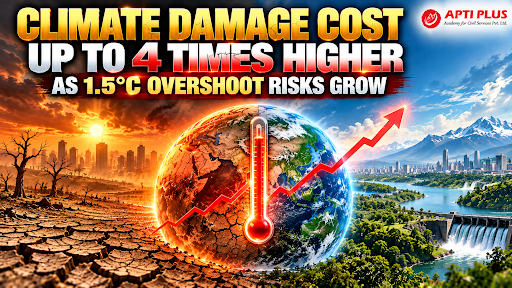
The 1.5°C overshoot risk has taken center stage in global policy and scientific discussions due to the publication of the 10 New Insights in Climate Science 2026/2027 report, compiled jointly by Future Earth, The Earth League, and the World Climate Research Programme (WCRP).
What Does the 1.5°C Target Mean?
-
Paris Agreement Goal: Article 2.1(a) of the 2015 Paris Agreement calls for keeping global warming well below 2°C above pre-industrial levels while pursuing efforts to limit it to 1.5°C.
-
Temperature Benchmark: The 1.5°C limit refers to the long-term global average temperature, not a single unusually warm year.
-
Pre-industrial Reference: Climate assessments generally use 1850–1900 as the baseline for measuring warming.
-
Temporary Overshoot: An overshoot occurs when global temperature rises above 1.5°C for a period, potentially by around 0.1°C–0.35°C, before falling again through strong emissions cuts and Carbon Dioxide Removal (CDR).
What is Climate Overshoot?
Climate overshoot means when global average temperatures temporarily go past the 1.5°C safety limit set by the Paris Agreement before coming back down.
Why It Happens
-
Delayed Action: Greenhouse gas emissions remain too high, making a temporary temperature spike likely around mid-century.
-
Two Key Factors: Scientists measure overshoot by its magnitude (how high temperatures rise above 1.5°C) and duration (how long they stay there).
Major Risks and Impacts
-
Irreversible Damage: Lowering temperatures later does not act like an "undo button". Ice sheets, sea-level rise, and species extinctions can become permanent.
-
Tipping Points: Higher heat raises the danger of triggering dangerous thresholds, such as the collapse of major ocean currents or Amazon rainforest dieback.
-
Human Toll: Communities face severe risks to food security, water access, health, and coastal living during the peak and decline phases.

What Are The Impact Of Warming?
-
Stronger Heatwaves: Every additional fraction of warming can increase the intensity of extreme heat, with tropical regions facing particularly high exposure.
-
Water Stress: Higher temperatures can worsen drought, groundwater depletion and agricultural stress in vulnerable river basins, while also increasing the risk of intense rainfall.
-
Long-Term Sea-Level Rise: Oceans absorb more than 90% of the excess heat in the climate system. Ocean warming and ice-sheet loss therefore continue to influence sea levels for centuries.
-
Impact on Agriculture: Heat stress, changing rainfall patterns and soil degradation can reduce crop productivity and weaken natural carbon uptake.
-
Ecosystem Loss: A 0.35°C overshoot could significantly damage coral ecosystems, while permafrost thaw can release large quantities of previously stored carbon.
-
Human Health: Rising heat, water shortages and expanding climate-sensitive diseases can affect the health, income and productivity of billions of people.
What Do Recent Climate Indicators Show?
-
Global Temperature: Global average surface temperature reached around 1.43°C above the pre-industrial level in 2025.
-
CO₂ Emissions: Fossil fuels and cement production generated about 38.1 Gt of CO₂ in 2025, marking a new record.
-
Atmospheric CO₂: Atmospheric carbon dioxide reached around 425.6 ppm in 2025, approximately 53% above pre-industrial levels.
-
Weak Emission Commitments: Existing national climate pledges imply only about a 12% reduction in global emissions by 2035 from 2019 levels, compared with the much deeper cuts needed for a 1.5°C pathway.
-
Record-Warm Period: The 2015–2025 period included the 11 warmest years in the instrumental record, according to the WMO.
-
2035 Emission Gap: Avoiding a large overshoot would require global greenhouse gas emissions to fall by roughly half by 2035, implying rapid annual reductions.
Impacts Of Global Warming
Economic Damage
-
GDP Impact: Some recent time-series research estimates that a 1°C rise in global temperature could reduce global GDP by around 12% at peak, substantially above estimates from older approaches.
-
Social Cost of Carbon: Models that include global temperature shocks and capital depreciation estimate the Social Cost of Carbon (SCC) at around $1,056 per tonne of CO₂.
-
Long-Term Welfare Loss: Under a high-warming pathway reaching around 3°C, permanent welfare losses could become very large, with estimates reaching 31% in present value and 52% by 2100.
-
Lost Economic Output: Estimates suggest that without global warming between 1960 and 2019, global GDP per capita could have been substantially higher.
Impact On Developing Countries
-
Climate-Sensitive Livelihoods: Many developing economies depend heavily on agriculture, livestock and fisheries, which remain highly sensitive to temperature and rainfall changes.
-
Limited Fiscal Capacity: High borrowing costs and restricted public finances make it difficult to invest in large-scale climate-resilient infrastructure.
-
Infrastructure Deficits: Weak transport, sanitation, healthcare and other basic infrastructure can magnify the effects of climate disasters.
-
Higher Heat Exposure: Tropical developing regions face greater exposure to extreme heat and could experience much larger economic losses than wealthier economies under high-overshoot pathways.
-
Development Setbacks: Climate disasters can force governments to redirect scarce resources from healthcare, education and development towards emergency response and reconstruction.
What Should Countries Do Next?
-
Raise 2035 Targets: Countries need stronger Nationally Determined Contributions (NDCs) that bring global emissions closer to a 1.5°C-compatible pathway.
-
Expand Renewable Energy: Governments should rapidly scale up solar, wind, transmission networks and energy storage across power, transport and industry.
-
Cut Fossil-Fuel Dependence: Phasing down inefficient fossil-fuel subsidies and redirecting investment towards clean energy and natural carbon sinks can reduce future emissions.
-
Scale Up Climate Finance: International public and private finance needs to increase substantially, including efforts towards the $1.3 trillion annual climate-finance goal by 2035.
-
Plan for Adaptation: Countries should prepare long-term adaptation strategies that account for climate risks throughout the century, including possible temporary warming above 1.5°C.
-
Prioritise Vulnerable Populations: Climate finance and resilience measures should focus strongly on low-income and highly exposed tropical communities.
Conclusion
Breaching 1.5°C causes lasting extreme weather, ecosystem loss, and economic damage. Mitigating these risks requires swift emission cuts, adaptation, and enhanced climate finance.
Source: DOWNTOEARTH
|
PRACTICE QUESTION Q. With reference to Climate Tipping Points in the Earth System, consider the following statements: 1. Exceeding 1.5°C global warming can trigger abrupt boreal permafrost thaw and low-latitude coral reef die-off. 2. Climate tipping points are always immediate and abrupt, occurring within less than five years across all Earth system components. 3. Ocean heat uptake accounts for over 90% of the excess heat accumulated in the Earth system. Which of the statements given above are correct? (a) 1 and 2 only (b) 2 and 3 only (c) 1 and 3 only (d) 1, 2 and 3 Answer: (c) Explanation: Statement 1 is correct: Research shows that passing 1.5°C of global warming risks triggering multiple climate tipping points, including widespread abrupt permafrost thaw and warm-water/low-latitude coral reef die-off. Statement 2 is incorrect: Climate tipping points are not always immediate or abrupt; some components of the Earth system (such as massive ice sheets) can take centuries or millennia to fully transition to a new state even after the threshold is crossed. Statement 3 is correct: The NASA Science Ocean Warming data and global assessments confirm that the world's oceans absorb more than 90% of the excess heat accumulated in the Earth system from greenhouse gas emissions. |