Why In News?
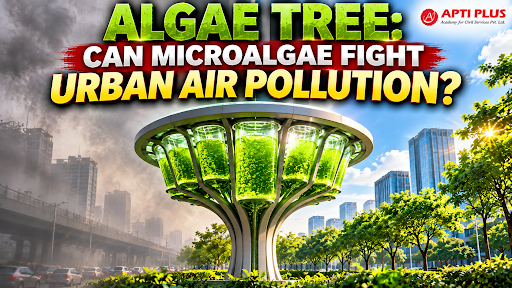
Guntur has installed Andhra Pradesh's first algae tree, a microalgae-based device meant to absorb carbon dioxide and improve air quality in congested urban spaces.
What Is An Algae Tree?
Meaning
-
"Liquid Tree": An algae tree, also called a liquid tree, is a tank of water containing microalgae that absorb CO₂ and release oxygen through photosynthesis, like a tree.
-
Urban Design: It is designed for crowded places where there is little space to plant trees, such as road medians, bus stops and markets.
How It Works
-
Photosynthesis: Microalgae use sunlight or LED light to convert CO₂ and water into biomass and oxygen.
-
Air Circulation: Pumps draw in surrounding air and bubble it through the algae-filled water.
-
Monitoring: Many units have sensors that display air quality, CO₂ levels, temperature, humidity and particulate matter.
-
Solar Power: Some units run on solar energy and offer features like seating and phone charging.
-
Biomass Use: Algae biomass is periodically removed and can be used as fertiliser or for biofuel.
Why Microalgae?
-
Efficient Photosynthesis: Microalgae grow fast and fix CO₂ efficiently in a small space.
-
Oxygen Producers: Marine phytoplankton, including algae, produce about half of the oxygen on Earth.
Earlier Algae Tree Installations
|
Location |
Year |
Details |
|
Belgrade, Serbia |
2021 |
"LIQUID 3", among the world's first liquid trees, set up with support from UNDP |
|
Delhi |
March 2026 |
Microalgae PureAir Tower along the Aerocity corridor, targeting CO₂, particulate matter and NOx |
|
Bhopal, Madhya Pradesh |
May 2026 |
Algae tree at Swami Vivekananda Park, claimed to absorb CO₂ equal to about 25 adult trees |
|
Dhanbad, Jharkhand |
July 2026 |
CSIR-CIMFR developed India's first mobile Smart Algal Liquid Tree (SALT) |
|
Guntur, Andhra Pradesh |
November 2026 |
Andhra Pradesh's first algae tree |
Why Does Air Pollution Need New Solutions?
Scale Of The Problem
-
Health Burden: Air pollution was linked to about 2.1 million deaths in India in 2021, according to the State of Global Air 2024 report.
-
Polluted Cities: The IQAir World Air Quality Report 2024 found that 13 of the world's 20 most polluted cities were in India.
-
Gap With Global Standards: India's annual PM2.5 standard is 40 µg/m³, while the WHO's 2021 guideline is 5 µg/m³.
Shrinking Urban Green Space
-
Space Constraints: Rapid urbanisation leaves little room for new trees in congested city centres.
Government Response
-
National Clean Air Programme (NCAP): Launched in 2019, it now targets a 40% reduction in PM10 levels by 2025–26 (from 2017–18) in about 130 non-attainment cities.
-
Urban Forests: The Nagar Van Yojana (2020) aims to develop urban forests in cities.
What Are The Benefits Of Algae Trees?
-
Space-Saving: They fit into small urban spaces where trees cannot grow.
-
No Soil Needed: They do not need soil and are less affected by pests and urban pollution.
-
Awareness: Visible, sensor-equipped units raise public awareness about air quality.
-
Useful By-Products: Algae biomass can become fertiliser or biofuel feedstock.
-
High Carbon Sequestration: Microalgae grow much faster than regular plants and capture carbon dioxide 10 to 50 times more efficiently than conventional forests on an area-normalized basis.
-
Intense Oxygen Production: Through active photosynthesis, the microalgae consume carbon dioxide and continuously release pure oxygen back into the environment.
-
Air Pollution and Particulate Reduction: The systems trap dirty urban air and filter out harmful pollutants, reducing particulate matter (such as PM2.5) and nitrogen oxides significantly in crowded spaces.
-
Solar-Powered and Continuous Operation: Many units (such as India's installation in Bhopal or global liquid tree models) run on integrated solar panels, and some feature supplemental lighting to keep the microalgae photosynthesizing year-round, even through darker or winter months.
What Are The Key Challenges?
Limited Impact On Overall Air Quality
-
Small Scale: A single unit cleans only a tiny volume of air compared with a whole city's pollution.
-
CO₂ vs. Particulates: Algae mainly absorb CO₂, while India's main air quality problem is PM2.5 and PM10, which algae trees remove only to a limited extent.
Unproven Effectiveness
-
Lack Of Independent Evaluation: Claims, such as one unit equalling about 25 adult trees, are largely made by developers and have not been widely verified by independent studies.
-
Lessons From Smog Towers: Earlier high-tech solutions have shown limited impact.
-
Example: Delhi's smog tower at Connaught Place, set up in 2021 at a cost of about ₹20 crore, was found by studies to improve air quality only within a short distance, raising doubts about such solutions.
Not A Substitute For Trees
-
Wider Benefits Of Trees: Real trees provide shade, cooling, biodiversity, groundwater recharge and long-term carbon storage, which algae tanks cannot replace.
Maintenance And Operating Costs
-
Sensitive Systems: Algae can die due to heat, contamination or lack of light, needing regular care.
-
Running Costs: Pumps, lights and sensors need power and maintenance, which can strain municipal budgets.
Risk Of "Techno-Fixes"
-
Distraction From Root Causes: Visible gadgets may divert attention and funds from tackling major pollution sources such as vehicles, industry, construction dust and biomass burning.
Lack Of Standards
-
No Guidelines: There are no national standards to certify the performance of algae-based purifiers.
Underused NCAP Funds And Weak Implementation
-
Implementation Gaps: Many cities have not fully used NCAP funds or met pollution reduction targets, showing that the bigger challenge is enforcement, not technology.
What Is The Way Forward?
Focus On Pollution Sources
-
Source Control First: Prioritise cutting emissions from vehicles, industry, construction and waste burning under NCAP.
-
Learn From Global Cities: Source-based policies deliver measurable results.
-
Example: London's Ultra Low Emission Zone, introduced in 2019, charges polluting vehicles to enter the city centre and has been linked to significant drops in nitrogen dioxide levels.
Expand Natural Green Cover
-
Urban Forests: Scale up Nagar Van Yojana and dense urban plantations.
-
Miyawaki Forests: Use the Miyawaki method, developed in Japan, to grow dense mini-forests in small urban spaces.
Scientifically Evaluate Algae Trees
-
Independent Testing: Have institutions such as CPCB, IITs and CSIR labs independently measure the air quality impact of algae trees.
-
Set Standards: Develop certification standards for algae-based and other air purification devices.
Use Algae Trees Smartly
-
Target Hotspots: Place them at specific high-exposure spots, such as bus stops, traffic junctions, schools and hospitals.
-
Combine With Monitoring: Use their sensors to build hyper-local air quality data.
Build A Circular Bioeconomy
-
Biomass Value: Use harvested algae as biofertiliser, animal feed or biofuel feedstock.
-
Learn From Research: Advances in algae biofuels, such as systems that greatly increase oil yield, can make algae biomass more valuable.
Ensure Sustainable Funding And Maintenance
-
Clear Responsibility: Fix maintenance responsibility with urban local bodies or partners, and budget for running costs.
-
Public–Private Partnerships: Use CSR and private partnerships for installation and upkeep.
Raise Public Awareness
-
Behavioural Change: Use algae trees as educational tools to encourage public transport use, reduced waste burning and tree planting.
-
Learn From Pioneers: Belgrade's LIQUID 3 became a symbol for public awareness of air pollution.
Conclusion
While microalgae can absorb CO₂ and raise awareness, they cannot replace real trees or substitute for cutting pollution at its source. Used wisely, after independent evaluation, algae trees can complement NCAP, urban forests and strong emission controls in India's fight for clean air.
Source: TIMESOFINDIA
|
PRACTICE QUESTION Q. Can technology-based solutions like algae trees and smog towers solve urban air pollution in India? Critically examine. (10 Marks, 150 Words) |