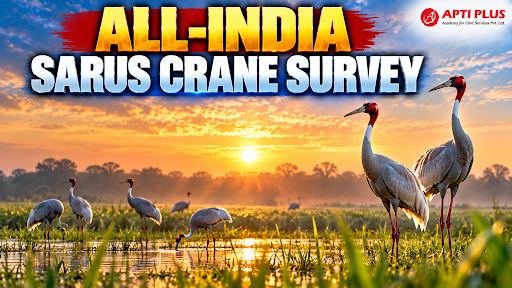
Why In News?
The Bombay Natural History Society (BNHS) has announced a coordinated All-India Sarus Crane Survey on 10th and 11th October 2026.
What Is The Bombay Natural History Society (BNHS)?
Origin: Founded in 1883, as non-governmental scientific organizations dedicated to wildlife research, natural history, and biodiversity conservation.
Headquartered at Hornbill House, Mumbai, eminent naturalists like Dr. Sálim Ali and S. Dillon Ripley guided its scientific development.
Status: BNHS is designated as a Scientific and Industrial Research Organisation (SIRO) by the Department of Science and Technology (DST) and serves as the official Indian partner of BirdLife International.
Official Emblem: Its emblem features the Great Hornbill, inspired by a live captive hornbill named "William" who lived at BNHS from 1894 to 1920.
Key Publications: Publishes the peer-reviewed Journal of the Bombay Natural History Society (JBNHS) (published continuously since 1886) and the quarterly magazine Hornbill.
Surveys: Leads nationwide ecological surveys, including the Asian Waterbird Census (AWC) in partnership with Wetlands International, the National Dragonfly Festival, the All-India Sarus Crane Survey, and migratory tracking along the Central Asian Flyway (CAF).
Surveillance & Species Recovery: Collaborates with the Indian Council of Medical Research (ICMR) on bird-human disease surveillance under the One Health framework, operates Vulture Conservation Breeding Centres (VCBC), and undertakes habitat restoration for the Great Indian Bustard.
What Is The Sarus Crane?
The Indian Sarus Crane (Antigone antigone antigone) is the world's tallest flying bird, standing 1.5 to 1.8 metres tall. It is the only resident breeding crane species in India.
-
Features: Overall grey plumage, bare red head and upper neck, pink legs, and distinct white neck collar. Weighs roughly 6.8 to 8 kg.
-
Geographical Range: Found in wetlands, marshes, ponds, canals, and agricultural flooded paddy fields in parts of South Asia (primarily India and Nepal), Southeast Asia (Myanmar, Cambodia, Vietnam), and northeastern Australia.
-
India hosts the vast majority of the nominate subspecies, with Uttar Pradesh serving as the primary stronghold, housing nearly 20,000 Sarus Cranes according to its 2024 census.
-
Conservation Status:
-
Wild Life (Protection) Act, 1972: Listed under Schedule I, granting it strict legal protection on par with the Bengal Tiger.
-
IUCN Red List: Globally classified as Vulnerable due to historical range contraction and threats like powerline collisions and habitat degradation.
-
CITES: Regulated under Appendix II to control commercial international trade.
-
State Symbol: Officially designated as the State Bird of Uttar Pradesh in 2013.
-
Behavior: Sarus Cranes form lifelong monogamous pair-bonds. They maintain territories across wetlands and farmlands, exhibiting social structures comprising breeding pairs, family groups, non-breeding flocks, and seasonal congregations.

Ecological Significance Of Sarus Crane
Bio-Indicator of Wetland Ecosystem Health: As a wetland-dependent bird, their population stability serves as an immediate bio-indicator of functional wetland hydrology, water quality, and landscape health.
Biological Pest Control and Omnivorous Diet: Sarus Crane diet includes crop-damaging insects, aquatic fish, food grains, mollusks/snails, and vegetation.
Umbrella Species for Agricultural Biodiversity: Protecting Sarus Crane breeding habitats—a mosaic of community ponds, irrigation canals, and flooded paddy fields—simultaneously safeguards over 350 co-existing bird species, aquatic flora, and semi-aquatic fauna along the Central Asian Flyway (CAF).
Source: DOWNTOEARTH
|
PRACTICE QUESTION Q. With reference to the Sarus Crane (Antigone antigone), consider the following statements: 1. It is recognized as the world's tallest flying bird and is the official State Bird of Uttar Pradesh. 2. It is a long-distance migratory bird that breeds exclusively in the Arctic tundra and winters in northern India. 3. It is listed as 'Vulnerable' on the IUCN Red List and is protected under Schedule I of the Wildlife (Protection) Act, 1972. Which of the statements given above is/are correct? (a) 1 and 2 only (b) 2 and 3 only (c) 1 and 3 only (d) 1, 2 and 3 Answer: (c) Explanation: Statement 1 is correct: The Sarus Crane (Antigone antigone) stands up to 1.8 meters (nearly 6 feet) tall, making it globally recognized as the world's tallest flying bird. It is also celebrated as the official State Bird of Uttar Pradesh, India. Statement 2 is incorrect: Unlike many other crane species, the Sarus Crane is predominantly a non-migratory (resident) bird. It does not breed in the Arctic tundra; instead, it is India’s only resident breeding crane, residing and breeding year-round in the wetlands and agricultural landscapes of the Indian subcontinent, Southeast Asia, and northern Australia. Statement 3 is correct: It is categorized as 'Vulnerable' on the IUCN Red List due to continuous habitat degradation and wetland loss. Under India's Wildlife (Protection) Act, 1972, it enjoys high-level legal safety under Schedule I. |