Why In News?
The Food Safety and Standards Authority of India (FSSAI) has proposed strict regulatory amendments prohibiting food manufacturers from using the nomenclature "paneer" for products made from non-milk fats and non-dairy proteins.
What Is Analogue Paneer?
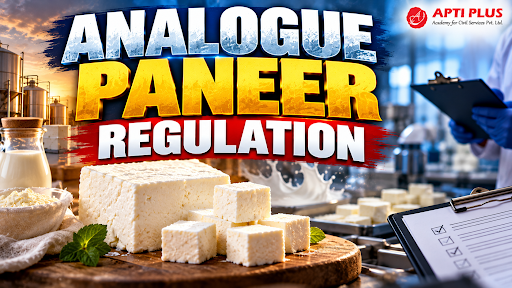
Analogue paneer (also referred to as imitation or synthetic paneer) is an ultra-processed food formulation engineered to mimic the physical appearance, elastic texture, mouthfeel, and culinary functionality of authentic milk paneer.
Substitution of Core Milk Constituents: While authentic paneer is derived exclusively from milk coagulation, analogue formulations replace natural milk fat and dairy solids with:
-
Non-dairy fats (primarily refined palm oil, palm kernel oil, or hydrogenated vegetable fats).
-
Plant-based proteins (such as soy protein isolate or pea protein).
-
Bulking agents, emulsifiers, stabilisers, and industrial starches to prevent phase separation during cooking.
Economic Incentive for Adulteration: Because vegetable oils and industrial starches cost less than whole dairy milk, analogue variants are manufactured at one-third to one-half the production cost of genuine dairy paneer, driving large-scale surreptitious substitution across the hospitality sector.
How Does Analogue Paneer Differ From Traditional Dairy Paneer?
Raw Material Composition: Under FSSAI standards, genuine paneer must be prepared solely from cow, buffalo, or goat milk (with or without added milk solids) precipitated through permissible food-grade acidulants (citric, lactic, or malic acid) and heat treatment.
Milk Fat vs Vegetable Fat: Authentic paneer derives 100% of its lipid content from natural butterfat, containing essential fat-soluble vitamins (A, D, E, K); analogue variants contain industrial vegetable triglycerides, often high in saturated fatty acids and potential trans-fat traces.
Protein Quality and Micronutrient Density: Traditional paneer delivers complete dairy protein (casein and whey) rich in bioavailable calcium, phosphorus, and essential amino acids; analogue formulations lack natural milk calcium and offer inferior protein bioavailability.
Distinct Legal Classifications: Authentic paneer is categorized as a standardized "Dairy Product"; analogue paneer is legally classified as an "Imitation/Non-Dairy Analogue," subject to completely separate quality parameters.
What Is The Statutory Role And Mandate Of FSSAI?
Apex Food Safety Regulator: Established as an autonomous statutory body under the Food Safety and Standards Act, 2006 (FSS Act) under the administrative aegis of the Ministry of Health and Family Welfare.
Standard Setting and Harmonization: Consolidates multiple pre-existing food laws into a single statutory framework, laying down science-based standards for food articles, food additives, contaminants, and pesticide residues.
Regulating Manufacture and Distribution: Licenses, registers, and audits Food Business Operators (FBOs) across the entire supply chain—from dairy farms and commercial processing units to cloud kitchens and retail grocers.
Safeguarding Consumer Welfare: Enforces packaging, labelling, and advertisement standards to eliminate deceptive marketing claims, ensuring food hygiene and nutritional authenticity.
FSSAI Proposed Regulations 2026
Absolute Restriction on the Word "Paneer": Non-milk-derived food products are legally barred from using the word "Paneer"—either as a standalone noun or as a qualifying compound (e.g., "Veg Paneer", "Plant Paneer", "Analogue Paneer", or "Soya Paneer").
Mandatory Standardized Nomenclature: Manufacturers must market such products under strictly descriptive trade names that truthfully disclose their primary ingredients, such as "Non-Dairy Protein and Fat Cube" or "Imitation Plant-Fat Food".
Hospitality and Restaurant Disclosure Norms: Restaurants, hotels, caterers, and cloud kitchens are mandated to clearly state on physical and digital menus whether a dish is prepared using authentic dairy paneer or a non-dairy analogue.
Packaging and Font Size Mandates: Requires packaged imitation products to carry prominent front-of-pack declarations specifying the percentage of added vegetable fat, printed in bold contrasting typography.
Conclusion
FSSAI's regulatory crackdown on analogue paneer establishes that commercial profitability cannot come at the expense of consumer trust, ensuring that food labels uphold nutritional honesty, fair competition, and public health.
Source: THEHINDU
|
PRACTICE QUESTION Q. Consider the following statements regarding 'Analogue Paneer': 1. It is synthesized by completely or partially replacing dairy milk fat with non-dairy vegetable oils and plant proteins. 2. It possesses higher bioavailable calcium and casein protein compared to traditional milk paneer. 3. Selling analogue paneer as authentic dairy paneer without disclosure attracts penalties under the Food Safety and Standards Act, 2006. Which of the statements given above is/are correct? (a) 1 and 2 only (b) 2 and 3 only (c) 1 and 3 only (d) 1, 2 and 3 Answer: (c) Explanation: Statement 1 is correct: Analogue paneer (imitation paneer) is a substitute formulated by replacing milk fat and milk solids, partially or entirely, with non-dairy constituents such as vegetable fats (e.g., palm oil), starches, and vegetable proteins (such as soy). Statement 2 is incorrect: Traditional paneer is a natural dairy product naturally rich in milk protein (casein) and highly bioavailable dairy calcium. Analogue paneer generally has a lower nutritional profile, with inferior calcium bioavailability and reduced or absent natural casein compared to authentic dairy paneer. Statement 3 is correct: Under the Food Safety and Standards Act, 2006 and regulations framed by FSSAI, non-dairy substitute products must be explicitly labeled as analogues. Passing off or selling analogue paneer as authentic dairy paneer constitutes misbranding and misleading commercial practice, attracting regulatory scrutiny, product seizures, and monetary or legal penalties. |