Why In News?
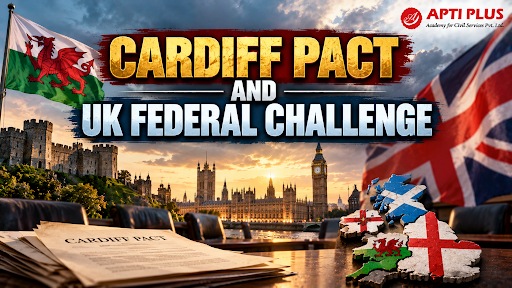
Leading nationalist parties from Scotland, Wales, and Northern Ireland signed a tripartite Memorandum of Understanding (MoU)—termed the Cardiff Pact.
What is the Cardiff Pact?
The Cardiff Pact is an inter-party cooperative accord signed in Cardiff (Wales) by pro-sovereignty leaders representing the three non-English constituent nations of the United Kingdom.
|
Signatories |
John Swinney (Scotland, SNP), Rhun ap Iorwerth (Wales, Plaid Cymru), Michelle O’Neill (Northern Ireland, Sinn Féin Vice President); also attended by Mary Lou McDonald, Sinn Féin President |
|
Nature of Pact |
A political memorandum of understanding, not a legally binding treaty; expresses shared intent for self‑determination and referendums on independence or reunification. |
|
Core Objectives |
1️⃣ Demand Westminster to “prepare, plan and facilitate constitutional change.” 3️⃣ Coordinate policies on economy, energy, and European relations. |
|
EU Vision |
Scotland and Wales would seek EU membership as new states; Northern Ireland would rejoin the EU through unification with the Republic of Ireland. |
|
Political Context |
All three devolved administrations are now led by pro‑independence parties, marking the first time since devolution that the UK’s outlying governments share a common separatist agenda. |
|
Westminster Response |
PM Andy Burnham rejected claims of majority support for independence votes but acknowledged “constitutional dialogue is inevitable.” |
|
Public Impact |
Seen as the most coordinated challenge to the UK’s union structure since the Good Friday Agreement; sparked debate on federal reform and future referendums. |
About United Kingdom (UK)
The United Kingdom (UK) is a sovereign island nation in north‑western Europe, comprising England, Scotland, Wales, and Northern Ireland.

Phase |
Key Developments |
|
Formation (1535–1920) |
- Wales annexed by England in the 16th century. - Acts of Union 1707: United English & Scottish Parliaments → Kingdom of Great Britain. - Act of Union 1801: Ireland joined → United Kingdom of Great Britain and Ireland. - Partition of Ireland 1920: Northern Ireland remained in UK; rest became independent. |
|
Devolution Era (Late 1990s) |
- Scotland Act 1998: Created Scottish Parliament with significant domestic powers. - Government of Wales Act 1998: Established Welsh Senedd. - Good Friday Agreement 1998: Power‑sharing Assembly in Northern Ireland; constitutional mechanism for a future “border poll” on reunification. |
|
Current Friction (Post‑Brexit) |
- Brexit (2020) exposed constitutional asynchrony: Scotland (62% Remain) & Northern Ireland (55.8% Remain) pulled out of EU against majority will. - UK Internal Market Act 2020 seen as a “power grab” overriding devolved autonomy. - Barnett Formula (outdated fiscal transfer system) deepened resentment. - Post‑Brexit shocks + centralizing measures foster perception of “coercive centralism.” |
|
Catalyst for Cardiff MoU (2026) |
- Devolved nations increasingly demand self‑determination and EU reintegration. - Coordinated separatist agenda by Scotland, Wales, and Northern Ireland culminated in the Cardiff Pact/MoU. |
Lessons for India
Constitutional Asymmetry as a Stabilizer: India’s use of Articles 371 to 371-J and the Fifth and Sixth Schedules demonstrates how tailored constitutional autonomy addresses diverse regional aspirations without fracturing national unity.
Supremacy of a Written Constitution: India's written constitution and independent judiciary protect state powers under the Seventh Schedule, preventing arbitrary central revocation of powers unlike Westminster's uncodified model.
Indestructible Union of Destructible Units (Article 1): The Indian model accommodates linguistic and regional identities via state reorganization (Article 3) while firmly preserving national territorial integrity.
Institutionalized Intergovernmental Forums: Forums like the Inter-State Council (Article 263), the NITI Aayog Governing Council, and the GST Council show that regular consensus-building prevents sub-national alienation.
Democratic Consultation over Coercion: Accommodating regional political parties within national coalitions safeguards cooperative federalism and anchors national integration.
Source: TIMESOFINDIA
|
PRACTICE QUESTION Q. The "Cardiff Pact," signed in September 2026, is primarily an alliance formed by the political leadership of which three nations? A) England, Scotland, and the Republic of Ireland B) Scotland, Wales, and Northern Ireland C) Wales, Northern Ireland, and England D) Scotland, Wales, and France Answer: B Explanation: The pact was signed by the pro-independence/nationalist leaders of Scotland (SNP), Wales (Plaid Cymru), and Northern Ireland (Sinn Féin). |