Why In News?
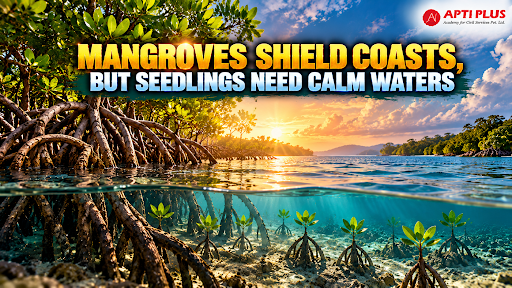
A Nature study shows that while mature mangroves protect coasts, young seedlings need extended calm, low-energy waters to root successfully.
What Are Mangroves?
Mangroves are specialized, halophytic woody vegetation communities distributed along tropical and subtropical intertidal coastlines, estuaries, and sheltered marine shores.
-
Morphological Adaptations: They possess complex specialized root architectures—such as stilt/prop roots (e.g., Rhizophora) and vertical pneumatophores (e.g., Avicennia)—that provide structural stability in soft, fine-grained intertidal mud, facilitate sediment retention, and support gas exchange under regular tidal inundation.
-
Reproductive Strategy: Mangroves reproduce via water-dispersed buoyant propagules that fall from parent trees and travel across coastal waters via currents and tidal flows before settling in suitable intertidal substrates.
What are the Significance of Mangrove Forests?
Coastal Protection: Mangrove vegetation dissipates wind and swell waves through hydraulic drag generated by aerial root systems, tree trunks, and leafy canopies.
-
Wide mangrove forests (>500 metres) reduce incoming wave energy by 75% or more regardless of local ambient conditions, whereas narrower forest bands (50–100 metres) provide variable dissipation depending on tree density and surge depth.
Flood Risk & Erosion Mitigation: Mangroves prevent severe erosion, attenuate storm surges, and shield coastal infrastructure by dampening flow velocities and reducing near-bed orbital forces.
Sediment Deposition: Dense prop roots and pneumatophores reduce turbulence, forcing fine suspended sediments to settle and bind to intertidal soil. This sediment trapping drives vertical accretion, enabling low-lying coasts to adapt to sea-level rise..
Carbon Sequestration (Blue Carbon Sinks): Mangrove ecosystems capture atmospheric carbon dioxide through high primary productivity and bury organic matter deep within anaerobic soils, functioning as highly effective blue carbon sinks.
Biodiversity & Nursery Habitat: Structural complexity of intertidal mangrove root networks creates nutrient-rich, sheltered environments that serve as primary feeding and nursery grounds for diverse fish, bird, and crustacean species.
Biotic Facilitation: Adult mangrove stands dissipate incoming waves and stabilize bed elevation. This shelters young seedlings from hydrodynamic stress, creating calm micro-environments (Windows of Opportunity) for propagules to root and sustain the forest.
What Is The Mangrove Establishment Paradox?
Core Paradox: Coastal managers frequently attempt to restore mangroves in exposed, high-wave-energy environments to achieve wave attenuation and shoreline defense; however, these hydrodynamically energetic zones are precisely where young seedlings are least capable of taking root and surviving.
Differential Life-Stage Vulnerability: While mature mangrove trees can withstand significant wave forces and hydrodynamic shear stresses, young seedlings (stem height <0.5 m) and recently stranded propagules are highly fragile and easily uprooted or destroyed by sediment erosion.
What Mechanisms Can Ensure Sustainable Mangrove Restoration?
Mandating Biophysical Elevation Profiling: Integrate Unmanned Aerial Systems (UAS)-based high-resolution photogrammetry and numerical hydrodynamic modeling (XBeach / Delft3D) prior to sanctioning any coastal restoration project to verify surface elevation and inundation-free periods.
-
Example: The MISHTI Scheme (Mangrove Initiative for Shoreline Habitats & Tangible Incomes) integrates scientific terrain and hydrological mapping with community-based co-management to restore mangroves across India's coastlines.
Upgrading Statutory Coastal Buffer Standards: Amend national coastal zone management frameworks to establish a mandatory 500-metre minimum mangrove greenbelt width along vulnerable tropical coastlines to secure long-term flood defense.
-
Example: Deltares Global Coastal Safety Model, adoption of a mandatory 500-metre ecological buffer requirement that achieves a certified 75% wave height attenuation across 46% of global tropical shorelines.
Hybrid Nature-Based Engineering: Combine temporary soft-engineering permeable timber dams or Melaleuca fences with natural propagule enrichment on wave-exposed mudflats to artificially reduce bed shear stress below critical thresholds.
-
Example: Vietnam Kien Giang Coastal Soft-Engineering Project, installation of permeable bamboo dams reduced wave shear stress, trapping fine sediment and increasing seedling survival from <10% to over 65%.
Conclusion
Transitioning mangrove conservation from speculative mass planting to evidence-based restoration requires aligning site selection with micro-topographic elevation thresholds, wave windows of opportunity, and minimum 500-metre greenbelt widths for resilient nature-based coastal defense.
Source: PHYS
|
PRACTICE QUESTION Q. With reference to mangrove ecosystems and seedling ecology, consider the following statements: 1. Vivipary is a reproductive adaptation where seeds germinate while still attached to the parent tree before dropping into the water. 2. Mangrove seedlings require continuous high-energy wave conditions to stimulate the rapid growth of their prop root systems. 3. The MISHTI scheme in India is designed to promote mangrove plantation along the coastline and salt pan lands. Which of the statements given above is/are correct? (a) 1 and 2 only (b) 1 and 3 only (c) 2 and 3 only (d) 1, 2 and 3 Answer: (b) Explanation: Statement 1 is correct: Vivipary is a characteristic reproductive adaptation of mangrove species (such as Rhizophora) where seeds germinate and develop into seedlings (propagules) while still attached to the maternal plant. This allows the seedling to bypass the harsh, anaerobic, and hypersaline conditions of coastal mudflats during early development before dropping into the water or substrate. Statement 2 is incorrect: Mangrove seedlings establish best in low-energy, sheltered intertidal environments with minimal wave action. Continuous high-energy wave action physically dislodges, damages, or sweeps away unanchored propagules before they can anchor and grow root systems. Statement 3 is correct: The MISHTI Scheme (Mangrove Initiative for Shoreline Habitats & Tangible Incomes), introduced by the Government of India in Union Budget 2023–24, facilitates mangrove plantation along the Indian coastline and across salt pan lands by converging funds from MGNREGS and the CAMPA Fund. |