Why In News?
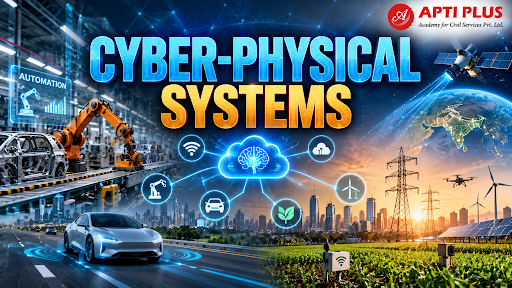
The Ministry of Science and Technology highlighted that Cyber-Physical Systems are anchoring India's technological translation across healthcare, mining, and autonomous mobility.
What are Cyber-Physical Systems (CPS)?
Cyber-Physical Systems (CPS) are engineered networks that integrate computational algorithms with physical processes to monitor and control real-world environments in real time.
-
Distinction from Internet of Things: IoT connects passive devices for data aggregation, whereas CPS actively controls and manipulates physical environments autonomously.
-
Three-Tier Functional Triad: Operates on a physical layer of sensors and actuators, a network layer for low-latency transmission, and a cognitive computational layer.
-
Backbone of Industry 4.0: Powers digital twins, smart automated assembly lines, and additive manufacturing across modern industrial factories.
Core Components
-
Sensors: Gather real-time data (like temperature, pressure, or movement) from the physical world.
-
Computation/Cyber Elements: Process and analyze the data using software, AI, or algorithms to make autonomous decisions.
-
Actuators: Take the computed instructions and execute physical actions or adjustments back on the environment.
-
Feedback Loop: Continuously sense, think, and act in a continuous closed loop.
National Mission on Interdisciplinary Cyber-Physical Systems (NM-ICPS)
It is a deep-tech initiative launched by the Department of Science and Technology (DST) in 2018, with a total financial outlay of ₹3,660 Crore.
Originally a five-year program, its active execution window has been extended up to December 2027 to complete its nationwide technology life cycle objectives.
Hub-and-Spoke Model: Operationalizes 25 Technology Innovation Hubs across premier research institutes under four distinct technology translation tracks.
Technology Translation Focus: Bridges laboratory academic research with commercial industrial scaling, supporting over 500 indigenous deep-tech startups.
Human Capital & Skill Building: Trains over 10,000 doctoral, postgraduate, and technical professionals in embedded systems, robotics, and cyber defense.

Strategic Applications of CPS
-
Healthcare Diagnostics & Robotic Surgery: Deploys AI-powered robotic surgical arms and wearable tele-ICU sensor patches for remote patient management.
-
Precision Agriculture & Water Stewardship: Utilizes autonomous drone swarms and soil moisture sensors to automate drip irrigation, slashing water consumption by 40%.
-
Deep Mining & Worker Safety: Operates unmanned robotic excavators and wireless toxic gas sensors to prevent fatal industrial collapses in underground mines.
-
Critical Infrastructure & Smart Grids: Coordinates real-time dynamic load balancing across renewable solar-wind grids to prevent systemic regional blackouts.
-
Autonomous Mobility & Drone Logistics: Integrates NavIC satellite signals with LiDAR and computer vision to navigate autonomous commercial freight drones.
-
Defense Robotics & Border Security: Deploys autonomous unmanned ground vehicles and perimeter sensor mesh along rugged Himalayan high-altitude borders.
Key Challenges in CPS Deployment
Hardware Import Dependency: India currently imports between 90% and 95% of its semiconductor chips, sensors, and actuators, predominantly from East Asian hubs like China, Taiwan, South Korea, and Japan.
Critical Operational Technology (OT) Vulnerabilities: Malicious ransomware and state-sponsored cyberattacks exploit legacy SCADA (Supervisory Control and Data Acquisition) systems in power grids and water networks.
Ultra-Low Latency Infrastructure Gaps: Autonomous vehicle fleets and robotic surgical units require edge computing networks that rural telecom towers cannot deliver.
Acute Scarcity of Interdisciplinary Talent: Engineering curricula remain strictly siloed, creating a severe shortage of engineers proficient across mechanical and computing domains.
-
According to Nasscom and India Skills Report, over half of higher education graduates lack the job-ready skills required by modern industries, particularly in technology and engineering.
Lack of Interoperability Standards: Incompatible communication protocols across proprietary equipment vendors obstruct seamless factory-floor system integration.
Ethical & Liability Ambiguities: Legal statutes fail to assign civil liability when autonomous AI algorithms cause physical workplace injuries or vehicular crashes.
Way Forward
Domestic Sensor Fabrication Under ISM: Extend India Semiconductor Mission (ISM) capital subsidies to establish dedicated fabrication units for MEMS sensors and actuators.
Mandate Zero-Trust Architecture for Critical OT: Direct power utilities and transport systems to implement National Critical Information Infrastructure Protection Centre guidelines.
Establish Multi-Institutional Regulatory Sandboxes: Authorize live testing environments for autonomous industrial drones and driverless vehicles in designated industrial corridors.
Revamp Cross-Disciplinary Engineering Curricula: All India Council for Technical Education (AICTE) must introduce integrated mechatronics, embedded systems, and cybernetics degrees across national technical universities.
Standardize National CPS Interoperability Protocols: Bureau of Indian Standards should formulate open-architecture guidelines for industrial robotics and smart-grid controllers.
Scale Public-Private Innovation Procurement: Direct central public sector enterprises (CPSEs) to allocate modernization budgets for procuring indigenous Technology Innovation Hub (TIH) startup technologies.
Learn from Successful Models
-
ARTPARK at IISc Bengaluru: Developed autonomous drones and AI-driven screening tools that conducted remote pulmonary health screenings in 500 villages.
-
C3iHub at IIT Kanpur: Built an indigenous cyber testbed that simulated attacks to patch zero-day vulnerabilities across 40 national power substations.
-
Germany's Industrie 4.0 Platform: Standardized cyber-physical production lines across Siemens and BMW, boosting national automotive manufacturing productivity by 25%.
-
Virtual Singapore Digital Twin (Global Urban CPS Model): Integrated city-wide IoT sensor feeds with 3D geospatial modeling to simulate emergency evacuations and urban heat management.
Conclusion
Harnessing Cyber-Physical Systems through robust domestic hardware fabrication, interdisciplinary skill building, and cyber-resilient infrastructure will cement India’s industrial competitiveness in the Fourth Industrial Revolution.
Source: PIB
|
PRACTICE QUESTION Q. Examine the critical infrastructure cybersecurity risks arising from the widespread convergence of operational technology and cyber-physical networks. (10 Marks, 150 Words) |