Why In News?
The Delimitation Bill, 2026 and the Constitution (131st Amendment) Bill, 2026 — proposing to expand the Lok Sabha from 543 to 850 seats using 2011 Census data — failed to secure the two-thirds majority needed in the Lok Sabha.
What is Delimitation?
Delimitation is the process of redrawing Lok Sabha and State Assembly constituency boundaries, redistributing seats among states based on Census data.
Ensures constituencies within each state have roughly equal population, upholding the "one vote, one value" principle.
The Constitution requires seats be allocated to states in proportion to their population, in principle recalculated after every census.
-
Article 82: Provides for readjustment of Lok Sabha seats and territorial constituencies after each Census, subject to constitutional provisions.
-
Article 170: Provides for composition and territorial division of State Legislative Assembly constituencies.
-
Article 327: Empowers Parliament to make laws relating to elections, including delimitation of constituencies.
Delimitation Commission: An independent body established to carry out the exercise; Delimitation Commissions have been constituted four times ( 1952, 1962, 1972 and 2002) since independence; its orders carry the force of law and cannot be challenged in any court.
Current Delimitation Debate
1971 Census-based seat allocation: Since the 42nd Amendment (1976), Lok Sabha seats have been frozen at 543, based strictly on 1971 Census figures, explicitly to avoid penalising states that controlled population growth.
2026 constitutional deadline: The 84th Amendment (2001) set the freeze to expire with the "first census taken after the year 2026" — a deadline now approaching, prompting the Centre to begin the next phase of electoral restructuring.
Proposed use of 2011 Census: The 2026 Delimitation Bill proposes decoupling delimitation from the post-2026 census, instead allowing the next delimitation to use 2011 Census data — bypassing the currently ongoing Census.
Possible change in state-wise representation: Under the proposed 850-seat model, allocation would shift toward faster-growing northern states like Uttar Pradesh, Bihar, Rajasthan, and Madhya Pradesh, altering the existing north-south seat balance.
Women's reservation and delimitation: The 106th Amendment's 33% women's reservation is legally tied to delimitation completion — but since the 2027 Census-based delimitation is unlikely to finish before the 2029 Lok Sabha elections, the 131st Amendment Bill seeks to decouple this timeline, using 2011 Census data to enable faster implementation of women's reservation.
Why are Southern States Concerned?
Lower population growth: States like Tamil Nadu, Kerala, Karnataka, Andhra Pradesh, and Telangana have recorded lower population growth compared to northern and northeastern states.
Perception of demographic penalty: Southern leaders frame the exercise as a "demographic penalty" — being disadvantaged in Parliament precisely because they succeeded in controlling population growth, unlike states with higher fertility rates.
Fiscal contribution versus political representation: Southern states point to their higher per-capita tax contribution and fiscal transfers to the Centre, arguing that reduced political representation would create a mismatch between fiscal contribution and political voice.
Government's Counter-Position
Proportional seat-share protection claim: Under the 50% increase model, the current 543 seats would rise to 816 (or 850 under the fuller proposal), with southern states' combined seats rising from 129 to 195 — keeping their overall Lok Sabha share nearly unchanged at around 24%.
Case Study: The Home Minister noted Kerala's 20 Lok Sabha seats (3.68% of 543) would rise to 30 seats, with its proportional share remaining at approximately 3.67% — i.e., numbers rise, but relative political weight is claimed to stay near-constant.
The government's position is that a uniform 50% increase across all states, rather than strict population-only reallocation, preserves each state's relative share even while redistributing seats to reflect updated population data.
|
Dimension |
Arguments in Favour of Delimitation |
Arguments Against Immediate Delimitation |
|
Democratic Equality |
Equal representation based on population: Restores the constitutional mandate where Lok Sabha seats are directly proportional to changing population sizes. |
Demographic penalty: Effectively punishes progressive states that successfully implemented national family planning goals. |
|
Voting Power |
One person, one vote, one value: Ensures every citizen's vote carries equal weight, correcting the current dilution of votes in high-population states. |
Impact on population control: Creates a harmful political disincentive for states to pursue future healthcare and development successes. |
|
Constituency Balance |
Correction of population imbalances: Fixes severe demographic disparities across states that have widened over five decades since the 1971 freeze. |
Regional political imbalance: Shifts national political weight heavily toward northern states, fundamentally altering coalition dynamics. |
|
Geographic Equity |
More equitable constituency sizes: Standardizes the number of voters per MP so northern voters do not have a weaker political voice than southern voters. |
North-South divide: Deepens geopolitical fractures across India regarding fiscal federalism, language representation, and development models. |
Challenges
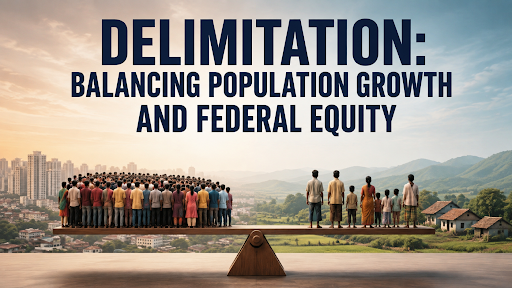
Representation vs Federal Equity
Population-based delimitation advances “one person, one vote”, but can penalise states that successfully controlled fertility.
North–South Demographic Divergence
Using the 2011 Census with unchanged 543 seats would have reduced Tamil Nadu from 39 to 32 and Kerala from 20 to 15, while UP rises from 80 to 89 and Bihar from 40 to 46.
Federal Incentive Problem
A purely population-based formula may create a “development penalty”, where states that achieved fertility reduction and better human-development outcomes experience declining parliamentary weight relative to high-growth states.
Equal Vote vs Equal State Voice
The government’s proposed 50% expansion model would increase Lok Sabha seats from 543 to 816, while Southern states' seats rise from 129 to 195, preserving their aggregate share at about 24%.
Rajya Sabha Imbalance
If Lok Sabha expands by 50% while Rajya Sabha's constitutional maximum remains 250, the Lok Sabha–Rajya Sabha ratio could move from about 2.2:1 to 3.3:1, strengthening the majoritarian chamber's relative weight.
Women’s Representation Linkage
The failed 131st Constitutional Amendment Bill, 2026 linked delimitation with operationalising 33% women's reservation, making a federal representation dispute a gender-representation issue.
Boundary-Level Inequality
Delimitation is not merely about seat numbers; constituencies must also have broadly comparable populations, while preserving geographical compactness, administrative boundaries and community interests.
Way Forward
Adopt a Balanced Representation Formula
Combine population with federal stability, rather than allowing population alone to determine political weight; the proposed proportional 50% expansion offers one possible model.
Create an Independent Expert Mechanism
A future Delimitation Commission should include constitutional experts, demographers and election specialists, with transparent publication of population calculations, seat-allocation formulas and draft maps.
Institutionalise Federal Consultation
The 2025 Joint Action Committee of Southern States demanded another 25-year freeze, showing the need for structured Centre–State consultation before finalising the formula.
Reward Demographic Performance
Develop a demographic-performance component alongside population so that fertility reduction, female education and human-development gains do not become politically disincentivised.
Use Transparent GIS-Based Delimitation
Modern GIS and population-density mapping can improve constituency equality and reduce arbitrary boundary-making; computational approaches can optimize population balance while maintaining geographical constraints.
Separate Women’s Reservation from Federal Bargaining
Future legislation should avoid making women's representation dependent on unresolved federal disputes, so that the constitutional objective of gender representation does not become hostage to the delimitation controversy.
Build a Long-Term Formula
Instead of renegotiating delimitation every generation, Parliament could establish a predictable review mechanism combining population, federal equity and demographic performance, reducing uncertainty for both high-growth and low-growth states.
Conclusion
Delimitation forces India to choose between "one person, one vote" and protecting states that succeeded at population control — and how that choice is made will shape Centre-State trust far beyond just Parliament's seat count.
Source: THEHINDU
|
PRACTICE QUESTION Q. Consider the following statements regarding delimitation in India:
Which of the statements given above is/are correct? (a) 1 and 2 only (b) 2 and 3 only (c) 1, 2 and 3 (d) 1 only Answer: (a) Explanation: Statement 1 is correct: The 42nd Constitutional Amendment Act, 1976 froze the total allocation of seats in the Lok Sabha and the State Legislative Assemblies until the year 2000, using the population figures of the 1971 Census as the baseline. This policy was introduced to prevent states with effective family planning measures from losing political representation. Statement 2 is correct: The 84th Constitutional Amendment Act, 2001 extended this freeze on the total number of seats for another 25 years. It specified that no readjustments to seat numbers would occur until the first census taken after the year 2026 Statement 3 is incorrect: According to Articles 82 and 329 of the Constitution of India, the orders issued by the Delimitation Commission have the absolute force of law once published in the Gazette of India. These orders cannot be challenged or called into question before any court of law, including the Supreme Court. |