Why In News?
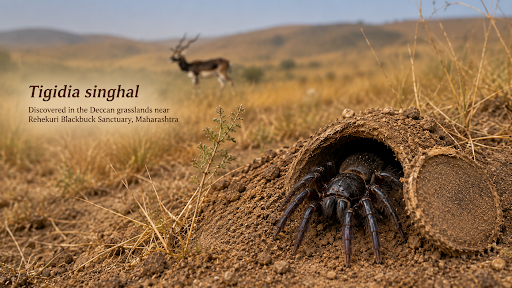
Researchers recently discovered a new species of trapdoor spider, *Tigidia singhal*, in the semi-arid grasslands of Ahilyanagar, Maharashtra.
About Tigidia singhal
It belongs to the genus Tigidia and the family Barychelidae (brush-footed spiders).
-
This family falls under the infraorder Mygalomorphae, an ancient lineage of spiders that also includes tarantulas and funnel-web spiders.
The discovered female specimen is about 15 millimetres long, features black legs covered in greyish bristle-like hairs, and has a lighter abdomen with chevron-shaped markings.
Behaviour & Habitat: Trapdoor spiders are long-living and sedentary, spending almost their entire lives in burrows and rarely leaving except to find a mate.
-
They build silk-lined burrows that are 4 to 10 centimetres deep with two openings.
Trapdoor Mechanism: They are named for their unique ability to construct camouflaged "doors" made of silk, soil, moss, and leaves over their burrows.
-
They hunt by quickly opening the door to ambush passing insects or arthropods.
-
This trapdoor also protects the spider from predators and prevents desiccation (drying out) in hot climates.
Geographical Distribution
Spiders of the Tigidia genus known to exist in the tropical evergreen and deciduous forests of peninsular India (such as the Western and Eastern Ghats).
Spiders of the Tigidia genus are found exclusively in India, Madagascar, and Mauritius.
With the discovery of T. singhal, the total number of recognized Tigidia species in India has increased to eight.
Ecological Importance
Trapdoor spiders are highly sensitive to habitat disturbances. Their presence is a strong indicator of a healthy ecosystem with rich soil biodiversity.
Their burrowing behaviour naturally aerates the soil, helps maintain soil structure, and provides microhabitats for other small organisms.
Source: MONGABAY
|
PRACTICE QUESTION Q. Consider the following statements regarding Tigidia singhal, recently seen in the news: 1. It is a critically endangered bird species endemic to the Western Ghats. 2. It belongs to an ancient group of spiders that show Gondwanan evolutionary links. 3. It builds silk-lined burrows in the semi-arid grasslands of the Deccan Plateau. Which of the statements given above is/are correct? A) 1 and 2 only B) 2 and 3 only C) 1 and 3 only D) 1, 2, and 3 Answer: B Explanation Statement 1 is Incorrect: Tigidia singhal is not a bird; it is a newly described species of trapdoor spider. Furthermore, it is not endemic to the Western Ghats' forests but was discovered in the semi-arid grasslands of the Deccan Plateau in Maharashtra. Statement 2 is Correct: The spider belongs to the infraorder Mygalomorphae, an ancient group of spiders. The genus Tigidia exhibits a Gondwanan distribution, being found only in India, Madagascar, and Mauritius, which indicates its evolutionary links to the ancient supercontinent. Statement 3 is Correct: This species constructs silk-lined burrows under rocks in the semi-arid grasslands of the Deccan Plateau (specifically recorded in the Karjat tehsil of Maharashtra). This behavior protects it from desiccation in the harsh, open environment. |