Why In News?
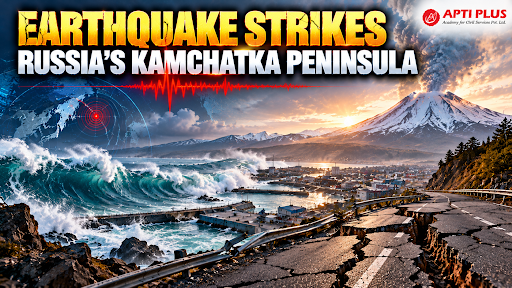
A powerful magnitude 7.0 earthquake struck Kamchatka Peninsula at an intermediate focal depth of approximately 150 kilometres.
About Kamchatka Peninsula
The Kamchatka Peninsula is a 1,250 km-long landmass in the Russian Far East, covering an area of approximately 270,000 sq km.
-
Surrounding Water Bodies: Sea of Okhotsk to the west and the Bering Sea and Pacific Ocean to the east.
In 1996, the Volcanoes of Kamchatka group was inscribed as a UNESCO World Heritage Site, comprising six distinct nature reserves and parks spanning over 3.8 million hectares.
-
Geothermal Features: Home to Eurasia’s famous Valley of Geysers within the Kronotsky Biosphere Reserve, containing major geyser fields and hot springs.
-
River Basins: The central valley between these ranges is drained by the Kamchatka River, which flows north and east into the Pacific Ocean. Other major rivers include the Bistraya River and Tigil River.
-
Climatic Classification: Under the Köppen climate classification, Kamchatka primarily features a Subarctic Climate (Dfc), transitioning to a Polar Climate (ET) on high-altitude peaks and an Ice Cap Climate (EF) on major glaciers.
-
Ocean Currents: Cold Arctic winds combined with the cold Oyashio Current keep the peninsula snow-covered from October to late May.
-
Flora & Forest Systems: Vegetation zones range from lowland Kamchatka Taiga (Yeddo spruce, Dahurian larch, Asian white birch) to subalpine meadows, tundra, and muskeg at higher elevations.
-
Terrestrial Fauna:
-
Kamchatka Brown Bear: Holds the highest population density globally (3 to 4 bears per 100 sq km in the Kronotsky Nature Reserve).
-
Other mammals include the Chukotka moose (largest in Eurasia), Kamchatka snow sheep, sable, wolverine, and tundra wolf.
-
Avifauna: Critical breeding habitat for Steller’s Sea Eagle (one of the world's largest raptors), Golden Eagle, and Gyrfalcon.
-
Salmonid Diversity: Produces approximately 20% of all Pacific salmon across six anadromous species (sockeye, chinook, coho, chum, pink, and seema). Kurile Lake in southern Kamchatka represents Eurasia’s largest spawning ground for sockeye salmon.

Source: DDINDIA
|
PRACTICE QUESTION Q. Which of the following oceanic trenches is associated with the subduction zone responsible for the intense seismicity and volcanism of the Kamchatka Peninsula? (a) Mariana Trench (b) Kuril-Kamchatka Trench (c) Sunda Trench (d) Tonga Trench Answer: (b) Explanation: The Kuril-Kamchatka Trench is an active subduction trench in the northwest Pacific Ocean running parallel to the Kamchatka Peninsula and the Kuril Islands, where the Pacific Plate subducts beneath the Okhotsk Plate. |