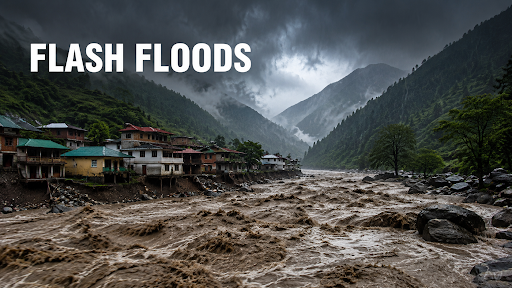
Why In News?
Torrential rains, cloudbursts, and highly destructive flash floods batter the twin border districts of Poonch and Rajouri in Jammu and Kashmir.
About Flash Floods
A flash flood is a sudden, rapid, and deadly surge of water that occurs within hours—often within minutes—of intense rainfall.
Unlike slow-rising river floods, flash floods can occur with little to no warning, transforming dry riverbeds, mountain canyons, and city streets into violent, fast-moving torrents capable of sweeping away cars and destroying infrastructure.
Key Causes
Flash floods occur when the ground cannot absorb water as fast as it falls. The primary triggers include:
-
Intense Rainfall: Heavy rain from severe thunderstorms, hurricanes, or tropical storms.
-
Topography & Soil: Steep terrain, rocky surfaces, and hydrophobic (water-repellant) soils accelerate runoff into low-lying areas.
-
Urban Environments: Concrete, asphalt, and inadequate drainage systems in cities prevent water from soaking into the ground.
-
Structural Failures: The sudden breach of a man-made dam, levee, or natural ice/debris dam.
Why Flash Floods are Common in Himalayan Regions?
Steep Mountain Slopes: The immature, rugged topography and high relative relief of the Himalayas physically accelerate the descent of rainwater, preventing ground absorption and violently funneling water into narrow valleys to cause instant inundation.
Intense Rainfall and Cloudbursts: The region frequently experiences cloudbursts, which dump localized, ultra-intense rainfall exceeding 100 mm per hour over a compact 20-30 sq. km geographical region via rapid orographic lift.
Fragile Geological Conditions: The Himalayas remain a highly tectonically active zone composed of weak, soft sedimentary and fractured igneous rocks; the Geological Survey of India (GSI) notes that approximately 0.42 million sq. km (nearly 12.6% of India's landmass) naturally stays highly prone to landslides.
Climate Change: A warming atmosphere structurally holds more moisture—nearly 7% more capacity for every 1°C rise in temperature—leading to much more powerful convective storms; a study published in the journal Nature explicitly links climate change shifts to a 20–50% rise in extreme rainfall events across specific Indian regions since the 1950s.
Accelerated Glacial Melting: Rising global temperatures cause rapid glacial retreat and create dangerous moraine-dammed lakes; for example, the South Lhonak glacier retreated roughly 400 meters between 2008 and 2019, drastically increasing the threat of catastrophic Glacial Lake Outburst Floods (GLOFs).
Major Impacts of Flash Floods
Loss of Human Lives: Extreme speed of the water leaves communities absolutely no time to escape, routinely resulting in drowning and blunt-force fatalities, as seen in the July 2026 Poonch-Rajouri floods which killed at least 11 individuals.
Infrastructure Destruction: Powerful floods wash away heavily constructed concrete bridges, highways, and municipal structures; in Jammu and Kashmir alone, the 2026 floods damaged over 100 houses and 24 schools
Disruption of Tourism and Pilgrimages: Climate-induced floods economically paralyze regions dependent on religious tourism; the Vaishno Devi and Amarnath shrines drew over 9.9 million pilgrims in 2024, and weather-related suspensions brutally halt this micro-economy, echoing the devastating 2013 Kedarnath floods which cost Uttarakhand's tourism sector roughly $195 million.
Agricultural Devastation: Surging waters deposit thick mud, boulders, and infertile silt directly over arable farmlands, instantly annihilating standing crops and drowning livestock, which wipes out the fundamental livelihoods of local villagers.
Triggering of Landslides: Saturated steep slopes quickly give way, unleashing massive landslides and debris flows—such as the tragic 2025 Dharali village disaster in Uttarakhand—which multiply the destructive power of floods and completely wipe out habitations.
Community Displacement: Destroyed housing and disabled basic civic amenities force long-term displacement, permanently degrading local ecosystems and triggering immense mental health crises where Post-Traumatic Stress Disorder (PTSD) rates hit 30-40% among flood-displaced survivors.
Challenges for Disaster Management
Limited Lead Time: Because flash floods strike within minutes to just a few hours after a rainfall event, authorities lack the time required to safely mobilize massive community evacuations.
Treacherous Terrain: Steep, slippery, and rugged mountain geography impedes the movement of specialized rescue units, while mud-blocked highways and bad weather routinely prevent rescue helicopters from flying.
Communication Failures: Landslides and floods abruptly snap essential fiber-optic cables and topple mobile towers, creating severe communication blackouts that prevent trapped victims from calling for help and stop command centers from coordinating swift ground responses.
Infrastructure Exposure: Decades of poorly planned urbanization encroach upon natural riverbeds and vulnerable floodplains, exposing critical assets to direct flood impacts and creating dangerous bottlenecks that elevate flood peaks by 1.8 to 8 times.
Forecasting Limitations: Meteorological agencies struggle to pinpoint exact cloudburst zones because accurate forecasting requires a dense network of advanced weather instruments, which remains economically and logistically unfeasible for the vast, rugged Himalayan terrain.

Measures to Reduce Flash Flood Risk
Strengthen Early Warning Systems: Deploying real-time weather monitoring systems and warnings via mobile alerts, loud sirens, and community radio channels provides communities the vital minutes needed to evacuate.
Advanced Weather Forecasting: Implementing Synthetic-Aperture Radar (SAR) imagery and Light Detection and Ranging (LiDAR) technologies constructs hyper-accurate Digital Elevation Models (DEMs), empowering authorities to pinpoint precise flood-prone zones and track dangerous glacial lake formations.
Hazard Zonation and Land-Use Planning: Enforcing strict floodplain zoning regulations prohibits unauthorized concrete construction and infrastructure encroachment along sensitive riverbanks and high-risk mountain slopes, thereby preserving natural water flow capacity.
Climate-Resilient Infrastructure: Integrating the Sponge City concept—using permeable pavements, robust stormwater drains, and urban green roofs—allows rainwater to organically percolate into the ground.
Community-Based Preparedness: Empowering Panchayati Raj Institutions (PRIs) and local volunteers through mock drills and emergency response training builds the most effective first line of defense.
Inter-Agency Coordination: Fostering data sharing and operational synergy between meteorological agencies (IMD), river authorities (CWC), and disaster forces (NDRF/SDRF) ensures synchronized emergency action plans and real-time reservoir management.
Afforestation and Catchment Management: Planting deep-rooted native tree species stabilizes fragile, highly erodible mountain soil, which powerfully decelerates surface water runoff and substantially minimizes landslide risks.
Conclusion
Addressing the escalating, deadly threat of flash floods requires an urgent, uncompromising paradigm shift from reactive relief to proactive, climate-resilient, and community-integrated multi-hazard disaster preparedness.
Source: THEHINDU
|
PRACTICE QUESTION Q. "The increasing frequency of flash floods in Himalayan regions highlights the need for a shift from disaster response to disaster risk reduction." Discuss. 150 words |