Why In News?
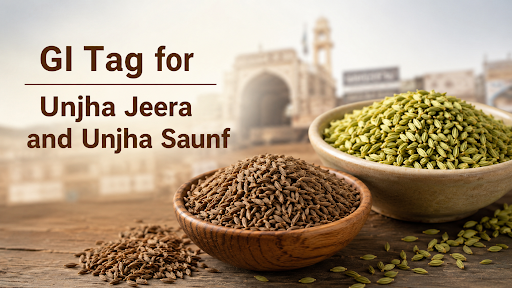
The Geographical Indications Registry grants Geographical Indication (GI) tags to Unjha Jeera (cumin) and Unjha Saunf (fennel) under the registration of the Unjha Agriculture Produce Market Committee (APMC) in Gujarat.
What is a Geographical Indication (GI) Tag?
GI is an Intellectual Property Right (IPR) that identifies a product as originating from a specific geographical region, where its quality, reputation or other characteristics are essentially attributable to that place of origin.
GI protection is available for:
-
Agricultural products
-
Natural products
-
Manufactured goods, including handicrafts and textiles, provided at least one stage of production, processing or preparation occurs in the specified region.
Legal Framework in India
-
Governed by the Geographical Indications of Goods (Registration and Protection) Act, 1999.
-
Administered by the Geographical Indications Registry, Chennai, under the Department for Promotion of Industry and Internal Trade (DPIIT), Ministry of Commerce & Industry.
-
The law was enacted to comply with the WTO's TRIPS Agreement.
Key Features
-
Validity: A GI registration is valid for 10 years and can be renewed indefinitely for further 10-year periods.
-
Authorised users alone can legally use the registered GI name.
-
GI is a collective right linked to a region and cannot be sold or assigned like a trademark.
Benefits of a GI Tag
-
Protects products from counterfeiting and misuse.
-
Preserves traditional knowledge and cultural heritage.
-
Enhances market value, exports and rural livelihoods.
-
Promotes tourism and regional branding.
-
Ensures authenticity and quality assurance for consumers.
Examples of Indian GI Products
-
Darjeeling Tea (India's first GI-tagged product)

What are Unjha Jeera and Unjha Saunf?
About Unjha Jeera (Cumin)
-
Derived from the seeds of Cuminum cyminum.
-
Renowned for its strong aroma, high volatile oil content, uniform seed size and rich flavour.
-
Cultivated mainly in Mehsana district, North Gujarat, where the dry climate and sandy-loam soils favour premium-quality cumin.
-
Unjha is India's largest cumin trading and price-discovery centre.
About Unjha Saunf (Fennel/Variyali)
-
Derived from the seeds of Foeniculum vulgare.
-
Known for its sweet taste, green colour, pleasant aroma and high essential oil content.
-
Widely used as:
-
A culinary spice
-
A mouth freshener
-
An ingredient in Ayurvedic and traditional medicines
-
North Gujarat's agro-climatic conditions contribute to its distinctive quality.
Why did they receive the GI Tag?
The GI registration recognises that these spices possess qualities and a reputation linked to the Unjha region, including:
-
Distinct aroma and flavour
-
High essential oil content
-
Established reputation in domestic and international trade
-
Traditional cultivation and post-harvest practices
-
Historical association with Unjha's spice market.
Current Issue
Following the grant of GI tags to Unjha Jeera and Unjha Saunf (Fennel), farmer organisations in Rajasthan have opposed the decision, arguing that Rajasthan accounts for a substantial share of India's cumin and fennel cultivation, whereas Unjha is primarily a trading and marketing hub rather than the principal cultivation region.
Source: INDIANEXPRESS
|
PRACTICE QUESTION Q. Which of the following international agreements specifically introduced the system of Appellation of Origin which required goods to have characteristics related to their geographical environment? A) Paris Convention B) Lisbon Agreement C) Madrid Agreement D) Berne Convention Answer: B Explanation: The correct answer is B) Lisbon Agreement. Concluded in 1958, the Lisbon Agreement for the Protection of Appellations of Origin and their International Registration specifically defined and introduced an international system for protecting appellations of origin linked to a geographical environment. |