Why In News?
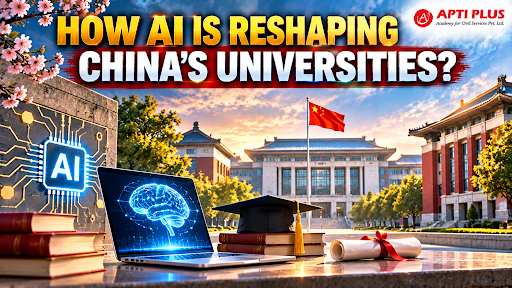
China unveiled a 10-year plan to restructure its universities into research, application, and skills-focused categories in response to AI disruption, economic slowing, and high youth unemployment.
What Is Driving China's Education Overhaul?
Youth Unemployment
-
One In Five Unemployed: The jobless rate for 16–24-year-olds (excluding students) was 18.9% in August 2026, up from 17.9% in July, according to China's National Bureau of Statistics.
Three Main Drivers
-
Skills Mismatch: Graduates' skills do not match what employers need.
-
Economic Slowdown: Weak sentiment and a prolonged real estate slump have led companies to cut hiring.
-
AI Disruption: AI, already widely used across Chinese industry, is rapidly changing which skills the market values.
Too Many Similar Graduates
-
Duplication: Many universities offer similar programmes and produce too many graduates of the same kind.
What Does The Reform Plan Involve?
Three Categories Of Universities
China's more than 3,000 higher education institutions will each be placed in one of three categories:
|
Category |
Focus |
|
Research universities |
"Driving major breakthroughs in science and technology" |
|
Application-oriented institutions |
Practice-oriented talent, industry–education integration, technological innovation and research commercialisation |
|
Skills development institutions |
Training master craftsmen and highly skilled professionals, with a focus on employment |
Aim: Experts say the goal is not to "label" universities but to create a rational division of functions.
Timeline
-
2026–2030: Implementation during the 15th Five-Year Plan.
-
By 2035: Completion by the end of the 16th Five-Year Plan, aligned with the 2024 master plan to make China a "leading nation" in education by 2035.
Reshuffling Of Degree Programmes
-
Large-Scale Change: In the four years up to 2025, about 30% of degree programmes were reshuffled, with 10,200 added and 12,200 cancelled.
-
What Was Added: AI, semiconductors, robotics and advanced manufacturing.
-
What Was Cut: Many humanities programmes and fields hit by AI, such as interpretation, along with parts of accounting and computing.
-
Example: The Communication University of China in Beijing suspended more than a dozen tracks, including translation, sociology and photography, scaled back its large journalism programme, and introduced a new programme in intelligent audiovisual engineering.
What India Can Learn From China Initiatives?
Similar Challenges
-
Graduate Unemployment: The ILO–IHD India Employment Report 2024 found that unemployment among young graduates was about 29.1%, far higher than among those with little education.
-
Employability Gap: The India Skills Report 2025 estimated that only about 55% of Indian graduates are employable.
-
Youth Unemployment: The PLFS shows youth (15–29) unemployment at about 10%.
India's Higher Education System
-
Large System: India had over 1,100 universities and about 45,000 colleges, with about 4.3 crore students, according to AISHE 2021–22.
-
Gross Enrolment Ratio: India's Gross enrolment ratio (GER) in higher education was about 28% in 2021–22.
A Parallel In NEP 2020
-
Similar Idea: India's National Education Policy, 2020 also envisages different types of institutions: Research-intensive Universities, Teaching-intensive Universities and Autonomous degree-granting Colleges.
-
GER Goal: NEP aims for a 50% GER in higher education by 2035.
AI's Impact On Jobs
-
Global Shift: The World Economic Forum's Future of Jobs Report 2025 projects that about 39% of workers' core skills will change by 2030.
What Are The Key Challenges For India?
Skills Mismatch Between Education And Jobs
-
Outdated Curricula: Many courses do not match industry needs, leaving graduates unemployable.
-
Low Employability: Only about 55% of Indian graduates are considered employable.
Rapid AI Disruption
-
Changing Job Market: AI is automating tasks in fields like translation, accounting and routine coding faster than education can adapt.
-
Uncertain Future Skills: It is hard to predict which skills will remain valuable.
Risk Of Neglecting Humanities
-
Loss Of Critical Thinking: Cutting humanities and social sciences may weaken critical thinking, ethics and creativity, which are needed even more in an AI age.
-
Short-Termism: Shaping education only around current job demand may fail future needs.
Rigid Categorisation
-
Labelling Effect: Classifying institutions may create hierarchies, with lower prestige and funding for skills-focused institutions.
-
Limited Mobility: Students may find it hard to move between research and skills tracks.
Weak Industry–Academia Links
-
Limited Internships: Few students get meaningful industry exposure.
-
Example: India's PM Internship Scheme, announced in the Union Budget 2024–25, aims to offer internships in top companies to 1 crore youth over five years, reflecting the gap in practical exposure.
Unequal Quality And Funding
-
Uneven Institutions: Quality varies sharply between elite and other institutions.
-
Low Research Spending: India's R&D spending is only about 0.6–0.7% of GDP, limiting research universities.
Economic Slowdown And Job Creation
-
Not Just An Education Problem: Even well-trained graduates struggle if the economy does not create enough good jobs, as China's experience shows.
What Is The Way Forward For India?
Implement NEP 2020's Differentiated Model
-
Clear Missions: Allow institutions to specialise as research-intensive, teaching-intensive or skill-focused, with equal respect and funding for each.
-
Learn From Global Models: Differentiated systems can work well.
-
Example: The California Master Plan for Higher Education (1960) created three tiers: research universities, state universities and community colleges, with easy transfer between them, offering both excellence and access.
Strengthen Applied And Vocational Education
-
Applied Sciences Universities: Build institutions focused on practical, industry-linked learning.
-
Example: Germany's Fachhochschulen (universities of applied sciences) and its dual system combine classroom learning with on-the-job training, keeping youth unemployment low.
-
Integrate Vocational Education: Implement NEP's goal of exposing at least 50% of learners to vocational education by 2025.
Integrate AI Into Education
-
AI Skills For All: Teach AI literacy across disciplines, not just in technical courses.
-
AI Centres Of Excellence: Use the Centre of Excellence in AI for Education, announced in the Union Budget 2025–26, and the IndiaAI Mission.
Protect Humanities And Interdisciplinary Learning
-
Balanced Education: Keep humanities and social sciences, while blending them with technology.
-
Multidisciplinary Universities: Follow NEP's vision of multidisciplinary institutions where students combine subjects such as AI with ethics or economics.
Deepen Industry–Academia Partnerships
-
Co-Designed Courses: Involve industry in designing curricula and offering internships.
-
Apprenticeships: Expand the National Apprenticeship Training Scheme and the PM Internship Scheme.
Promote Lifelong Learning
-
Continuous Reskilling: Enable workers to update their skills throughout their careers.
-
Example: Singapore's SkillsFuture programme, launched in 2015, gives citizens credits to take approved courses throughout their lives, helping workers adapt to technological change.
Focus On Job Creation
-
Labour-Intensive Growth: Combine education reform with policies that create jobs in manufacturing, services and new sectors.
-
Better Data: Use PLFS and tracer studies to track graduate outcomes and guide course planning.
Conclusion
China’s university reforms reflect how AI and economic slowing push education systems to adapt. Facing similar youth unemployment and skill gaps, India can draw on its NEP 2020 framework to expand applied education, embed AI, preserve humanities, strengthen industry ties, and generate quality jobs.
Source: THEHINDU
|
PRACTICE QUESTION Q. How is artificial intelligence changing the relationship between higher education and employment? Discuss with reference to China's university reforms. (10 Marks, 150 Words) |