Why In News?
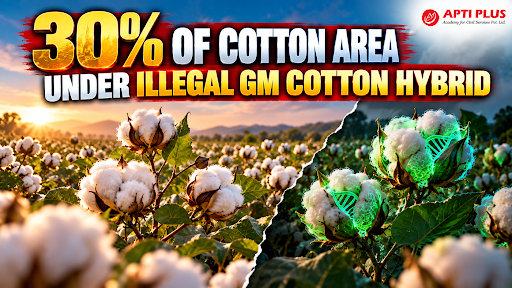
Study by the South Asia Biotechnology Centre (SABC) revealed that unapproved Herbicide-Tolerant Bt (HTBt) cotton covers 24–30% of India's total cotton area during Kharif 2025-26, fueling a Rs 1,500-crore black market for illicit seeds.
What Is HTBt Cotton?
HTBt cotton (Herbicide-Tolerant Bt cotton) is a genetically modified cotton hybrid that combines built-in insect resistance with cellular tolerance to chemical weedkillers.
Key Features
Insect-Resistant Bt Base: Standard Bt cotton engineered in India incorporates genes (cry1Ac and cry2Ab) from the soil bacterium Bacillus thuringiensis to produce proteins toxic to bollworm pests.
Herbicide-Tolerance Trait (cp4-epsps): HTBt cotton incorporates an alien transgene, cp4-epsps (sourced from Agrobacterium tumefaciens), which renders the plant tolerant to glyphosate, a broad-spectrum herbicide.
Over-the-Top Weed Control: Because glyphosate normally kills crops and weeds indiscriminately, conventional cotton cannot survive direct spraying.
-
HTBt cotton allows farmers to apply glyphosate directly over standing crops, destroying surrounding weeds while leaving the cotton plant unharmed.
Next-Generation Pest Resistance (Vip3A): Many illegal HTBt seed hybrids circulating in India also incorporate the unapproved Vip3A transgene.
-
This trait controls a broader spectrum of larvae and protects crops against pink bollworm strains that have developed resistance to approved Bollgard I and Bollgard II seeds.
Regulatory Status in India
HTBt cotton remains unapproved for commercial cultivation by the Genetic Engineering Appraisal Committee (GEAC) under the Environment (Protection) Act, 1986.
Despite the prohibition, field investigations reveal that unauthorized HTBt hybrids cover 24–30% (26.2 to 29 lakh hectares) of India's total cotton area, driven primarily by acute farm labor shortages and high manual weeding expenses.
Parameter |
Approved Bt Cotton (Bollgard II) |
Unapproved HTBt Cotton (BG-III / HT Trait) |
|
Gene Profile |
Uses cry1Ac and cry2Ab genes from Bacillus thuringiensis to control bollworms. |
Uses cp4-epsps for glyphosate tolerance and may contain Vip3A for wider pest resistance. |
|
Regulatory Status |
Evaluated and approved by the Genetic Engineering Appraisal Committee (GEAC). |
Remains unauthorised under the applicable GMO regulatory framework. |
|
Weed Management |
Does not tolerate glyphosate, increasing dependence on manual or alternative weed control. |
Allows over-the-top glyphosate spraying, sharply reducing reported weed-control costs. |
|
Legal Protection |
Operates through the formal seed regulatory system with quality-control mechanisms. |
Often sold through an illegal supply chain, leaving farmers without normal seed-quality guarantees and remedies. |
Why Are Farmers Turning to Unapproved HTBt Cotton?
-
Lower Weed-Control Cost: Labour shortages have pushed manual weeding expenses to around ₹12,000–15,000 per acre. In comparison, 2–3 glyphosate applications on HTBt cotton may cost only ₹750–850 per acre.
-
Declining Bt Effectiveness: Increasing pink bollworm resistance has reduced the effectiveness of approved Bollgard II hybrids. In some northern cotton-growing areas, yield losses have reportedly reached up to 90%, encouraging farmers to seek newer unapproved traits.
-
Higher Reported Returns: Some field studies found illegal F1 hybrids producing around 1,148 kg/acre, compared with 653 kg/acre for legal non-Bt hybrids. Low-cost F2 seeds have also attracted farmers because of their lower cultivation cost.
What Problems Does Unregulated HTBt Cultivation Create?
-
Ecological and Resistance Risks: Unregulated F2 hybrids may show inconsistent expression of cry and cp4-epsps traits, potentially accelerating pest resistance and increasing the risk of glyphosate-resistant weeds.
-
Weak Biosafety Oversight: Unapproved cultivation bypasses formal assessment of possible effects on soil microorganisms, non-target organisms and food-chain safety.
-
Limited Farmer Protection: Farmers purchasing seeds without proper bills or documentation may find it difficult to seek remedies under the Seeds Act, 1966 and Consumer Protection Act, 2019.
-
Contamination of Formal Supply Chains: Agriculture department testing has reportedly detected CP4-EPSPS transgenes in commercial seed lots, indicating that unauthorised traits can enter parts of the formal seed network.
-
Centre-State Enforcement Gap: The Union government handles environmental and GMO approval through institutions such as GEAC, while agriculture and field-level enforcement largely involve the States. This division can create coordination and enforcement challenges.
What Policy Measures Can Address the HTBt Cotton Problem?
-
Time-Bound Biosafety Assessment: The GEAC should establish a transparent and time-bound process to assess traits such as cp4-epsps and Vip3A, based on scientific biosafety standards.
-
Strengthen Seed Surveillance: Authorities can introduce rapid molecular testing, ELISA and lateral-flow tests at seed processing units and local testing centres to identify unauthorised GM traits early.
-
Reduce the Economic Incentive for Illegal Seeds: Public support for certified seeds, integrated pest management, mechanical weeders and efficient weed-control methods can reduce farmers' dependence on illegal HTBt varieties.
-
Improve Technology Access: Policy should balance intellectual property protection with affordable access to agricultural technologies, including appropriate licensing or public intervention where necessary.
-
Support Cotton Productivity: The Mission for Cotton Productivity (Kapas Kanti), with an allocation of ₹5,659.22 crore for 2026-27 to 2030-31, focuses on improving cotton productivity through measures such as high-density planting, certified seeds and integrated pest management.
Conclusion
India must bridge the widening gap between rigid regulatory timelines and field-level agrarian realities by establishing a transparent, time-bound biosafety evaluation framework while strictly prosecuting illicit seed supply networks under the Environment (Protection) Act, 1986.
Source: INDIANEXPRESS
|
PRACTICE QUESTION Q. With reference to agricultural biotechnology in India, the term 'Vip3A' recently seen in the news refers to: (a) A bio-fertilizer developed by ICAR for drought resistance in coarse cereals. (b) An unapproved insect-resistance gene derived from Bacillus thuringiensis targeting a broad spectrum of bollworm larvae. (c) A gene editing protocol exempted from biosafety regulation under Site-Directed Nuclease (SDN-1) guidelines. (d) An indigenous plant growth regulator promoted under the Mission for Cotton Productivity. Answer: (b) Explanation: Vip3A is a next-generation insect-resistance gene derived from Bacillus thuringiensis that controls a broader spectrum of bollworms, including pink bollworm. It is currently unapproved for commercial cultivation in India. |