Why In News?
The Kerala Health Department has confirmed nine cases of Shigella infection in Malappuram district and stepped up preventive measures.
What Is Shigellosis?
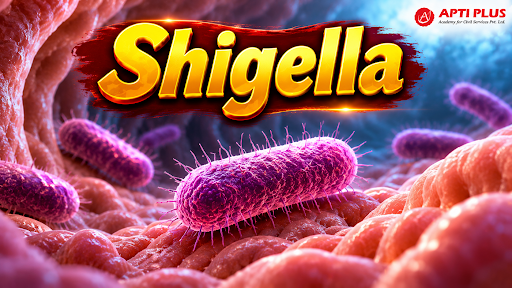
Shigellosis is a highly contagious bacterial intestinal infection caused by a group of Shigella bacteria (Shigella sonnei, S. flexneri, S. boydii, and S. dysenteriae).
-
Causative Agent: Gram-negative Shigella bacteria. Humans are the sole natural reservoir.
-
Transmission:
-
Fecal-oral route (ingesting microscopic amounts of bacteria from unwashed hands, contaminated food, or water).
-
Direct person-to-person contact or sexual contact.
-
High infectivity: Swallowing just 10 to 100 bacteria can cause an infection.
-
Incubation Period: Typically 1 to 4 days.
-
Common Symptoms:
-
Watery or bloody diarrhea (often containing mucus or pus, termed bacillary dysentery).
-
Severe stomach cramps and abdominal pain.
-
Fever and vomiting.
-
Tenesmus (a persistent, painful urge to pass stool even when the bowels are empty).
-
High-Risk Groups: Children under the age of 5 (most affected globally), malnourished individuals, and immunocompromised persons. Outbreaks are closely tied to poor sanitation, crowded living conditions, and unsafe drinking water.
-
Treatment & Management:
-
Most mild cases are self-limiting and resolve with supportive care, rest, and Oral Rehydration Solution (ORS).
-
Antibiotics are reserved for severe or invasive cases, though multi-drug resistant (MDR) strains are an emerging clinical concern.
-
No approved vaccine is currently available commercially.
-
Prevention: Frequent handwashing with soap, safe drinking water (boiling), proper sewage disposal, and food safety standards.
Source: THEHINDU
|
PRACTICE QUESTION Q. Consider the following statements about shigellosis: 1. It is caused by bacteria. 2. It spreads mainly through the faecal–oral route. 3. A licensed Shigella vaccine is part of India's Universal Immunisation Programme. How many of the statements given above are correct? (a) Only one (b) Only two (c) All three (d) None Answer: (b) Explanation: Statement 1 is correct: Shigellosis is a highly contagious intestinal infection caused by a group of bacteria called Shigella. Statement 2 is correct: The infection spreads mainly through the faecal–oral route. This occurs when a person accidentally ingests food, water, or particles contaminated with the stool of an infected individual. Statement 3 is incorrect: Globally, there is no widely licensed Shigella vaccine currently available, and it is not part of India's Universal Immunisation Programme (UIP). |