Why In News?
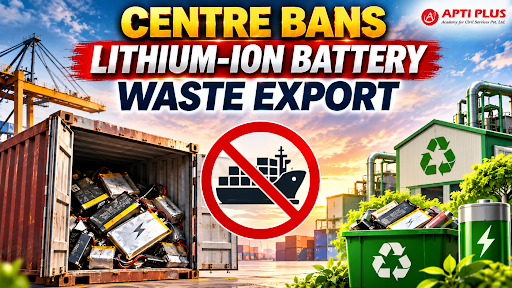
The Directorate General of Foreign Trade (DGFT) changed the export policy for lithium-ion battery black mass under ITC(HS) Code 85491400 from "Free" to "Prohibited", with immediate effect.
Highlights of The Notification
|
Feature |
Details |
|
Issued by |
DGFT, Department of Commerce |
|
Item |
"Lithium-Ion Battery Black Mass" |
|
Tariff line |
ITC(HS) 85491400 |
|
Policy change |
Free → Prohibited |
|
Scope |
Unsorted spent Li-ion battery waste and scrap not containing lead, cadmium or mercury |
|
Linked scheme |
Complements the ₹1,500 crore Critical Mineral Recycling Incentive Scheme |
- Earlier Anomaly: Trade policy listed black mass as "Free", but as hazardous waste it still needed Ministry of Environment, Forest and Climate Change (MoEFCC) permission and a DGFT licence, a gap exporters exploited.
What Is Black Mass?
-
Origin: Dark powder left after shredding end-of-life Li-ion batteries and battery manufacturing scrap, once larger metal and plastic pieces are removed.
-
Contents: Recoverable lithium, nickel, cobalt, manganese and graphite, plus toxic electrolyte residues.
Value Depends On Battery Chemistry
|
Chemistry |
Main Use |
Key Metals In Black Mass |
Recycling Value |
|
LCO (lithium cobalt oxide) |
Phones, laptops |
Cobalt, lithium |
Highest (cobalt-rich) |
|
NMC (nickel manganese cobalt) |
Many EVs |
Nickel, cobalt, manganese, lithium |
High |
|
LFP (lithium iron phosphate) |
Many Indian EVs, storage |
Lithium, iron, phosphate (no cobalt or nickel) |
Lowest |
Current Feedstock: Most of India's end-of-life feedstock still comes from cobalt-rich phone and electronics batteries, which is why export prices were attractive.
Recycling Chain
|
Stage |
Process |
Output |
|
1. Collection |
Under Extended Producer Responsibility (EPR) from producers, dealers |
Spent batteries |
|
2. Pre-treatment |
Discharging, dismantling, shredding |
Black mass, copper/aluminium foil, plastics |
|
3. Refining |
Hydrometallurgy (acid leaching) or pyrometallurgy (smelting) |
Lithium carbonate, nickel and cobalt sulphates |
|
4. Re-manufacturing |
Precursor and cathode production |
Battery-grade materials |
- Missing Middle: Only a few Indian firms run end-to-end ("R4") recycling that converts scrap into metals.
Why Was The Ban Needed?
Feedstock Shortage, Not Capacity Shortage
-
Idle Capacity: India's capacity to process black mass exceeds what it generates, leaving refiners short of raw material.
-
Scale Of Waste: India generates about 1.75 million tonnes of e-waste and 60,000 tonnes of spent Li-ion batteries a year.
Value Leakage Through Misdeclaration
-
Wrong Codes: Exporters evaded hazardous-waste checks by declaring black mass as cobalt powder, a nickel intermediate or other industrial products.
-
Price Pull: Foreign buyers paid more than domestic refiners, so material flowed out.
Total Import Dependence
-
No Domestic Output: India depends on imports for lithium, cobalt and nickel.
-
Lithium Setback: The Geological Survey of India found 5.9 million tonnes of inferred lithium resources in Reasi, Jammu and Kashmir, in 2023, but the block's auction failed for lack of bids.
Global Resource Nationalism
|
Country |
Measure |
Date |
|
United States |
Black mass exports barred without licence ("100% domestic sales requirement") |
From 27 August 2026 |
|
China |
Export licences for lithium battery cells, cathode and graphite anode materials and equipment |
From 8 November 2025 |
|
European Union |
Black mass classified as hazardous waste, restricting shipments to non-OECD countries |
2025 |
|
Indonesia |
Ban on nickel ore exports to force domestic smelting |
2020 |
What Is The Legal And Trade Framework?
-
Foreign Trade (Development and Regulation) Act, 1992: Empowers the Centre to prohibit or restrict exports; DGFT notifies changes in ITC(HS) export policy.
-
Export Policy Categories: Items are classified as Free, Restricted (licence needed), Prohibited, or exported only through State Trading Enterprises.
-
Basel Convention (1989): Regulates transboundary movement of hazardous waste; India is a party.
-
WTO Rules: GATT Article XI bars quantitative export restrictions, but Article XX(g) allows measures to conserve exhaustible natural resources if applied alongside domestic restrictions.
Initiatives Taken By Government for Mineral Recycling
-
Battery Waste Management Rules, 2022: Mandated Extended Producer Responsibility, with Li-ion material recovery targets rising to 90% from 2026–27, and recycled content requirements for new batteries rising to 20% by 2030–31.
-
Hazardous and Other Wastes Rules, 2016: Require prior permission for import and export of hazardous waste, including battery black mass.
-
National Critical Mineral Mission (2025): Approved in January 2025 with ₹16,300 crore from the Centre and about ₹18,000 crore from PSUs, covering exploration, overseas assets and recycling.
-
Critical Mineral Recycling Incentive Scheme (2025): ₹1,500 crore, approved in September 2025, for recycling e-waste, Li-ion batteries and catalytic converters, targeting about 2.7 lakh tonnes of recycling capacity.
-
Customs Duty Removal: The Union Budget 2025–26 removed customs duty on Li-ion battery scrap to make imports of feedstock easier.
-
PLI For Advanced Chemistry Cells (2021): ₹18,100 crore to build 50 GWh of domestic cell manufacturing, creating future demand for recycled materials.
What Are The Key Challenges?
Short-Term Price Hit For Shredders
-
Lower Returns: Domestic refiners may not match export prices, squeezing small shredding units that relied on exports.
-
Monopoly Fears: Industry voices warn that a few large refiners could dictate prices in a largely unorganised scrap market.
Enforcement At Ports
-
Name Games: The same waste can be declared as cobalt powder or nickel intermediates, so Customs must verify how material was produced, not just its label.
-
Repeat Evasion: Recyclers had already dodged earlier curbs through misclassification.
Weak Downstream Industry
-
No Buyers For Refined Output: India lacks large-scale precursor and cathode makers to absorb refined lithium, nickel and cobalt salts.
Chemistry Shift Hurting Economics
-
LFP Problem: As Indian EVs shift to LFP batteries without cobalt or nickel, black mass value falls, weakening recycling margins.
Informal Collection
-
Leakage Before Recycling: Much battery waste is handled by informal dismantlers, causing fires, toxic exposure and metal loss before it reaches authorised recyclers.
Delayed EV Battery Wave
-
Feedstock Timing: Most EV batteries in India are young; large volumes of end-of-life EV packs will arrive only around the end of the decade, making refinery investments risky now.
WTO Exposure
-
Legal Risk: Export bans have been struck down when they favour domestic industry without matching domestic conservation.
-
Example: In China – Raw Materials (2012), the WTO ruled against China's export restrictions on minerals, and in 2022 a WTO panel ruled against Indonesia's nickel ore export ban in a case brought by the EU.
What Is The Way Forward?
Build The Missing Midstream
-
Cathode Ecosystem: Link the recycling scheme with cell PLI makers to set up precursor and cathode plants, so recovered salts have assured buyers.
Fix Pricing For Domestic Feedstock
-
Benchmark Prices: Publish transparent reference prices for black mass based on metal content, preventing exploitation of small shredders.
Traceability From Battery To Refinery
-
Battery Passport: Assign each battery a digital ID recording chemistry, origin and end-of-life route, linked to the CPCB EPR portal and Customs data.
-
Example: The EU Battery Regulation (2023) requires a digital battery passport for EV and industrial batteries from 2027.
Smarter Port Checks
-
Lab Testing: Use XRF and chemical testing at ports to identify black mass declared under other codes.
Make LFP Recycling Viable
-
Lithium And Graphite Recovery: Fund processes that profitably recover lithium and graphite from LFP batteries, through IIT and CSIR research.
Formalise Collection
-
Deposit-Refund: Refund consumers when they return used batteries, and register informal collectors with authorised recyclers.
Keep The Ban WTO-Compatible
-
Pair With Domestic Measures: Back the export ban with domestic recycling mandates and environmental controls, strengthening an Article XX(g) defence.
-
Allow Feedstock Imports: Continue easy imports of battery scrap, so the policy is about resource conservation, not protectionism.
Conclusion
The black mass export ban retains critical battery metals in India, supporting domestic refiners and aligning with global resource strategies.
Source: ECONOMICTIMES
|
PRACTICE QUESTION Q. Consider the following statements regarding a Lithium-ion battery:
Which of the statements given above is/are correct? (a) 1 and 2 only (b) 3 only (c) 2 and 3 only (d) 1, 2, and 3 Answer: (b) Explanation: Statement 1 is incorrect: During discharging, lithium ions move from the negative electrode (anode) to the positive electrode (cathode) through the electrolyte. During charging, the flow reverses. Statement 2 is incorrect: While lithium ions flow internally from anode to cathode, electrons travel through the external circuit in the opposite direction (from anode to cathode) to power the device. Statement 3 is correct: The vast majority of standard lithium-ion batteries use graphite as the anode (negative electrode) material. |