Why In News?
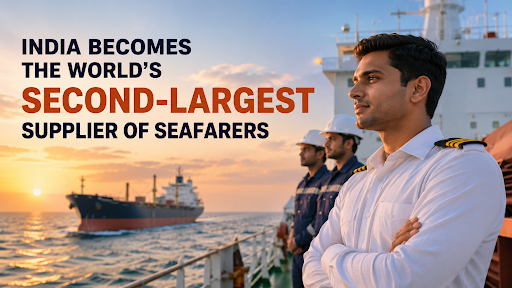
According to the BIMCO–ICS Seafarer Workforce Report, India emerged as the world's second-largest supplier of seafarers in 2026, jumping from fifth position in 2015.
What is the BIMCO–ICS Seafarer Workforce Report?
It is the world's most comprehensive assessment of the global supply and demand of STCW-certified seafarers, published every five years since 1990.
It is jointly prepared by the Baltic and International Maritime Council (BIMCO) and the International Chamber of Shipping (ICS).
It serves as a key reference for maritime workforce planning, training capacity, certification policies and global shipping competitiveness.
|
A seafarer workforce consists of all the maritime professionals, officers, and crew members who operate commercial merchant ships, cargo vessels, and tankers globally. |
Key Findings of the 2026 Report
Global Ranking: India has become the world's second-largest supplier of seafarers, behind the Philippines and ahead of China, the Russian Federation and Indonesia.
Workforce Share: India's contribution increased from 5.2% in 2015 to 12.16% in 2026, with 311,936 active seafarers, more than doubling its global share over the past decade.
Officer Strength: India supplies 140,718 officers, accounting for 13.41% of the global officer workforce, reflecting its strength in navigation, marine engineering and ship management.
Ratings Contribution: India contributes 171,218 ratings, representing 11.29% of the world's ratings workforce.
Rapid Growth: India improved from 5th position (2015) to 2nd position (2026) due to expansion in maritime education, training capacity, digitised certification and policy reforms.
Mission 20%: India has launched Mission 20%, targeting one in every five global seafarers to be Indian by 2047 under the Maritime Amrit Kaal Vision 2047.
Major Challenges
Management-Level Deficit: The shipping industry faces a severe shortage of senior officers like Chief Engineers and Masters due to slow promotion pipelines for junior cadets.
Technological Disruption: Eco-friendly vessels utilizing gas, chemicals, LNG, and methanol demand highly specialized training, which limits the eligible talent pool.
Ship Abandonment: Indian seafarers remain the worst affected globally. In 2025, 1,125 Indian seafarers were abandoned out of 6,223 abandoned seafarers worldwide, often without wages, food or repatriation.
Maritime Security Threats: Geopolitical tensions in the Red Sea, Gulf of Aden and Strait of Hormuz, along with piracy, missile and drone attacks, continue to endanger commercial shipping and Indian seafarers.
Upskilling Demands: Workers must rapidly adapt to IMO 2020 Sulphur regulations, renewable energy systems, and automated ship technologies.
Gender Disparity: Women represent only 0.5% of Indian onboard seafarers, despite female participation rising from 1,600 in 2021 to over 7,000 in 2025.
Mental Health & Welfare Issues: Long voyages, isolation, conflict-zone deployment and work-related stress adversely affect seafarers' mental well-being.
Measures to Strengthen India's Maritime Workforce
Expand Maritime Education: Establish additional Indian Maritime University (IMU) campuses and international training centres while increasing intake capacity and simulator-based learning.
Promote Green Shipping Skills: Implement the National Action Plan for Green Shipping by training seafarers in LNG, methanol, ammonia, hydrogen fuels, shore power systems and energy-efficient ship operations.
Increase Women's Participation: Expand the Women in Seafarer Programme through scholarships, fee waivers, mentorship, safe onboard workplaces and career counselling to substantially raise female participation by 2030.
Strengthen Digital Certification: Expand end-to-end e-certificates, online verification systems and simulation-based competency assessments to improve international recognition of Indian certifications.
Accelerate Mission 20%: Invest in modern maritime training infrastructure, increase sea-time berths through international partnerships and strengthen placement support to achieve 20% global workforce share by 2047.
Enhance Seafarer Welfare: Develop a Seafarer First Initiative with real-time monitoring of conflict zones, dedicated liaison officers and emergency repatriation support for Indian crew members.
Strengthen e-Navik Services: Upgrade the 24×7 e-Navik grievance platform with multilingual support, WhatsApp integration and faster grievance resolution.
Expand International Partnerships: Collaborate with BIMSTEC, ASEAN, Africa and Gulf countries for mutual recognition of certificates, cadet exchange programmes and employment opportunities.
Strengthen Maritime Security Training: Provide specialised training on anti-piracy operations, cybersecurity, emergency response and navigation in conflict-prone maritime regions.
Source: NEWSONAIR
|
PRACTICE QUESTION Q. "India's rise as the world's second-largest supplier of seafarers presents a massive strategic and economic opportunity, but the growing crisis of ship abandonment and conflict zone attacks threaten this human capital." Analyze. 150 words |