Why In News?
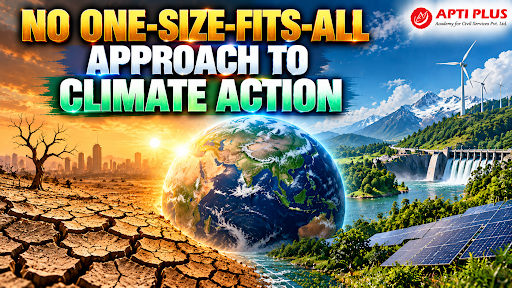
At the UNFCCC Pre-COP31 meetings in Fiji, the Union Minister for Environment declared that there is no "one-size-fits-all" approach to climate action, demanding equal priority for adaptation, mitigation, and means of implementation.
|
Pre-COP31 was co-hosted by Australia, Fiji and Tuvalu, while COP31 will take place in Antalya, Türkiye, from 9–20 November 2026. |
What is UNFCCC?
The United Nations Framework Convention on Climate Change (UNFCCC) is the primary international treaty established to coordinate global action and policy on climate change
-
Adoption: Formulated and signed at the Rio Earth Summit in 1992 in Rio de Janeiro, Brazil.
-
Entry into Force: Became operational on March 21, 1994.
-
Membership: Features universal membership with 198 Parties (197 countries plus the European Union).
-
Secretariat: Headquartered in Bonn, Germany, providing organizational and technical support for negotiations.
-
Nature: It is a framework convention, meaning it sets broad principles, goals, and institutional structures rather than imposing immediate, legally binding emission reduction targets on its own.
Core Objectives
-
Stabilization: Aims to stabilize greenhouse gas (GHG) concentrations in the atmosphere at a level that prevents dangerous human interference with the climate system.
-
Survival & Growth: Seeks to ensure ecosystems adapt naturally, food production is not threatened, and economic development remains sustainable.
Key Principles
-
CBDR-RC: Operates on the principle of Common But Differentiated Responsibilities and Respective Capabilities—acknowledging that all nations share a duty to fight climate change, but developed countries bear historical responsibility and greater economic capability to lead.
-
Scientific Guidance: Relies on scientific assessments from the Intergovernmental Panel on Climate Change (IPCC).
Institutional Structure
-
COP (Conference of the Parties): The supreme decision-making body of the treaty where member states meet annually to review progress and negotiate new climate commitments.
-
Parent Treaty: Serves as the foundational legal parent for major subsequent climate pacts, including the Kyoto Protocol (1997) and the Paris Agreement (2015).
The UNFCCC Pre-COP31 meeting took place in Fiji, co-hosted by Australia, Fiji, and Tuvalu as a preparatory summit ahead of the annual UN Climate Change Conference (COP31), which is scheduled for November in Antalya, Türkiye.
India's Key Priorities Ahead of COP31
Climate Action Must Reflect Local Conditions: India opposed a uniform global model for climate action. It stressed that local studies and regional assessments should guide mitigation and adaptation measures according to the specific needs of each area.
Three Areas Need Equal Attention: India called for a balanced focus on adaptation, mitigation and means of implementation. The last pillar includes climate finance, technology transfer and capacity building needed by developing countries.
Equity and CBDR-RC: India reiterated that climate negotiations must follow Equity and Common but Differentiated Responsibilities and Respective Capabilities (CBDR-RC). This recognises that countries share climate responsibilities but differ in their historical contributions and capacity to respond.
Implementation Over New Targets: India argued that the major climate goals, including the 1.5°C temperature limit under the Paris Agreement, are already established. The focus should therefore shift towards implementing existing commitments, delivering promised support and scaling up workable solutions.
Bridging Climate Knowledge Gaps: India highlighted the need to connect scientific climate knowledge with local and traditional practices and to narrow the gap between available financial resources and the requirements of vulnerable communities.
How Does The Principle Of Common But Differentiated Responsibilities (CBDR-RC) Protect Climate Equity?
The CBDR-RC principle establishes that while all countries share a collective duty to preserve the planet, developed nations must lead in absolute emission reductions due to their historical contribution to global warming.
India emphasizes climate equity because per-capita emissions across the Global South remain well below global averages, making uniform emission caps socially regressive.
National climate strategies in India derive statutory and constitutional backing from Article 48A (Directive Principles of State Policy) and Article 51A(g) (Fundamental Duty to protect environment), implemented via the Environment (Protection) Act, 1986.
India's updated NDC 3.0 operationalizes CBDR-RC by pledging to reduce the emissions intensity of GDP by 47% by 2035 from the 2005 baseline. India already achieved a 36% reduction by 2020.
Under NDC 3.0, India targets achieving 60% cumulative installed electricity capacity from non-fossil energy sources by 2035. India reached 52.57% non-fossil capacity in February 2026, surpassing its 2030 target of 50% four years ahead of schedule.
NDC 3.0 elevates the national carbon sink creation target to 3.5 to 4.0 billion tonnes CO2 equivalent through afforestation by 2035. As of 2025, India created an additional carbon sink of 2.29 billion tonnes CO2 equivalent.
Source: THEHINDU
|
PRACTICE QUESTION Q. Climate action cannot be separated from equity, development needs and historical responsibility. Discuss. 150 words |