Why In News?
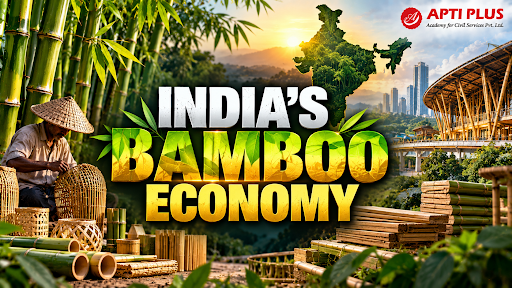
Policy deregulation and technological innovation under the National Bamboo Mission are driving rural enterprises and women's empowerment.
What is the Bamboo Economy?
Bamboo Cultivation: Agronomic propagation of fast-growing, non-forest bamboo species across private lands, agro-forestry boundaries, and degraded wastelands.
Bamboo Processing: Primary and secondary mechanical processing, converting round poles into treated splints, slivers, fibers, and industrial chips.
Value-Added Products: Manufacturing lifestyle consumer items, high-grade charcoal, bamboo fabric, activated carbon, and modern interior decor.
Handicrafts: Traditional artisanal weaving of baskets, lifestyle bags, mats, and ethnic toys, modernised for domestic and urban retail.
Construction Materials: Engineered lumber, bamboo-composite corrugated roofing sheets, laminates, scaffolding, and prefabricated housing panels.
Food Processing: Harvesting and canning edible bamboo shoots, creating nutrient-rich pickles, dietary supplements, and fermented culinary delicacies.
Renewable Energy Applications: Utilizing shredded bamboo biomass for thermal boiler co-firing, bio-coal pellets, and second-generation ethanol synthesis.
Why is Bamboo Economically Important?
Rural Employment: Provides labor-intensive livelihood opportunities, with NECTAR initiatives generating over 30 million man-days of employment annually.
Farmer Income: Cultivating bamboo as an agroforestry asset yields steady returns (₹75,000–1,00,000 per acre) alongside multi-tiered intercropping.
Women’s Livelihoods: Offers decentralized home-based employment, creating primary and supplementary wage opportunities through village SHG clusters.
MSME Development: Nucleates micro-enterprises in incense stick (agarbatti) making, furniture manufacturing, mat weaving, and utility packaging.
Northeast Economy: Anchors regional growth in the Northeast, which holds over 50% of India's bamboo reserves and rich germplasm diversity.
Export Potential: Positions India to tap the multi-billion-dollar global bamboo trade by substituting plastic tableware and wooden flooring.
Sustainable Manufacturing: Displaces carbon-intensive steel, timber, and synthetic polymers in automotive components and architectural paneling.
What is the National Bamboo Mission?
The National Bamboo Mission (NBM) is a Centrally Sponsored Scheme, originally launched in 2006–2007, and restructured in 2018–2019, under the Ministry of Agriculture & Farmers Welfare .
|
Objective |
To promote bamboo‑based livelihoods, industry, and environmental sustainability by integrating cultivation, processing, and marketing. |
|
Bamboo Cultivation |
Expands plantation acreage in non‑forest areas through agro‑forestry and intercropping models, especially in North‑East, Central, and Tribal belts. |
|
Quality Planting Material |
Funds tissue‑culture labs and certified nurseries to supply disease‑free, high‑yield clonal saplings. |
|
Processing Infrastructure |
Establishes Common Facility Centres (CFCs), primary processing units, mechanized seasoning kilns, and carbonization hubs to boost value addition. |
|
Market Access & Value Addition |
Connects rural artisan clusters with national expos, SARAS fairs, and GeM portal; raises farm‑gate value from 10 % to 70 % through mechanized processing. |
|
Farmer Support |
Provides direct subsidies up to ₹1.2 lakh per hectare for commercial and homestead bamboo plantations. |
|
Skill Development & Capacity Building |
Trains artisans in modern joinery, lamination, and CAD‑based design through partnerships with KVIC, TRIFED, and IITs. |
|
Environmental Impact |
Enhances carbon sequestration, soil conservation, and climate resilience while supporting tribal livelihoods and women’s participation. |
|
Integration with Other Schemes |
Linked with PM‑FME, SFURTI, and PMEGP for enterprise development and rural employment generation. |
What are the Major Challenges?
Limited Processing Capacity: Scarcity of industrial‑scale primary processing units near major cultivation zones forces farmers to sell raw bamboo poles cheaply, reducing income potential.
Technology Gaps: High capital cost of precision lamination and treatment machinery (mostly imported from Europe and Taiwan) deters small rural MSMEs from investing in value‑addition.
Market Linkages & Price Realization: Fragmented marketing channels and opaque middlemen networks depress farm‑gate prices for tribal and small bamboo harvesters.
Quality & Standardization Issues: Inconsistent chemical treatment against fungal rotting and powder‑post beetles affects structural reliability and export competitiveness.
Skill Gaps & Workforce Modernization: Traditional artisans lack training in modern geometric design, industrial joinery, and computerized laser‑cutting techniques needed for global markets.
Logistics & Transportation Constraints: Bulky hollow culms incur high freight costs; poor road connectivity to chipping and splitting facilities increases wastage and delays.
Weak Value‑Chain Integration: Limited coordination among agroforestry growers, industrial processors, institutional buyers, and retail consumers hampers sustainable value‑chain development.
Policy & Institutional Fragmentation: Overlapping jurisdiction between forest departments, MSME ministries, and tribal welfare boards creates regulatory confusion and slows project approvals.
Way Forward
Cluster‑Based Processing Infrastructure: Establish bamboo industrial clusters near major cultivation zones under PM‑FME and SFURTI schemes to reduce transport costs and boost local value addition.
Technology Upgradation & MSME Support: Provide capital subsidies and technology‑transfer partnerships for affordable lamination, treatment, and laser‑cutting machinery through the Technology Upgradation Fund (TUF) model.
Market Linkages & Branding: Create national bamboo e‑market platforms and GI‑tagged regional brands to connect tribal producers directly with institutional buyers and export markets.
Quality Assurance & Standardization: Implement BIS‑certified treatment protocols and eco‑labeling standards to ensure durability, pest resistance, and global competitiveness of bamboo products.
Skill Development & Design Innovation: Launch National Bamboo Skill Mission under MSME and Tribal Affairs ministries for training artisans in design, joinery, and product diversification.
Integrated Value‑Chain Development: Promote PPP models linking agroforestry growers, processors, and retailers; incentivize contract farming and institutional procurement by housing and construction sectors.
Sustainable Logistics & Green Finance: Develop light‑freight bamboo transport corridors and introduce green credit lines for bamboo enterprises under NABARD and SIDBI to support eco‑industrial growth.
Conclusion
Reimagining bamboo as an industrial engineered composite and rural enterprise driver will decouple construction from carbon emissions while transforming the rural green economy.
Source: PIB
|
PRACTICE QUESTION Q. With reference to the legal and policy framework governing bamboo in India, consider the following statements: 1. The Indian Forest (Amendment) Act, 2017 removed bamboo grown in non-forest areas from the definition of a "tree". 2. Following the 2017 amendment, felling and transit permits are no longer required for bamboo grown on private and agricultural lands. 3. The National Bamboo Mission is implemented as a central sector scheme directly administered by the Ministry of Environment, Forest and Climate Change. Which of the statements given above are correct? A) 1 and 2 only B) 2 and 3 only C) 1 and 3 only D) 1, 2, and 3 Answer: A Explanation: - Statements 1 and 2 are correct: The Indian Forest (Amendment) Act, 2017 amended Section 2(7) of the 1927 Act to exclude bamboo grown outside forest areas from the statutory definition of a "tree", freeing private farmers from cumbersome felling and transit permissions. - Statement 3 is incorrect: The restructured National Bamboo Mission (NBM) is a Centrally Sponsored Scheme implemented under the Department of Agriculture & Farmers Welfare (Ministry of Agriculture), not MoEFCC. |