Why In News?
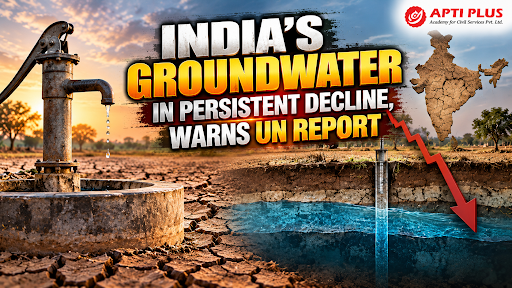
The State of Global Water Resources 2025 report, published by the World Meteorological Organization (WMO), highlights that India’s groundwater levels are in a persistent decline.
What is Groundwater?
Groundwater is freshwater stored beneath the Earth's surface in the empty spaces of soil, sand, and rock.
How Groundwater is Stored
-
Aquifers: Underground layers of porous rock or sediment filled with water.
-
Unconfined Aquifers: Shallow layers where water connects directly to the open air through the soil.
-
Confined Aquifers: Deeper layers trapped between heavy, hard layers of rock or clay that keep the water under pressure.
How It Gets Recharged
-
Rain and Snow: Water from the sky sinks deep into the ground.
-
Seepage: Water leaks down from rivers, canals, and farm fields.
-
Total Recharge: India receives about 448.52 billion cubic meters (bcm) of natural groundwater recharge every year, according to the Central Ground Water Board (CGWB).
Highlight of the World Meteorological Organization (WMO) Report
Persistent Groundwater Deficits: The WMO State of Global Water Resources 2025 report documents persistent multi-year groundwater deficits between 2022 and 2025, indicating a fundamental rupture in India's water balance where annual extraction continuously outpaces natural recharge.
Northern and Northwestern India Pressure: Groundwater stress is heavily concentrated across Northern and Northwestern India, where subsurface storage remained in persistent below-normal to much-below-normal categories despite monsoon rainfall lifting river flows in 2025.
Global Groundwater Stress: Globally, 34% of monitored observation wells reported below-normal levels in 2025 (up from 25% in 2024), while 65% of stations recorded conditions deviating from historical 20-year reference norms.
Decline in Terrestrial Water Storage: The report highlights a persistent, decade-long global decline in total terrestrial water storage—the sum of groundwater, soil moisture, surface water, snow, and ice—since 2014–2016.
Below-Normal River Baseflows: Multi-year over-extraction has lowered phreatic water tables below natural riverbed levels, severing dry-season baseflow contributions to major river systems including the Indus, Ganga, Cauvery, Narmada, and Mahanadi.
World Meteorological Organization (WMO)
|
Why is Groundwater Vital for India's Food, Water, and Economic Security?
Dominant Agricultural Irrigation Anchor: Groundwater powers 62% of India's total agricultural irrigation and sustains 60% of total irrigated crop area, making India the world's largest consumer of groundwater, drawing 247.22 bcm annually—over 25% of the global total.
Rural and Urban Drinking Water Backbone: Groundwater supplies 85% of rural domestic drinking water needs and 45% to 50% of urban domestic consumption across the country.
National Food Security Foundation: Groundwater-fed agriculture supports over 600 million farmers, with North-Western India (specifically Punjab and Haryana) producing 50% of the nation's rice supply and 85% of its central wheat stocks.
Livelihood and Climate Resilience Security: Groundwater serves as the primary socio-economic buffer against seasonal dry spells, drought shocks, and monsoon anomalies for 1.4 billion people.
Industrial Sector Supply: Industrial operations account for 4.23 bcm (2%) of total national groundwater extraction annually.
Why is Groundwater Depleting Rapidly Across Indian States?
Agricultural Over-Extraction: Agriculture consumes 87% of total extracted groundwater annually, driven by a massive expansion of private tubewells.
Water-Intensive Cropping Patterns: High Minimum Support Price (MSP) incentives and open-ended procurement policies promote water-intensive paddy and sugarcane cultivation in semi-arid regions; in Punjab, paddy cultivation consumes 94.74% of total extracted groundwater via 1.45 million electric tubewells.
Excessive Dependence on Borewells: Agricultural borewells expanded from 1 million during the 1960s Green Revolution to over 20 million. (Source: World Bank)
Subsidised Electricity for Pumping: Unmetered or free agricultural power reduces the marginal cost of extraction to zero, creating severe moral hazard.
Urbanisation and Concrete Imperviousness: Rapid urban growth, soil compaction, wetland encroachment, and expanding built-up surfaces severely impair natural surface infiltration, while cities over-extract via unregulated private borewells.
Reduced Natural Recharge: Deforestation, land degradation, and loss of traditional village water bodies reduce the natural percolation of rainwater into phreatic aquifers.
Climate Variability: Warming temperatures, erratic monsoons, and frequent dry spells force farmers to pump deeper to combat crop heat stress, a trend projected to triple groundwater depletion rates by 2080.
Government Initiatives to Address Groundwater Crisis
Atal Bhujal Yojana (ATAL JAL): A Central Sector Scheme with an outlay of Rs 6,000 crore (50:50 GoI-World Bank funding) implemented across 7 states (Gujarat, Haryana, Karnataka, MP, Maharashtra, Rajasthan, UP), establishing Hydrogeological Monitoring Networks, community Water Security Plans, and constructing recharge structures.
Jal Shakti Abhiyan: Catch the Rain: A nationwide movement focused on rainwater harvesting, artificial aquifer recharge, and traditional Amrit Sarovar rejuvenation.
National Aquifer Mapping Programme (NAQUIM 2.0): Executed by the CGWB, utilizing high-resolution 3D mapping and heliborne geophysical surveys covering 1.0 lakh sq km in arid Northwest India to guide local water management.
Pradhan Mantri Krishi Sinchayee Yojana (PMKSY): Promotes micro-irrigation (Per Drop More Crop), bringing 9.7 lakh hectares under efficient water-use practices under Atal Jal.
Groundwater Regulation Reforms: The Model Groundwater Bill 2017 and UP Ground Water Act 2020 institutionalize the Doctrine of Public Trust and decouple water extraction rights from private land ownership under Article 243G of the Constitution of India.
Conclusion
India must urgently transition from colonial land-based extraction rights to community-led aquifer governance under the Doctrine of Public Trust to prevent catastrophic water insolvency and ensure long-term national food security.
Source: DOWNTOEARTH
|
PRACTICE QUESTION Q. Examine the Water-Energy-Food nexus in Indian agriculture and evaluate how community-led participatory governance under Atal Bhujal Yojana can avert regional water bankruptcy. 150 words |