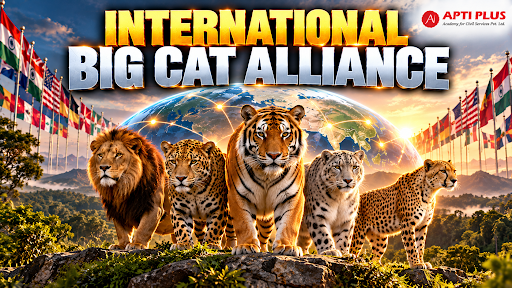
Why In News?
The Union Minister for Environment inaugurated the new permanent headquarters and office premises of the International Big Cat Alliance (IBCA) in New Delhi.
What is the International Big Cat Alliance (IBCA)?
It is an India-led, treaty-based intergovernmental coalition established to secure global consensus and long-term protection for the world’s seven primary big cat species and their ecosystems across 95 range countries.
-
First proposed by the Prime Minister of India in 2019 during Global Tiger Day.
-
Officially launched on April 9, 2023, at Mysuru during the 50th anniversary of Project Tiger.
-
Formally approved by the Union Cabinet in February 2024.
-
Permanent global headquarters and Secretariat at New Delhi.

Core Objectives & Mandate
-
Species & Habitat Conservation: Safeguarding the 7 big cat species along with their natural prey bases and transboundary habitat corridors across Asia, Africa, and the Americas.
-
Combating Wildlife Crime: Disrupting illicit international wildlife trade and poaching syndicates through joint intelligence sharing, standardized protocols, and capacity building.
-
Technology Transfer & R&D: Deploying modern tools including camera-trap grids, satellite mapping, AI-based risk analytics, and DNA wildlife forensics.
-
Climate Change & Ecosystem Resilience: Protecting big cat landscapes as vital carbon sinks and watersheds, directly mitigating climate-driven ecological degradation.
-
Global Framework Alignment: Integrating operational targets with the Kunming-Montreal Global Biodiversity Framework (GBF), Aichi Biodiversity Targets, and UN Sustainable Development Goals (SDGs).
Governance Structure
-
Assembly of Members: The highest decision-making body representing all signatory member states; decisions are made by consensus or a two-thirds majority.
-
Standing Committee / Council: An executive body consisting of 7 to 15 elected member states serving a 5-year term.
-
Secretariat: Headed by a Director General (DG) based in New Delhi, managing day-to-day operations, legal compliance, and technical verticals.
Membership & Financial Mechanism
-
Membership Scope: Open to 95 big cat range states, non-range nations, multilateral UN agencies (UNEP, UNDP, FAO), and international conservation organizations (IUCN, WWF, CITES, GTF). Membership carries no mandatory joining fees. As of 2026, 29 countries have signed on as members alongside 5 observer countries.
-
Financial Allocations: Supported by an initial one-time grant of ₹150 crore committed by the Government of India for five years (2023–24 to 2027–28).
-
Long-Term Sustainability: Designed to transition into a self-sustaining financial framework by tapping into CSR capital, ESG investments, green/biodiversity bonds, and voluntary sovereign contributions.
What are the Seven Big Cats Under the IBCA Mandate?
Five of these species (Tiger, Lion, Leopard, Snow Leopard, and Cheetah) are found in the wild or reintroduced in India. The Jaguar and Puma are native exclusively to the Americas.
1. Tiger (Panthera tigris)
-
Key Characteristics: Largest wild cat species; distinguished by dark vertical stripes on orange fur; apex predator regulating forest ecosystem balance. D
-
Distribution & Population: Estimated global wild population stands at 5,574 individuals across 13 Asian range countries. India holds over 70% of the world's wild tigers (3,682 tigers). Extinct in Cambodia, Lao PDR, and Vietnam.
-
IUCN Red List Status: Endangered.
2. Lion (Panthera leo)
-
Key Characteristics: Second largest felid; uniquely social cat living in territorial groups called prides (3 to 40 individuals). Asiatic lions (P. l. leo) possess a distinct belly-fold of skin, sparser mane, and extra infraorbital skull foramen.
-
Distribution & Population: 23,000–39,000 African lions in sub-Saharan Africa; the entire wild Asiatic lion population survives as a single population in Gujarat's Gir landscape, India (891 individuals in 2025).
-
IUCN Red List Status: Vulnerable (Asiatic lions were downlisted from 'Endangered' to 'Vulnerable' due to sustained population recovery).
3. Leopard (Panthera pardus)
-
Key Characteristics: Extremely adaptable, stealthy, solitary predator with rosette-patterned coat; broadest elevation distribution (recorded up to 5,200 meters in the Himalayas).
-
Distribution & Population: Widespread across sub-Saharan Africa, the Middle East, and Asia; India shelters 13,874 leopards. Certain subspecies are critically low (e.g., Amur leopard <60 in wild).
-
IUCN Red List Status: Vulnerable globally; listed under Appendix I of CITES.
4. Snow Leopard (Panthera uncia)
-
Key Characteristics: Known as the "Ghost of the Mountains"; acts as an indicator species for high-altitude mountain ecosystems. Features an exceptionally long tail (75–90% of body length) for balance/warmth and extra-large paws serving as natural snowshoes.
-
Distribution & Population: Estimated 3,500–7,000 individuals across 12 Central and South Asian range countries (China holds 60%); India shelters 718 snow leopards across its Himalayan region.
-
IUCN Red List Status: Vulnerable.
Cheetah (Acinonyx jubatus)
-
Key Characteristics: World’s fastest land mammal; sleek frame with facial black "tear marks" from eyes to mouth. Displays a unique social structure where females are solitary and males form territorial coalitions.
-
Distribution & Population: ~7,100 wild individuals globally (mainly in Southern & Eastern Africa; Asiatic cheetah in Iran <20). Declared extinct in India in 1952; reintroduced in Kuno National Park in 2022–2023 under Project Cheetah (intercontinental translocation of 20 African cheetahs, expanding to 27 individuals).
-
IUCN Red List Status: Vulnerable globally (Northwest African cheetah listed as Critically Endangered).
Jaguar (Panthera onca)
-
Key Characteristics: Largest native cat in the Americas and 3rd largest globally. Features rosettes with central black spots; possesses a powerful bite mechanism capable of piercing reptilian armor and mammalian skulls. Expert swimmer inhabiting dense rainforests and wetlands.
-
Distribution & Population: 173,000 wild jaguars across 18 American countries (Brazil holds 50%, with 89% in the Amazon River basin).
-
IUCN Red List Status: Near Threatened.
Puma (Puma concolor / Cougar / Mountain Lion)
-
Key Characteristics: Widest geographical distribution of any New World land mammal (spanning Alaska to southern Chile). 4th largest felid; belongs to the Puma lineage and lacks an elastic hyoid bone (cannot roar; produces chirps, growls, and whistles).
-
Distribution & Population: Native across North, Central, and South America. The Florida panther subspecies is critically endangered (100–180 individuals).
-
IUCN Red List Status: Least Concern globally.

Source: PIB
|
PRACTICE QUESTION Q. With reference to the International Big Cat Alliance (IBCA), consider the following statements: 1. It is a treaty-based inter-governmental international organization headquartered in New Delhi, India. 2. The alliance focuses on the conservation of seven big cats, which include the Jaguar and Puma alongside the Tiger and Lion. 3. Membership in the IBCA is strictly restricted to countries that harbor wild populations of all seven big cats within their national borders. Which of the statements given above is/are correct? (a) 1 and 2 only (b) 2 and 3 only (c) 1 and 3 only (d) 1, 2 and 3 Answer: (a) Explanation: Statement 1 is correct: The International Big Cat Alliance (IBCA) officially became a treaty-based international inter-governmental organization on January 23, 2025. It is permanently hosted and headquartered in New Delhi, India. Statement 2 is correct: The alliance focuses on the global protection and conservation of seven major big cat species, which are the Tiger, Lion, Leopard, Snow Leopard, Cheetah, Jaguar, and Puma. Statement 3 is incorrect: Membership in the IBCA is not restricted to countries that harbor all seven species. Instead, membership is open to all United Nations member states. This encompasses 95+ "range countries" (where at least one big cat species naturally occurs) as well as "non-range countries" that have an interest in supporting conservation efforts. For example, India itself does not harbor wild populations of the Jaguar or Puma, yet it is a leading member and host of the alliance. |