Why In News?
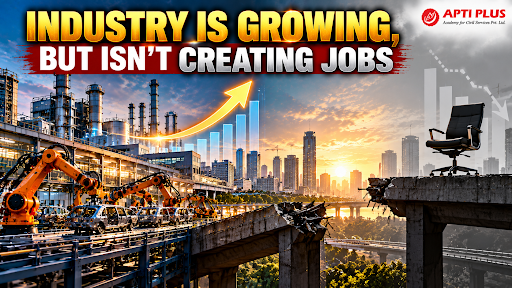
Recent economic data highlights India's "jobless industrial growth," where strong manufacturing GVA growth contrasts with sluggish formal employment generation.
Why is Industry Not Creating Enough Jobs?
Capital-Intensive Production: Industrial policies and fiscal tax incentives historically favored capital over labor, lowering the cost of capital relative to wage labor.
Automation and Industrial Robotics: Deployment of computer numerical control (CNC) machines, automated assembly arms, and artificial intelligence reduces shop-floor headcount per unit of output.
Rising Labour Productivity: Manufacturing plants generate significantly higher real output per worker, dampening incremental hiring demand during economic expansions.
Acute Skill Mismatch: Deficiencies in vocational curricula mean ITI and polytechnic graduates often lack the modern technical competencies demanded by Industry 4.0 manufacturers.
Limited Labour-Intensive Manufacturing: Slower growth in traditional labor-absorbing industries (apparel, leather, footwear) relative to capital-heavy engineering, chemicals, and basic metals.
MSME Constraints: The "dwarfism" phenomenon, where micro-enterprises intentionally stay small to avoid complex regulatory compliance, prevents scale economies and stable formal job creation.
High Logistics Costs: Domestic logistics and freight costs hover around 8% to 9% of GDP, diminishing export price-competitiveness in labor-intensive global markets.
Technology-Intensive Production: Strategic policy pushes prioritize high-tech sectors (semiconductors, green hydrogen, pharmaceuticals) that generate high GVA but employ relatively fewer shop-floor operators.
|
Capital-Intensive vs Labour-Intensive Manufacturing Capital-Intensive Manufacturing (e.g., Petrochemicals, Automotive, Semiconductors): Characterized by massive fixed capital investments per job created, high automation, and high value-addition per employee.
Labour-Intensive Manufacturing (e.g., Ready-Made Garments, Leather, Footwear, Food Processing): Requires lower capital investments per job created, utilizes standardized shop-floor operations, and employs large numbers of women and semi-skilled laborers.
|
What is the Employment Challenge?
Large Working-Age Population: India adds 7 to 8 million youths to the active labor force annually, requiring rapid formal job creation to capitalize on its demographic dividend.
Agriculture-to-Industry Transition: A post-pandemic reversal showed millions of workers returning to low-yield agriculture or unpaid family labor, stalling structural transformation.
Informal Employment: Over 89% of India’s total labor force remains trapped in informal employment lacking written contracts, paid leave, and statutory social security safety nets.
Youth Employment Deficits: Youth unemployment (ages 15–29) remains high in urban areas, reflecting growing structural underemployment among educated graduates.
Low Female Labour Force Participation Rate (FLFPR): Despite recent upticks, female labor participation remains low, with women disproportionately employed in low-return agricultural operations rather than formal factory lines.
Quality of Employment: Proliferation of insecure gig, platform, and temporary contract labor lacking career mobility, statutory provident fund (EPFO), or healthcare benefits (ESIC).
Why is Manufacturing Important for India?Large-Scale Employment: Historically the primary engine capable of absorbing millions of low-to-semi-skilled workers into the formal economy at living wages. Structural Transformation: Accelerates the classic economic transition formulated by Arthur Lewis, shifting surplus labor from low-productivity subsistence farming to high-productivity industrial clusters. Export Growth: Drives merchandise exports, strengthening the current account balance and accumulating foreign exchange reserves through high-value goods. Productivity Improvement: Generates substantial dynamic scale economies, capital accumulation, and technological spill-overs across domestic value chains. Global Value Chains (GVCs): Integrates domestic factories into multinational production networks, expanding trade complexity and foreign direct investment (FDI). Agricultural Workforce Transition: Provides an essential exit route for the 46.1% of India’s workforce currently dependent on agriculture, which generates less than 18% of national GDP. |
What are the Government Initiatives?
Make in India: A national program designed to transform India into a global manufacturing hub, raise manufacturing's share of GDP to 25%, and attract foreign direct investment.
Production Linked Incentive (PLI) Scheme: Allocated ₹1.97 lakh crore across 14 strategic sectors to scale manufacturing output, boost domestic value addition, and spur capital investment.
PM GatiShakti National Master Plan: A digital multimodal connectivity platform coordinating infrastructure planning across 16 ministries to eliminate logistics bottlenecks.
National Logistics Policy (NLP): Formulated to lower domestic logistics costs down to global benchmarks (around 8% of GDP) and improve the Logistics Performance Index (LPI) ranking.
Skill India Mission: Upgrading vocational curricula and scaling apprenticeship programs through the Pradhan Mantri Kaushal Vikas Yojana (PMKVY) and the National Apprenticeship Promotion Scheme (NAPS).
Pradhan Mantri MUDRA Yojana (PMMY): Disburses collateral-free institutional credit up to ₹20 lakh across Shishu, Kishore, and Tarun categories to fund micro-enterprises.
MSME Support Schemes: The Emergency Credit Line Guarantee Scheme (ECLGS), Raising and Accelerating MSME Performance (RAMP) program, and the Udyam Registration Portal facilitating credit access and formalization.
What are the Major Challenges?
Regulatory Compliance Burden: Excessive regulatory filings, overlapping factory inspections, and rigid exit thresholds discourage firms from scaling workforce sizes beyond 100 or 300 workers.
-
Example: Regulatory Burden on Manufacturing Establishments, an average manufacturing firm must navigate hundreds of recurring compliance filings and statutory licenses annually across central, state, and local bodies.
Credit Squeeze on MSMEs: Traditional banks demand real estate collateral, resulting in an estimated ₹25 lakh crore addressable credit gap for micro and small enterprises.
Incentive Bias Toward Capital Intensity: Schemes like the PLI base subsidies primarily on incremental sales and heavy capital investment rather than direct employment generation quotas.
Way Forward
Introduce an Employment-Linked Incentive (ELI) Scheme: Rebalance industrial policy by offering direct wage subsidies and provident fund contribution rebates to manufacturers creating net formal jobs in labor-intensive sectors.
-
Example: Employment-Linked Incentive Packages, subsidizing EPFO contributions for first-time formal employees in manufacturing lines.
Reduce Regulatory Compliance and Decriminalize Labor Laws: Streamline bureaucratic procedures by unifying factory inspections into automated digital portals and decriminalizing minor procedural labor infractions under the new Labour Codes.
-
Example: National Single Window System (NSWS), unifying multi-departmental manufacturing clearances into a single digital touchpoint.
Improve MSME Cash Flow via TReDS: Mandate all central public sector enterprises, state entities, and large corporate buyers to settle MSME invoices through the Trade Receivables Discounting System (TReDS) to eliminate working capital lock-ups.
-
Example: TReDS Mandatory Onboarding Mandate, scaling bill discounting to resolve chronic delayed payments to micro-suppliers.
Develop Plug-and-Play Industrial Mega-Parks: Construct ready-to-use plug-and-play factory sheds equipped with common effluent treatment plants, power grids, and on-site worker housing.
-
Example: PM MITRA Mega Integrated Textile Regions and Apparel Parks, providing integrated common infrastructure across 7 states to scale textile supply chains.
Boost Female Industrial Employment via Social Infrastructure: Establish secure dormitory housing, safe transit corridors, and subsidized on-site crèche facilities near export manufacturing zones.
-
Example: Tamil Nadu Electronics Manufacturing Housing Model, constructing large-scale industrial hostels for women assembly workers in Sriperumbudur and Hosur.
Integrate Domestic MSMEs into Global Value Chains: Help domestic component suppliers achieve global quality, ESG, and traceability certifications to integrate into multinational electronics, aerospace, and apparel supply lines.
Conclusion
To make India's industrial growth labor-absorptive, policy must shift from capital subsidies to employment-linked incentives, modernizing MSME credit, and scaling labor-intensive clusters.
Source: INDIANEXPRESS
|
PRACTICE QUESTION Q. India needs manufacturing-led growth that creates productive employment rather than merely increasing industrial output. Examine the reasons for the manufacturing-employment disconnect. 150 words |