Why In News?
Chief Ministers of six Yamuna basin states—Uttarakhand, Himachal Pradesh, Uttar Pradesh, Haryana, Rajasthan, and Delhi—signed a Memorandum of Understanding (MoU) to construct the Kishau Multipurpose Project on the Tons River.
What is the Kishau Multipurpose Project?
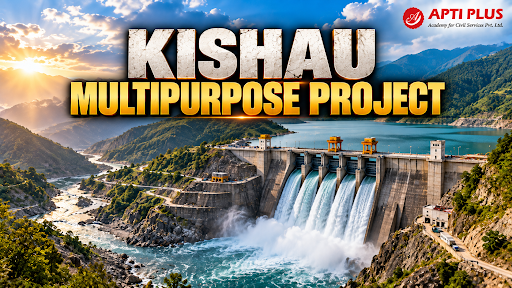
It is a hydro-infrastructure constructed on the Tons River (the largest tributary of the Yamuna River) in Dehradun district in Uttarakhand and Sirmaur district in Himachal Pradesh.
Executing Agency: The project is executed by Kishau Corporation Limited (KCL), a 50:50 joint venture by the Governments of Uttarakhand and Himachal Pradesh.
National Project Status: Declared a National Project in 2008, the Central Government covers 90% of the water component's capital cost as central grant assistance, while the six beneficiary states share the remaining 10%.
Power Capacity: The project features an installed hydroelectric capacity of 422 MW, generating 1,476 million units (MU) of clean peaking power annually.
What are the major concerns related to the Kishau Project?
Involuntary Displacement & Submergence: The reservoir will submerge 2,950 hectares of land across 17 villages, displacing 5,498 people. This heavily impacts the Schedule V tribal area of Jaunsar-Bawar and landless Dalit tenant farmers (Koltas and Bajgis).
Seismic Hazard: Located in a geologically active, high-risk Himalayan seismic zone.
Ecological & Biodiversity Loss: Threatens Tons valley flora, including 761 species of phanerogams, 55 medicinal plant species, 79 butterfly species, and cash-crop agricultural lands (ginger and tomato).
Source: DOWNTOEARTH
|
PRACTICE QUESTION Q. With reference to the Kishau Multipurpose Project, consider the following statements:
Which of the statements given above is/are correct? (A) 1 and 2 only (B) 2 and 3 only (C) 1 and 3 only (D) 1, 2 and 3 Answer: (A) Explanation: Statement 1 is correct: The Kishau Dam Project on Wikipedia involves constructing a concrete gravity dam on the Tons River. The Tons is the largest tributary of the Yamuna River, flowing through the Garhwal region of Uttarakhand and touching Himachal Pradesh. Statement 2 is correct: Under the Government of India's National Project scheme guidelines, the Central Government provides 90% of the capital cost of the water component (irrigation and drinking water) as central grant assistance, while the remaining 10% is shared by the beneficiary basin states. Statement 3 is incorrect: The project site does not lie entirely within Uttarakhand, nor is it under the sole administration of UJVNL. It straddles the Uttarakhand–Himachal Pradesh border (between Dehradun district of Uttarakhand and Sirmaur district of Himachal Pradesh). |