Why In News?
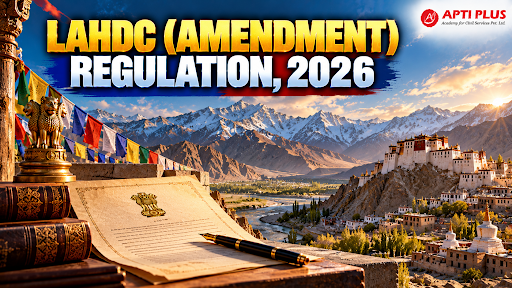
The Lieutenant Governor of Ladakh notified the Ladakh Autonomous Hill Development Councils (Amendment) Regulation, 2026, promulgated by President Droupadi Murmu.
What Is The LAHDC (Amendment) Regulation 2026?
The regulation amends the Ladakh Autonomous Hill Development Councils Act, 1997 to establish Autonomous Hill Development Councils (LAHDCs) across all 8 districts of Ladakh.
-
Coverage: Extends hill councils beyond Leh and Kargil to six newly created districts: Sankoo, Changthang, Nubra, Sham, Zanskar, and Drass.
-
Rationalisation of Seats: Replaces the former rigid structure of 26 seats per council with a flexible apportionment ranging from a minimum of 7 constituencies to a maximum of 24 constituencies.
-
Expansion of Elected Representation: Formally notifies 100 elected constituencies across the 8 district councils (nearly doubling total elected seats from 52): Leh (22), Kargil (21), Sankoo (13), Changthang (10), Nubra (9), Sham (9), Zanskar (9), and Drass (7).
-
Inclusive Representation: Nomination of up to 4 members representing women and unrepresented communities, subject to a statutory ceiling capped at one-sixth of total elected council seats.
-
Administrative and Fiscal Powers: Grants councils authority equivalent to district-level panchayats under the Jammu and Kashmir Panchayati Raj Act, 1989, including powers over land allotment, district cadre recruitment, managing dedicated council funds, levying local taxes, and formulating district development plans.
-
Electoral Oversight: Vests superintendence, direction, and election control in the State Election Commission of the UT of Ladakh.
Evolution of Governance in Ladakh
1995–1997 (Establishment of LAHDCs): The Ladakh Autonomous Hill Development Council Act, 1997 statutory framework was enacted to address regional grievances, establishing the first hill council in Leh (1995) and subsequently extending it to Kargil (2003) for local governance.
August 2019 (Abrogation of Article 370 and UT Creation): Under the Jammu and Kashmir Reorganisation Act, 2019, Ladakh was bifurcated from the erstwhile state of Jammu and Kashmir and designated as a Union Territory without a legislature, centralising executive authority under the Lieutenant Governor (L-G) and central bureaucracy.
2021–2026 (Political Agitation and Civil Society Mobilisation): Dissatisfaction with bureaucratic governance led to the alignment of the Leh Apex Body (LAB) and Kargil Democratic Alliance (KDA).
-
They formulated a core 4-point agenda demanding full Statehood, inclusion under the Sixth Schedule, a dedicated Public Service Commission (PSC), and separate Lok Sabha seats for Leh and Kargil.
July–October 2026 (District Expansion and 2026 Amendment): The Ministry of Home Affairs (MHA) approved expanding Ladakh from 2 to 8 districts, followed by the presidential promulgation of the LAHDC (Amendment) Regulation, 2026 under Article 240 to establish hill councils in all 8 districts.
October 2026 (Dissolution and Grassroots Elections): The LAHDC Kargil was dissolved under Section 4(1) of the LAHDC Act, 1997, temporarily transferring executive authority to the Deputy Commissioner, Kargil, while the State Election Commission announced general polls for 193 panchayat halqas on November 21, 2026.
What Are The Challenges In Ladakh's Governance Framework?
Executive Veto and Bureaucratic Centralisation: The MHA draft proposal for a UT-level body conditions all elected legislative decisions on mandatory assent from the Lieutenant Governor (L-G), reducing elected representatives to an advisory role.
Rejection of Central Draft Proposals: Civil society groups (LAB and KDA) categorically rejected the MHA proposal in principle, characterizing it as an "archaic administrative model" akin to the erstwhile North-East Frontier Agency (NEFA) that backtracks on prior dialogue commitments.
Absence of Constitutional Safeguards: Local leadership argues that expanding administrative districts without constitutional guarantees under the Sixth Schedule or Article 371(K) leaves high-altitude indigenous land, culture, employment, and fragile Himalayan ecology unprotected.
Dialogue Stalemate: Stalled negotiations between the Ministry of Home Affairs and regional leaders have heightened political friction and public protest.
Governance Vacuum and Operational Friction: Interim arrangements centralising authority in district collectors (e.g., DC Kargil managing council duties) cause administrative delays.
-
Multiplying district bodies without legislative autonomy mirrors the functional friction observed in Jammu and Kashmir's District Development Councils (DDCs).
Way Forward
Constitutional Guarantees under Article 371(K): Enact a customized constitutional insertion under Article 371(K) to provide legislative supremacy over local land, culture, forests, and environmental management without bureaucratic veto override.
Empowered UT-Level Legislature: Transition from restrictive administrative territorial council models to a directly elected Union Territory Assembly where executive bureaucracy remains accountable to elected representatives.
Fiscal Autonomy and Local Cadre Recruitment: Ensure direct financial devolution to all 8 district councils alongside independent local taxation and transparent job recruitment managed by a dedicated Public Service Commission (PSC).
Sustained Political Dialogue and Timely Elections: Resume structured negotiations between the MHA and regional stakeholders while conducting time-bound council elections to maintain democratic continuity and public trust.
Conclusion
True democratic stability and ecological protection in Ladakh depend on complementing district-level administrative expansion with genuine legislative autonomy and constitutional safeguards under Article 371(K).
Source: HINDUSTANTIMES
|
PRACTICE QUESTION Q. With reference to the governance of Ladakh and the LAHDC (Amendment) Regulation, 2026, consider the following statements:
Which of the statements given above are correct? (a) 1 and 2 only (b) 2 and 3 only (c) 1 and 3 only (d) 1, 2, and 3 Answer: (a) Explanation: Statement 1 is correct: The Ladakh Autonomous Hill Development Councils (LAHDC) (Amendment) Regulation, 2026 was promulgated by the President of India. While Ladakh is a Union Territory, Section 58(2) of the Jammu and Kashmir Reorganisation Act, 2019 specifically enables the President to make regulations for its governance under Article 240 of the Constitution. Statement 2 is correct: The updated framework mandates the creation of Autonomous Hill Development Councils across all eight districts of the Union Territory. It expands local governance from the original two councils (Leh and Kargil) to cover the six newly created districts: Sham, Nubra, Changthang, Zanskar, Drass, and Sankoo. Statement 3 is incorrect: Rather than enforcing a fixed, uniform configuration of 30 elected members, the regulation rationalizes the composition of each council. It changes the earlier layout to a flexible structure ranging from a minimum of 7 seats to a maximum of 24 seats depending on the council. Additionally, it provides for the nomination of four members representing women and unrepresented communities. |