Why In News?
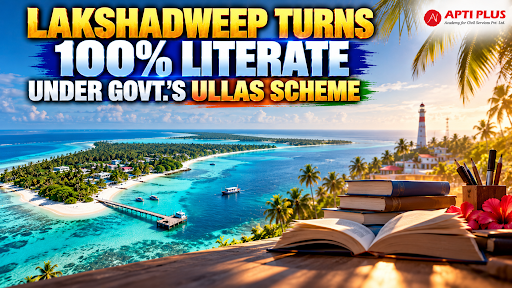
The Union Territory of Lakshadweep was formally declared 100% literate after all identified adult non-literate learners cleared the Foundational Literacy and Numeracy Assessment Test (FLNAT) under the ULLAS Scheme.
What is the ULLAS Scheme?
ULLAS stands for Understanding of Lifelong Learning for All in Society, officially titled the Nav Bharat Saaksharta Karyakram or New India Literacy Programme (NILP).
-
Type: Centrally Sponsored Scheme implemented across all States and UTs.
-
Nodal Agency: Department of School Education & Literacy (DoSEL) under the Union Ministry of Education.
-
Implementation Tenure: Approved for five financial years from FY 2022–23 to FY 2026–27.
-
Financial Outlay: Total budget of ₹1,037.90 crore, comprising a Central share of ₹700 crore and a State share of ₹337.90 crore.
-
Vision & Tagline: "Jan Jan Saakshar", anchored in the spirit of civic duty ("Kartavya Bodh") through widespread community volunteerism.
-
Policy Links: Operationalizes Paragraph 21.4 of the National Education Policy (NEP) 2020 and advances UN Sustainable Development Goal (SDG 4.6) targeting universal adult literacy by 2030.
Core Objectives & Target Group
-
Target Population: Adults aged 15 years and above who missed formal schooling, focusing on rural areas, women, SC/ST/OBC/Minorities, Persons with Special Needs (Divyangjans), and Aspirational Districts.
-
Coverage Target: Aims to educate 5 crore non-literate learners over five years (1 crore learners per year) via the Online Teaching, Learning and Assessment System (OTLAS).
-
Redefined Literacy Benchmark: Evaluates literacy as the ability to read, write, and compute with comprehension, integrated with critical life skills, digital literacy, and financial literacy.
-
"Fully Literate" Tag: A State or Union Territory is officially recognized as Fully Literate upon attaining at least a 95% literacy rate.
Operational Components
-
Foundational Literacy and Numeracy (FLN): Imparts core reading, writing, and basic arithmetic skills.
-
Critical Life Skills: Includes Financial Literacy, Digital Literacy, Legal Literacy, healthcare, disaster management, commercial skills, and family welfare awareness.
-
Basic Education: Provides equivalency learning at preparatory (Classes 3–5), middle (Classes 6–8), and secondary (Classes 9–12) stages through National Institute of Open Schooling (NIOS) and State Institutes of Open Schooling (SIOS).
-
Vocational Skills: Offers skill development and upskilling for local employment in convergence with Jan Shikshan Sansthans (JSS).
-
Continuing Education: Delivers adult education courses in arts, sciences, culture, sports, and technology at community centers.
Implementation Framework & Infrastructure
-
Operational Units: Government and government-aided schools registered under UDISE serve as primary units, utilizing unused spaces as Samajik Chetna Kendras (Social Awareness Centers).
-
Volunteer Network: Driven by volunteer teachers including school and college students (incentivized through academic credits from UGC, AICTE, and NCTE), NSS, NCC, NYSK members, ASHA workers, and Anganwadi workers.
-
Digital Infrastructure: Learning resources and surveys are managed via the ULLAS Mobile App, ULLAS Portal, and DIKSHA platform, offering primers in 22 to 27 regional languages and dialects.
-
Evaluation & Certification: Knowledge is assessed biannually through the Foundational Literacy and Numeracy Assessment Test (FLNAT), with successful learners receiving formal certificates jointly issued by NIOS and DoSEL.
-
Institutional Cadre: State Centres for Literacy (SCL) located inside SCERTs (or principal DIETs in Union Territories like Lakshadweep) customize curriculum modules to suit local needs.
Key Achievements & Milestones
-
Fully Literate States/UTs: Regions reaching or surpassing the 95%+ literacy threshold under ULLAS include Ladakh (2024), Mizoram (98.2%), Goa (99.72%), Tripura, Himachal Pradesh, Chandigarh, Andaman & Nicobar Islands, Sikkim, Uttarakhand, and Lakshadweep (October 2026).
-
Overall Impact: Registered over 4.03 crore learners and 52.20 lakh volunteer teachers, with more than 3.3 crore participants taking the FLNAT assessment nationwide.
Source: THEHINDU
|
PRACTICE QUESTION Q. With reference to the 'ULLAS – Nav Bharat Saaksharta Karyakram' (New India Literacy Programme), consider the following statements: 1. The scheme is a Centrally Sponsored Scheme approved for implementation from FY 2022–23 to 2026–27. 2. It caters exclusively to out-of-school children aged between 6 and 14 years under the Right to Education Act, 2009. 3. The Foundational Literacy and Numeracy Assessment Test (FLNAT) is conducted to evaluate learning outcomes under the scheme. Which of the statements given above is/are correct? (a) 1 and 2 only (b) 1 and 3 only (c) 2 and 3 only (d) 1, 2 and 3 Answer: (b) Explanation: Statement 1 is correct: The Government of India approved the New India Literacy Programme (NILP), popularised as ULLAS – Nav Bharat Saaksharta Karyakram, as a Centrally Sponsored Scheme for implementation over five financial years from FY 2022–23 to 2026–27. Statement 2 is incorrect: ULLAS targets non-literate individuals aged 15 years and above who missed formal schooling, focusing on adult education and lifelong learning. Schooling for children aged 6 to 14 years falls under the Right to Education (RTE) Act, 2009 and is covered under school education programmes such as Samagra Shiksha. Statement 3 is correct: Learning outcomes and competency in reading, writing, and numeracy are evaluated through the Foundational Literacy and Numeracy Assessment Test (FLNAT), certifying successful learners as literate. |