Why In News?
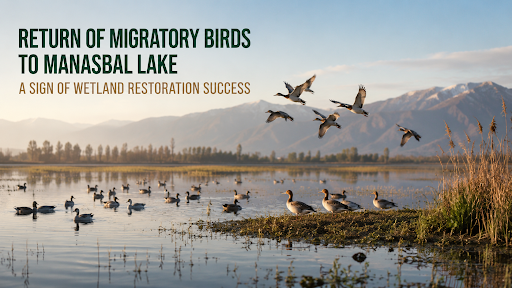
The Wular-Manasbal Development Authority (WMDA) restored Manasbal Lake, triggering the return of over 46 migratory bird species.
What is Manasbal Lake?
The lake lies in the Safapora area of Ganderbal district, Jammu and Kashmir, approximately 30 km northwest of Srinagar.
It ranks as the deepest freshwater lake in India, reaching a maximum depth of 13 meters and spanning an area of 2.81 square kilometers.
It is the only major meromictic lake in India, meaning its deep-water layers do not mix with the upper layers. It has no major surface inlet and is primarily fed by over 1,200 groundwater springs and precipitation.
The wetland hosts vital aquatic flora like Nelumbo nucifera (Lotus) and endemic fish species such as Schizothorax niger.
It serves as a critical staging ground within the Central Asian Flyway, hosting migratory species like the White-Headed Duck, Long-Eared Owl, and Mallard.

Factors Contributing to Ecological Recovery
Wetland Restoration: Dredging processes over a vast area restore natural depth, clear blocked water channels, and improve water circulation.
Invasive Weed Removal: Authorities execute massive weeding operations to eliminate dense mono-specific stands of Ceratophyllum demersum, preventing severe oxygen depletion.
Water Quality Management: The J&K Water Resources Regulatory Authority implements water budgeting to assess carrying capacity and regulate artificial and natural outflows.
Habitat Protection: Installation of trash guards at the junctions of the Lar Canal successfully stops solid waste from entering the lake's limnetic zones.
Community Participation: Active engagement of local stakeholders, including fishermen and boatmen, in sanitation drives ensures solid waste collection across 6.44 lakh square meters.
Source: THEHINDU
|
PRACTICE QUESTION Q. Consider the following statements regarding Manasbal Lake: 1. It is recognised as the deepest freshwater lake in India. 2. It acts as a critical staging ground for migratory birds within the Central Asian Flyway. 3. The lake faces severe eutrophication primarily due to stone quarrying adding excessive calcium. Which of the statements given above is/are correct? A) 1 and 2 only B) 2 and 3 only C) 1 and 3 only D) 1, 2 and 3 Answer: D Explanation: Statement 1 is correct: Manasbal Lake (located in Jammu and Kashmir) is recognized as the deepest freshwater lake in India, with a maximum depth of approximately 13 meters. Statement 2 is correct: It acts as an important staging ground for migratory waterbirds within the Central Asian Flyway and supports rich avian biodiversity. Statement 3 is correct: The lake's ecosystem is heavily threatened by eutrophication, largely driven by agricultural runoff, municipal waste, and limestone quarrying (and the functioning of limestone kilns) from the nearby Ahtung hills, which introduces excessive calcium into the water body. |