Why In News?
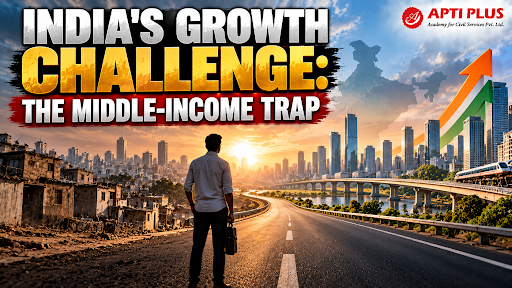
Despite strong GDP growth, India risks a middle-income trap due to weak job creation, stagnant wages, low private investment, and slow innovation transition.
What is the Middle-Income Trap?
The Middle Income Trap is an economic situation where a developing country grows until it reaches a middle level of income, but then fails to advance further into a high-income, developed economy.
The World Bank introduced this term in 2007. It describes nations whose gross national product per capita stalls in the middle-income range.
-
The World Bank defines middle-income economies as those with a Gross National Income (GNI) per capita between $1,146 and $14,005 (subdivided into lower-middle and upper-middle income); nations above $14,005 are classified as high-income economies.
Over the past 34 years, out of 108 middle-income countries studied by the World Bank (World Development Report 2024), only 34 economies (such as South Korea, Chile, Poland, and Singapore) have successfully transitioned into high-income status.

Why Do Countries Enter the Middle-Income Trap?
Loss of Low-Cost Competitive Advantage: As wages rise during early growth, the economy loses its cost competitiveness in low-skilled, labor-intensive exports to poorer, low-income nations.
Lack of Innovation to Compete with Advanced Economies: Domestic industrial base lacks the advanced technology, patents, and engineering skills required to compete with advanced nations in high-value goods.
Stagnant Total Factor Productivity (TFP): Growth remains dependent on adding more labor and physical machinery rather than improving systemic efficiency, operational workflows, and indigenous technological innovation
Severe Human Capital Deficits: Inadequate public spending on primary healthcare, malnutrition reduction, and foundational schooling produces a workforce ill-equipped for complex modern industries.
Institutional Rigidity and Rent-Seeking: Incumbent domestic business conglomerates lobby for protectionism, creating regulatory barriers that stifle competitive start-ups and prevent creative destruction.
What are the Major Transitions Required?

The 1i to 2i Transition: Moving from low-income to lower-middle income requires supplementing physical capital investment with the infusion of existing global technologies, managerial practices, and foreign production techniques.
Technology Adoption Over Reinvention: Under the 2i phase, developing nations import machinery, licence foreign patents, and integrate into multinational supply chains to upgrade domestic manufacturing processes.
The 2i to 3i Transition: Transitioning from upper-middle income to high-income requires adding indigenous innovation to ongoing investment and technology infusion.
Pushing the Global Technology Frontier: At the 3i stage, countries can no longer rely on copying foreign designs; they must develop domestic intellectual property, commercialize frontier research, and foster creative destruction.
Institutional Upgrading: Successful transitions require modernizing capital markets, protecting intellectual property, liberalizing labor mobility, and enforcing anti-monopoly competition laws.
What are the Major Structural Challenges for India?
Low-Productivity Agrarian Employment: Approximately 45% of India’s workforce remains engaged in agriculture, a sector that contributes less than 18% to the national Gross Value Added (GVA), reflecting hidden underemployment.
Premature Deindustrialization Trend: Manufacturing's share in India’s GDP has stagnated around 15% to 17%, failing to absorb millions of low- and semi-skilled workers leaving agricultural fields.
High Prevalence of Informal Employment: Over 85% of India’s total labor force operates in the informal economy, characterized by a lack of written contracts, social security, health insurance, and workplace protections.
Demographic Window of Vulnerability: India’s working-age population is expanding by 7 to 12 million individuals annually; failing to generate productive non-farm jobs risks turning the demographic dividend into a demographic challenge.
Foundational Learning Deficits: The Annual Status of Education Report (ASER) reveals that over 50% of Grade 5 children in rural schools struggle to read a Grade 2 textbook or solve basic subtraction problems.
Severe Graduate Employability Gaps: The India Skills Report indicates that only about 50% of graduating college students possess the practical, job-ready skills required by modern businesses.
Underinvestment in Public Healthcare: Public healthcare expenditure stands at approximately 1.9% of GDP, leaving millions exposed to out-of-pocket health shocks that push households back into poverty.
Stagnant Real Wage Growth: Periodic Labor Force Survey (PLFS) data shows that real wage growth for regular wage earners and informal workers has remained subdued relative to headline GDP growth, constraining domestic consumption demand.
High Logistics and Power Costs: Industrial electricity tariffs remain elevated due to cross-subsidization of agricultural users, and logistics costs consume 8% to 10% of GDP, undermining manufacturing export margins.
Severe Regional and Spatial Disparities: Economic growth remains concentrated in southern and western coastal states (Maharashtra, Tamil Nadu, Gujarat, Karnataka), while populous northern states face high youth unemployment.
What Government Initiatives Can Support Structural Transformation?
Production Linked Incentive (PLI) Scheme: Allocated over ₹1.97 lakh crore across 14 strategic manufacturing sectors (smartphones, advanced chemistry cells, pharmaceuticals, solar PV) to spur scale and capital investment.
PM GatiShakti National Master Plan: A multi-modal digital platform synchronizing the planning and execution of rail, road, port, and telecom infrastructure projects to reduce logistics overheads.National Logistics Policy (NLP): Designed to reduce logistics costs from ~10% of GDP to global benchmarks (7–8%), establishing a unified logistics interface platform (ULIP).
National Education Policy (NEP) 2020: Overhauling foundational education by prioritizing early literacy, multidisciplinary higher education, and vocational skilling from middle school.
Jan Vishwas (Amendment of Provisions) Act: Decriminalizing minor economic offenses across dozens of central business statutes to lower bureaucratic harassment and improve the Ease of Doing Business.
What Should India Do to Escape the Middle-Income Trap?
Adopting the World Bank's "3i" Evolutionary Roadmap: Shifting industrial policy from pure capital deployment toward technology infusion from abroad, culminating in domestic innovation ecosystems.
-
Example: South Korea's Economic Planning Board Strategy moved from state-backed capital construction in the 1960s to foreign licensing and massive corporate R&D by Samsung and Hyundai in the 1980s.
Revitalizing Labor-Intensive Manufacturing Zones: Establish large-scale Coastal Employment Zones (CEZs) with unified single-window clearances, reliable green power, and flexible labor operating models.
-
Example: Tamil Nadu’s Electronics & Footwear Clusters, successfully drawing global contract manufacturers (Foxconn, Pegatron) and employing thousands of women workers.
Incentivizing Private Sector Research and University Alliances: Operationalize the Anusandhan National Research Foundation (ANRF) with venture-matching funds to bridge theoretical academic science with commercial manufacturing.
-
Example: Taiwan's Industrial Technology Research Institute (ITRI) Model seeded advanced semiconductor manufacturing by transferring lab research to commercial spin-offs like TSMC.
Unlocking Female Economic Participation through Social Infrastructure: Build safe urban working-women hostels, subsidize formal daycare crèches, and ensure safe public bus transit to raise female labor participation toward global averages.
-
Example: Bangladesh’s Ready-Made Garment (RMG) Social Ecosystem mobilized millions of female workers through safe transit corridors and community daycare support.
Reforming Municipal Urban Governance and Rental Housing: Empower elected city governments with financial devolution to develop affordable rental housing stocks, enabling low-income rural workers to settle securely in industrial hubs.
Maintaining Policy Predictability and Open Trade Regimes: Resist broad import-tariff walls; instead, sign comprehensive Free Trade Agreements (FTAs) with developed markets (the UK, EU) to bind Indian suppliers into global production lines.
Conclusion
Achieving Viksit Bharat by 2047 requires India to overcome the middle-income trap through structural transformation. By adopting the World Bank's 3i model—infusing global technology, enhancing human capital, expanding manufacturing, and fostering indigenous innovation—India can boost productivity and transition to a high-income economy.
Source: THEHINDU
|
PRACTICE QUESTION Q. Discuss the importance of labor-intensive manufacturing and human capital formation in driving India's transition to a high-income economy by 2047. (15 Marks, 250 Words) |