Why In News?
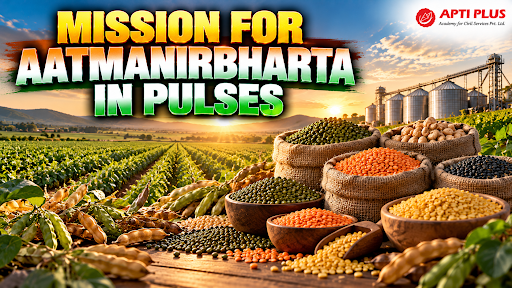
On October 11, 2026, the Ministry of Agriculture and Farmers' Welfare marked the first anniversary of the Mission for Aatmanirbharta in Pulses.
What Is The Mission For Aatmanirbharta In Pulses In Detail?
Origin: The Union Cabinet approved the Mission for Aatmanirbharta in Pulses (also known as the Dalhan Aatmanirbharta Mission) on 1st October 2025 as a Centrally Sponsored Scheme spanning six fiscal years from 2025–26 to 2030–31 with a total financial outlay of ₹11,440 crore.
Import Substitution: Designed under Vision 2047, the Mission aims to transition India from a net importer to a fully self-reliant producer by meeting national pulse requirements entirely through domestic production.
-
In 2023–24, India imported 47.38 lakh tonnes of pulses valued at $3.74 billion representing 18.5% of domestic demand. (Source: NITI Aayog)

Targets: By 2030–31, the Mission seeks to expand domestic pulse output from 242 lakh tonnes to 350 lakh tonnes, increase total cultivated area from 275 lakh hectares to 310 lakh hectares, and enhance national average productivity from 881 kg/ha to 1,130 kg/ha.
Institutional Integration: The Mission subsumes the pulses component of the earlier National Food Security and Nutrition Mission (NFSNM-Pulses).
Significance: Pulses deliver 20–25% of protein in Indian diets—containing double the protein content of wheat and triple that of rice.
-
Fulfilling Article 47 of the Constitution of India (duty to raise nutrition levels) and Sustainable Development Goal 2 (Zero Hunger), the Mission addresses protein deficiency where per capita daily pulse availability trails the ICMR-NIN recommendation of 85 grams per day.
What Are The Core Pillars Of The Mission For Aatmanirbharta In Pulses?
Pillar 1: Assured MSP Procurement Under PM-AASHA: Central procurement agencies NAFED and NCCF guarantee 100% procurement at Minimum Support Price (MSP) for Tur (Arhar), Urad, and Masoor (Lentil) for four consecutive years (2025–26 to 2028–29) for pre-registered farmers.
-
Other pulse crops like Gram and Moong operate under the standard Price Support Scheme (PSS) cap of 25% of state production.
Pillar 2: Accelerated Seed System & Varietal Replacement: The government is distributing 87.5 lakh free seed kits (containing 16 kg for Gram, 8 kg for Lentil, and 4 kg for Moong, Urad, and Tur) and supplying 126 lakh quintals of certified seeds over six years.
-
It targets elevating the Seed Replacement Rate (SRR) and Varietal Replacement Rate (VRR) by mandating that varieties under 5 years old constitute 70% of distribution by 2028–29.
Pillar 3: Cluster-Based Area Expansion: The Mission targets a net area expansion of 35 lakh hectares across 489 focused districts.
-
This comprises converting 10.5 lakh hectares of Targeted Rice Fallow Areas (TRFA) in 13 states (e.g., West Bengal, Bihar, Odisha, Chhattisgarh, Assam) into post-Kharif pulse cropping and expanding intercropping with sugarcane, cotton, and sorghum.
Pillar 4: Post-Harvest Processing Infrastructure: To minimize post-harvest losses and retain local value addition, the Centre approved 1,000 pulse processing units (dal mills) with a 33% capital subsidy (up to ₹25 lakh per unit) for Farmer Producer Organizations (FPOs), Primary Agricultural Credit Societies (PACS), and Self-Help Groups (SHGs).
Pillar 5: Digital Public Infrastructure & Traceability:
-
SATHI Portal: Centralized seed portal built by MoA&FW and NIC for end-to-end digital tracking across breeder, foundation, and certified seed lifecycle stages.
-
Krishi Mapper: Geospatial app enabling real-time geo-fencing, plot geo-tagging, and monitoring of Cluster Frontline Demonstrations (CFLDs) across mandatory crop growth stages.
-
E-Samriddhi & AgriStack: NAFED/NCCF procurement platforms providing Aadhaar-enabled biometric authentication, direct Direct Benefit Transfer (DBT) payments, and integration with unified Farmer IDs.
What Is The Current Status Of The Pulses Sector In India?
Production & Acreage Performance: National pulse production expanded from 256 lakh tonnes in 2024–25 to 274 lakh tonnes in 2025–26. Pulse cultivation occupies 21.86% of total foodgrain area. (Source: PIB)
Global Ranking & Productivity Deficit: India ranks as the world's largest producer (27.40% global share) and consumer (27% global share) of pulses. (Source: NITI Aayog)
-
However, India ranks 10th globally in yield productivity, with national yields averaging 851–902 kg/ha compared to global benchmarks of 969 kg/ha and top-performing nations like Canada (1,880 kg/ha) and China (1,821 kg/ha). (Source: NITI Aayog)
Geographical Concentration: Five states account for over 70% of national production: Madhya Pradesh (22.11%), Maharashtra (16.46%), Rajasthan (16.30%), Uttar Pradesh (10.33%), and Karnataka (7.83%). (Source: NITI Aayog)
 Crop-Wise Balance & Deficit Dynamics:
-
Chickpea (Gram): Accounts for 50% of total pulse output; achieves self-sufficiency during normal monsoon years
-
Pigeonpea (Tur): Structural deficit of 17–26% requiring substantial imports from Mozambique, Myanmar, and Tanzania
-
Lentil (Masoor): High deficit of 64–68% met through imports from Canada and Australia
-
Black Gram (Urad): Deficit of 17–20% imported primarily from Myanmar
What Key Government Initiatives Expand Pulse Production In India?
Pradhan Mantri Annadata Aay Sanrakshan Abhiyan (PM-AASHA): Umbrella price protection framework comprising Price Support Scheme (PSS), Price Deficiency Payment Scheme (PDPS), and Market Intervention Scheme (MIS), with a budget allocation of ₹7,200 crore in 2026–27.
Substantial MSP Enhancements: The Centre announced steep Minimum Support Price hikes for the 2026–27 marketing season:
-
Tur (Arhar): Raised by ₹900 to ₹8,450 per quintal
-
Urad: Raised by ₹800 to ₹8,200 per quintal
-
Masoor (Lentil): Raised by ₹300 to ₹7,000 per quintal
ICAR Seed Hub Network: Establishment of 150 specialized Pulse Seed Hubs across ICAR institutes, KVKs, and State Agricultural Universities (SAUs) generating over 1.05 lakh quintals of quality seeds annually.
Targeted Rice Fallow Area (TRFA) Scheme: Sub-scheme under NFSNM-Pulses driving zero-tillage pulse sowing in post-Kharif paddy fallows across 13 states.
Sub-Mission on Agricultural Mechanization (SMAM): Provision of custom hiring equipment (e.g., raised-bed planters, multi-crop harvesters) for pulse growers.
Bharat Dal Retail Scheme: Government distribution of subsidized chana dal at ₹70/kg, whole chana at ₹58/kg, moong dal at ₹107/kg, and masoor dal at ₹89/kg through NAFED, NCCF, and Kendriya Bhandar to stabilize consumer inflation.
What Structural And Institutional Bottlenecks Challenge The Pulses Sector In India?
Asymmetric Procurement & Intra-Sectoral Distortion: While Tur, Urad, and Masoor enjoy 100% procurement, Gram and Moong remain restricted under the 25% state production cap under PSS. This creates price risk for pulses that comprise half of national production.
Administrative Procurement Delays: Physical procurement under PSS requires formal requests from individual state governments. Bureaucratic delays in notifying procurement centers leave farmers vulnerable during peak arrival weeks.
Rainfed Fragility & High Yield Gap: Over 80% of pulse cultivation is rainfed and pushed to marginal, low-fertility soils. (Source: NITI Aayog)
Ad-Hoc Import Duty Revisions: Dynamic, unannounced zero-duty import extensions for yellow peas and lentils depress domestic market prices during peak domestic harvesting windows, disrupting long-term price signals.
What Is The Strategic Way Forward For Pulse Self-Reliance?
Universal Rollout of Price Deficiency Payment Scheme (PDPS): Scale PDPS under PM-AASHA for Gram and Moong to compensate farmers for the price gap between market realization and MSP (up to 15% of MSP) directly via DBT, eliminating central physical storage burdens. (Source: NITI Aayog)
"One Block–One Seed Village" FPO Model: Decentralize certified seed multiplication by creating block-level seed hubs managed by Farmer Producer Organizations (FPOs).
Tapping Rice Fallows & Speed Breeding: Expand short-duration, climate-resilient pulse varieties (e.g., Pusa Jawahar Arhar Dwarf) in paddy fallows utilizing residual soil moisture.
Counter-Cyclical Variable Import Tariff Mechanism: Replace ad-hoc import waivers with an automated, counter-cyclical variable tariff system managed by the Agricultural Trade Policy, Promotion and Logistics Development Division (ATPP&LD) to auto-raise import duties when domestic prices fall below MSP.
Conclusion
The Mission for Aatmanirbharta in Pulses (2025–31) provides an institutional roadmap combining guaranteed price support, digital seed traceability via SATHI, and area expansion. Achieving self-reliance by 2030–31 requires bridging yield gaps, extending price deficiency coverage to all pulses, and aligning import tariffs with domestic harvest cycles.
Source: PIB
|
PRACTICE QUESTION Q. With reference to pulses production and the 'Mission for Aatmanirbharta in Pulses' in India, consider the following statements: 1. Pulses fix atmospheric nitrogen in the soil through symbiotic association with Rhizobium bacteria. 2. India is the largest producer, largest consumer, and largest importer of pulses in the world. 3. Under the e-Samridhi portal, registered farmers are assured 100% procurement of Tur, Urad, and Masur at Minimum Support Price. Which of the statements given above is/are correct? (a) 1 and 2 only (b) 2 and 3 only (c) 1 and 3 only (d) 1, 2 and 3 Answer: (d) Explanation: Statement 1 is correct: Being leguminous plants, pulses develop root nodules containing symbiotic Rhizobium bacteria. These bacteria fix atmospheric nitrogen gas into plant-absorbable forms (like nitrates/ammonia), enriching soil fertility and reducing the need for chemical nitrogen fertilizers. Statement 2 is correct: India is globally the largest producer (25% of global output), the largest consumer (27% of global consumption), and the largest importer (14–15% of global pulse trade). Statement 3 is correct: Under the e-Samridhi portal (launched via NAFED and NCCF under the umbrella of PM-AASHA), the Government of India provides an assured 100% procurement of Tur (Arhar), Urad, and Masur at the Minimum Support Price (MSP) for pre-registered farmers to encourage domestic cultivation and achieve pulses self-sufficiency. |