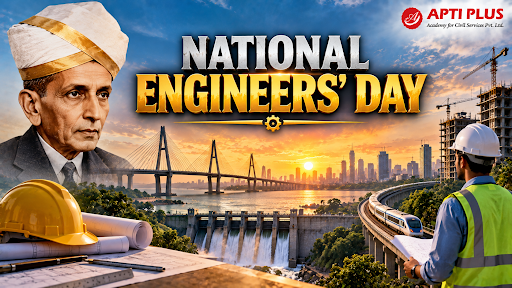
Why In News?
Prime Minister Narendra Modi paid tribute to Bharat Ratna Sir M. Visvesvaraya on National Engineers’ Day, celebrated nationwide on September 15.
About National Engineers’ Day
Every year on September 15, India celebrates National Engineers’ Day to commemorate the birth anniversary of Bharat Ratna Sir Mokshagundam Visvesvaraya.
Formally instituted by the Government of India in 1968 to recognize the engineering fraternity's pivotal role in nation-building.
Who Was Sir M. Visvesvaraya?
Born on September 15, 1861, in Muddenahalli, Karnataka, Sir M. Visvesvaraya was a visionary civil engineer, administrator, and statesman.
-
Honors: Knighted as Knight Commander of the Order of the Indian Empire (KCIE) (1915) and awarded the Bharat Ratna (1955) for his unmatched public service.
-
Irrigation Engineering: Introduced the “Block System” in canal irrigation to prevent water wastage and improve crop productivity.
-
Flood Protection: Designed Hyderabad’s modern drainage system after the 1908 Musi River flood, setting new standards in urban flood management.
-
Economic Visionary: Authored Reconstructing India (1920) and Planned Economy for India (1934), pioneering India’s earliest economic planning frameworks.
-
Administrator: As Diwan of Mysore (1912–1918), he transformed Mysore into a model state with industries, banks, and universities.
Major Contributions
Domain |
Key Achievements |
|
Irrigation Systems |
Developed the Deccan Canal “Block System” aligning water supply with crop cycles. |
|
Hydraulic Engineering |
Patented automatic sluice gates (1903), first installed at Khadakwasla Reservoir, Pune. |
|
Infrastructure |
Engineered the Krishnaraja Sagara (KRS) Dam, then Asia’s largest reservoir. |
|
Industrial Development |
Founded Mysore Iron and Steel Works, Government Soap Factory, and Sandal Oil Factory. |
|
Education & Institutions |
Established University of Mysore (1916), State Bank of Mysore (1913), and UVCE Bengaluru (1917). |
Legacy
Sir M. Visvesvaraya’s life exemplifies discipline, innovation, and service to humanity. His motto — “Work is Worship” — continues to inspire generations of engineers to build a self‑reliant and technologically advanced India.
Source: NEWSONAIR
|
PRACTICE QUESTION Q. With reference to Sir M. Visvesvaraya, consider the following statements: 1. He patented the design of automatic weir sluice gates, which were first installed at the Khadakwasla reservoir in Pune. 2. He authored the book Planned Economy for India (1934), laying down an early structural framework for national economic planning. 3. He served as the Diwan of the Princely State of Hyderabad during the Great Musi River flood of 1908. Which of the statements given above are correct? A) 1 and 2 only B) 2 and 3 only C) 1 and 3 only D) 1, 2, and 3 Answer: A Explanation: Statement 1 is correct: Sir M. Visvesvaraya designed and patented a system of automatic weir sluice gates (floodgates). They were first installed in 1903 at the Khadakwasla reservoir in Pune to raise the food supply and storage levels without damaging the dam. Statement 2 is correct: He authored the landmark book Planned Economy for India (1934), which proposed a 10-year plan for the country and served as an early blueprint for national economic planning and industrialization. Statement 3 is incorrect: He served as the Diwan of the Princely State of Mysore (from 1912 to 1918), not Hyderabad. Following the Great Musi River flood of 1908, he was invited by the Nizam of Hyderabad as a special consulting engineer to design flood protection measures for the city, but he never held the position of Diwan there. |