Why In News?
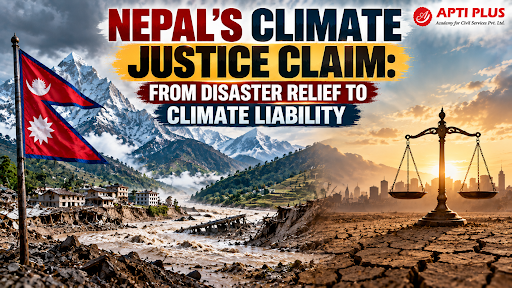
Following Himalayan flash floods and landslides, Nepal’s government demanded legally binding climate compensation from major global greenhouse gas emitters, moving beyond voluntary disaster aid.
Why is Nepal Seeking Climate Compensation Instead of Traditional Disaster Aid?
Reframing Disaster Aid as Legal Restitution: Nepal is challenging the international status quo that treats climate destruction as an unfortunate natural occurrence requiring voluntary humanitarian charity, arguing instead that it constitutes compensatory legal liability for historical carbon pollution.
Severe Emission-Impact Asymmetry: Nepal contributes an about 0.05% of global greenhouse gas (GHG) emissions, yet ranks among the most climate-vulnerable nations globally, enduring climate-induced damages that exceed 1.5% to 2% of its annual GDP in severe disaster years.
Failure of Traditional Humanitarian Relief: Post-disaster grants and bilateral emergency relief packages are ad-hoc, slow to arrive, and vastly insufficient to rebuild destroyed mountain highways, hydropower dams, and bridge infrastructure.
What is Climate Justice?
Climate justice is a moral and political framework that treats climate change as a human rights and equality issue, recognizing that its severe impacts fall disproportionately on marginalized populations who contributed the least to causing the crisis.
-
Common But Differentiated Responsibilities and Respective Capabilities (CBDR-RC): Enshrined in the 1992 UNFCCC and the 2015 Paris Agreement; acknowledges that while all nations must act, developed Annex-I countries bear greater historical responsibility due to their post-industrial cumulative carbon emissions.
-
The Polluter Pays Principle: Those who have produced the high share of atmospheric carbon pollution must finance the costs of adaptation and compensate for residual irreversible loss and damage.
-
Intergenerational & Geographic Equity: Protection of geographically fragile, low-emitting nations (Least Developed Countries - LDCs and Small Island Developing States - SIDS) from existential threats caused by high-emitting industrial societies.
What is Loss and Damage (L&D)?
-
Third Pillar of Climate Action: Represents climate impacts that occur beyond the limits of mitigation (cutting emissions) and adaptation (building resilience).
-
Categorization of Losses:
-
Economic Loss and Damage: Direct quantifiable destruction of public infrastructure, agricultural crops, hydropower projects, residential housing, and commercial revenues.
-
Non-Economic Loss and Damage (NELD): Irreversible, non-monetary losses including loss of human lives, destruction of ancestral cultural heritage sites, disappearance of native biodiversity, and permanent forced migration of indigenous mountain communities.
Status of the Loss and Damage Fund (LDF)
-
Agreed upon in principle at COP27 (Sharm el-Sheikh, 2022) and formally operationalized at COP28 (Dubai, 2023) to provide financial assistance to developing countries vulnerable to climate impacts.
-
Interim Institutional Host: Housed temporarily at the World Bank as a Financial Intermediary Fund (FIF) for an initial four-year period, with an independent governing board representing developing and developed states.
-
Voluntary Nature & Legal Carve-Outs: Contributions remain voluntary. Article 8 of the Agreement does not involve or provide a basis for any liability or compensation, creating an international legal shield for historic polluters.
-
Severe Undercapitalization: Total global financial pledges to the fund currently hover around $822 million, which pales in comparison to the estimated $400+ billion annual loss and damage suffered across developing nations. (Source: UNFCCC)
Why is the Himalayan Ecosystem Hyper-Vulnerable to Climate Disasters?
The Melting "Third Pole": The Hindu Kush Himalayas (HKH) store the largest volume of ice outside the Polar regions. Research by the International Centre for Integrated Mountain Development (ICIMOD) projects that up to two-thirds of Himalayan glaciers could disappear by 2100 under business-as-usual warming scenarios.
Glacial Lake Outburst Floods (GLOFs): Accelerated glacial melting has caused thousands of high-altitude glacial lakes (e.g., Tsho Rolpa, Imja Tsho) to swell dangerously, held back only by unstable moraine dams prone to sudden breaches triggered by avalanches or cloudbursts.
Extreme Cloudbursts and Orographic Precipitation: Warming atmospheric air holds more moisture, generating intense localized downpours that trigger massive debris flows, scouring steep mountain valleys and destroying downstream settlements.
What are the Major Challenges in Enforcing Climate Liability?
Scientific Attribution Hurdles in Mountain Meteorology: Disentangling anthropogenic global warming from local tectonic fragility, seismic activity, and unplanned mountain road construction complicates legal causation.
Explicit Legal Exclusion of Liability under the Paris Agreement: Developed nations condition their participation in climate finance on the complete waiver of sovereign legal liability or judicial compensation claims under Article 8 of the Paris Agreement and Decision 1/CP.21.
-
Case Study: During COP28 negotiations in Dubai, the United States and the European Union insisted that disbursements from the Loss and Damage Fund constitute voluntary humanitarian solidarity rather than compensatory reparation for climate harms.
Financial Disparity Between Pledges and Ground Reality: Total global pledges to the World Bank-hosted Loss and Damage Fund ($822 million) represent less than 0.2% of the annual loss and damage costs borne by developing nations.
-
Case Study: Economic damages from a single season of monsoon floods across Nepal and Pakistan exceeded $15 billion, dwarfing the capitalization of the multilateral Loss and Damage Fund.
Institutional Overhead and Conditionalities of World Bank Hosting: Developing countries and Least Developed Countries (LDCs) face administrative bottlenecks and conditionalities imposed by the World Bank as an interim trustee.
Diplomatic Friction in Transboundary River Basins: Demanding compensation from emerging neighboring economies (like India and China) creates diplomatic strain and fragments the collective bargaining power of the Global South.
Difficulties in Quantifying Non-Economic Loss and Damage (NELD): International disaster evaluation mechanisms lack standardized methodologies to value the permanent loss of ancestral Himalayan cultural landscapes, sacred shrines, and community displacement.
Way Forward for Global Climate Governance
Direct-Access Grant-Based Financing: Operationalize rapid, non-debt grant disbursement mechanisms under the Fund for Responding to Loss and Damage (FRLD), ensuring that vulnerable mountain nations receive emergency funding without compounding their sovereign debt burdens.
-
Case Study: The Pacific Resilience Facility (PRF), a Pacific Island-owned, grant-based financing mechanism delivering immediate post-disaster liquidity to island communities without commercial debt conditionalities.
Automated Transboundary GLOF Telemetry: Establish a regional sensor network under the SAARC Disaster Management Centre (SDMC) and ICIMOD, deploying automated satellite-linked water-level sensors on high-risk glacial lakes across the Himalayas.
Developing Scientific Extreme Event Attribution Protocols: Strengthen regional scientific capacities under the Ministry of Earth Sciences (MoES) and WMO to deploy peer-reviewed climate attribution modeling that isolates global warming signals from natural meteorological variability.
Enhancing Real-Time Bilateral River Telemetry: Upgrade telemetry sharing under the India-Nepal Joint Committee on Inundation and Flood Management (JCIFM) to automate the flow of upstream hydrological gauge data from Nepal to downstream flood control rooms in India.
Mandating Climate-Resilient Mountain Infrastructure: Utilize engineering standards from the India-led Coalition for Disaster Resilient Infrastructure (CDRI) to build slope-stabilized roads, tunnel bypasses, and reinforced bridges designed to withstand high-altitude flood surges.
Deploying Sovereign Parametric Climate Insurance: Introduce parametric risk transfer insurance under the Global Shield against Climate Risks, ensuring automated cash payouts of pre-determined extreme rainfall thresholds being breached.
Conclusion
Nepal’s demand for climate compensation highlights the widening gap between historical emissions and geographic vulnerability; resolving it requires moving beyond ad-hoc humanitarian relief toward an equitable, grant-based multilateral loss-and-damage architecture.
Source: THEHINDU
|
PRACTICE QUESTION Q. The demand by vulnerable Himalayan nations like Nepal for climate compensation signifies a paradigm shift from seeking post-disaster humanitarian aid to asserting international climate liability. Discuss (15 Marks, 250 Words) |