Why In News?
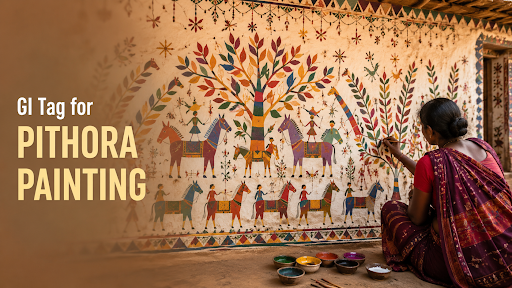
Gujarat's traditional Pithora painting recently gained a Geographical Indication (GI) tag.
About Pithora Painting
Pithora painting is a folk art native to the Rathwa, Bhil, and Bhilala tribes of central Gujarat (like Chhota Udaipur) and Madhya Pradesh, originating approximately 3000 years ago.
Cultural Significance
-
Tribes treat Pithora as a living entity inside their homes.
-
They perform the art to please Baba Pithora (the chief god) to cure illnesses, bring peace, and remove obstacles from their lives.
-
Historically, tribes used these paintings as a secret map (cartography), coding rivers and hills as tigers and horses to safely escort traders.
Features of Pithora Painting
Ritual-Based Folk Art
-
Artists called Lakharas write or paint the art, while the head priest called Badvo or Badwa guides the sacred ritual.
-
Families must completely clean their central house wall (Raj Bhitt) and coat it with cow dung and mud (Leepna) before painting begins.
Rich Symbolism
-
A single Pithora painting features up to 165 different types of motifs.
-
The main symbols include horses, the sun, the moon, and ancestors.
-
Modern artists now include symbols like trains, airplanes, and computers to reflect their changing environment.
Natural Colours
-
Artists create natural pigments from dried leaves, flowers, and mineral sources.
-
They mix these color powders with cow or goat milk and a local tree liquor called Mahuda, which acts as a strong binder to keep the painting bright for years.
What is a Geographical Indication (GI) Tag?
GI is an Intellectual Property Right (IPR) that identifies a product as originating from a specific geographical region, where its quality, reputation or other characteristics are essentially attributable to that place of origin.
GI protection is available for:
-
Agricultural products
-
Natural products
-
Manufactured goods, including handicrafts and textiles, provided at least one stage of production, processing or preparation occurs in the specified region.
Legal Framework in India
-
Governed by the Geographical Indications of Goods (Registration and Protection) Act, 1999.
-
Administered by the Geographical Indications Registry, Chennai, under the Department for Promotion of Industry and Internal Trade (DPIIT), Ministry of Commerce & Industry.
-
The law was enacted to comply with the WTO's TRIPS Agreement.
Key Features
-
Validity: A GI registration is valid for 10 years and can be renewed indefinitely for further 10-year periods.
-
Authorised users alone can legally use the registered GI name.
-
GI is a collective right linked to a region and cannot be sold or assigned like a trademark.
Benefits of a GI Tag
-
Protects products from counterfeiting and misuse.
-
Preserves traditional knowledge and cultural heritage.
-
Enhances market value, exports and rural livelihoods.
-
Promotes tourism and regional branding.
-
Ensures authenticity and quality assurance for consumers.
Examples of Indian GI Products
-
Darjeeling Tea (India's first GI-tagged product)

Source: ANINEWS
|
PRACTICE QUESTION Q. Consider the following statements regarding the Pithora painting tradition: 1. It is primarily practiced by the Rathwa and Bhil communities. 2. Pithora paintings strictly exclude modern elements like airplanes or clocks as they disturb the sacred ritual. Which of the statements given above is/are correct? A) 1 only B) 2 only C) Both 1 and 2 D) Neither 1 nor 2 Answer: A Explanation: Statement 1 is correct: Pithora paintings are a ritualistic mural tradition practiced primarily by the Rathwa, Bhil, and Bhilala tribal communities in Gujarat and Madhya Pradesh. Statement 2 is incorrect: Pithora art is dynamic and adapts to modern surroundings, meaning contemporary artists often incorporate modern motifs and items like airplanes, guns, and railway tracks into their visual narratives. |