Why In News?
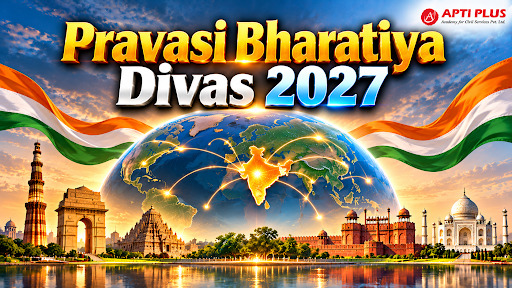
The 19th Pravasi Bharatiya Divas (PBD) Convention will be held in Kolkata, West Bengal, from 7 to 9 January 2027.
What Is Pravasi Bharatiya Divas?
Pravasi Bharatiya Divas (also known as Non-Resident Indian (NRI) Day) is observed on 9 January to recognize the contributions and achievements of the overseas Indian community in the development of the nation.
-
Why 9 January: It marks the return of Mahatma Gandhi, often called the greatest Pravasi, from South Africa to India on 9 January 1915.
Origin
-
Committee Recommendation: The High-Level Committee on the Indian Diaspora, chaired by L.M. Singhvi (2000–01), recommended an annual diaspora day.
-
First Convention: The first PBD was held in 2003, during the tenure of Prime Minister Atal Bihari Vajpayee.
Format
-
Biennial Since 2015: The full convention is now held every two years, with theme-based PBD conferences in between.
-
Youth PBD: Conventions usually begin with a Youth Pravasi Bharatiya Divas, connecting diaspora youth with Indian youth.
Pravasi Bharatiya Samman Award
-
Highest Diaspora Honour: The award is the highest honour for a Non-Resident Indian (NRI), Person of Indian Origin (PIO), or an organisation run by them, for contributions such as improving India's image abroad and supporting Indian communities.
How Large And Significant Is The Indian Diaspora?
Size
-
World's Largest Diaspora: India has the world's largest diaspora, with about 3.5 crore overseas Indians, including NRIs and PIOs.
-
Major Hubs: Large communities live in the Gulf countries, the United States, the UK, Canada, Southeast Asia, Africa and the Caribbean.
|
Category |
Meaning |
|
NRI |
Indian citizen living abroad |
|
PIO |
Foreign citizen of Indian origin |
|
OCI |
Overseas Citizen of India cardholder, a foreign national of Indian origin with lifelong visa and certain rights in India |
Economic Contribution
-
Top Remittance Receiver: India is the world's largest recipient of remittances, receiving about $135 billion in 2025, according to the Economic Survey.
-
Investment And Skills: The diaspora brings investment, technology and global business networks.
Strategic And Cultural Influence
-
Soft Power: Diaspora communities spread Indian culture, yoga, cuisine and films.
-
Advocacy: Diaspora groups have supported Indian interests in host countries, as in the India–US Civil Nuclear Deal (2008).
-
Political Presence: Several people of Indian origin have become heads of state or government in countries such as Mauritius, Guyana, Suriname and the UK.
Challenges faced by overseas Indians
Exploitation Of Migrant Workers
-
Gulf Labour Issues: Low-skilled workers in the Gulf face wage theft, passport confiscation and poor working conditions under restrictive sponsorship (kafala) systems.
Fraudulent Recruitment
-
Fake Agents: Unregistered agents trap job seekers through fake overseas job offers.
-
Example: In 2024, several Indians were lured by agents into serving with the Russian army in the Ukraine war, prompting India to press Moscow for their release. Tighter Immigration Rules Abroad
-
Restrictive Policies: Stricter visa and immigration rules in major destinations affect Indian students and professionals.
-
Example: In September 2025, the United States imposed a $100,000 fee on new H-1B visa petitions, a category in which Indians form the largest group of recipients.
-
Deportations: Deportation of undocumented Indians, especially from the US, has raised concerns about their treatment.
Rising Hostility And Racism
-
Hate Incidents: Indian students and workers have faced racial attacks and hate crimes in some countries.
Diplomatic Strains Affecting Diaspora
-
Bilateral Tensions: Political disputes, such as tensions with Canada in recent years, can affect diaspora communities.
Brain Drain
-
Loss Of Talent: Many highly skilled Indians, such as doctors, engineers and researchers, settle abroad permanently.
Limited Political Participation
-
Voting Barriers: NRIs can vote only in person at their registered constituency in India, so very few actually vote.
-
Example: Out of approximately 1.34 crore NRIs living worldwide, only 1,19,374 were registered as overseas electors for the 2024 Lok Sabha elections, and just 2,958 actually voted.
Outdated Emigration Law
-
Old Framework: The Emigration Act, 1983 does not fully address modern migration, such as for students and skilled professionals.
Way Forward
Modernise Migration Law
-
New Legislation: Replace the Emigration Act, 1983 with a modern law covering safe migration, recruitment regulation and welfare of all categories of migrants.
Protect Migrant Workers
-
Labour Agreements: Sign and enforce labour and social security agreements with destination countries.
-
Pre-Departure Training: Expand skill and orientation training under the Pravasi Kaushal Vikas Yojana, launched in 2016.
Crack Down On Illegal Agents
-
Stronger Enforcement: Prosecute unregistered agents and run awareness campaigns about fake job offers.
Turn Brain Drain Into Brain Gain
-
Talent Return And Networks: Create research fellowships and startup incentives to attract diaspora talent back, and build networks with those abroad.
-
Learn From Others: Some countries use diaspora talent strategically.
-
Example: Israel and China have run long-term programmes to attract diaspora scientists and entrepreneurs back home, boosting their technology sectors.
Enable Diaspora Investment
-
Easier Investment: Simplify rules for diaspora investment in startups, infrastructure and GIFT City.
-
Lower Remittance Costs: Push for cheaper cross-border transfers, including UPI links with other countries.
Strengthen Political Participation
-
Remote Voting: Explore secure postal or proxy voting for overseas electors.
Deepen Cultural And Youth Engagement
-
Heritage Connect: Expand programmes for Girmitiya descendants and diaspora youth to trace their roots in India.
-
Kolkata As A Bridge: Use the 2027 convention to highlight Kolkata's link with indentured migration and connect with diaspora communities in the Caribbean, Africa and the Pacific.
Conclusion
By modernising migration laws, protecting workers, tapping diaspora talent and investment, and deepening cultural ties, India can turn its global community into a stronger partner in building a developed India.
Source: INDIANEXPRESS
|
PRACTICE QUESTION Q. Consider the following statements about Pravasi Bharatiya Divas: 1. It is observed on 9 January to mark Mahatma Gandhi's return from South Africa in 1915. 2. The first Pravasi Bharatiya Divas was held in 2003. 3. Since 2015, the full convention has been held every two years. How many of the statements given above are correct? (a) Only one (b) Only two (c) All three (d) None Answer: (c) Explanation: Statement 1 is correct: Pravasi Bharatiya Divas is observed on 9 January every year to commemorate Mahatma Gandhi's return to India from South Africa on 9 January 1915. Statement 2 is correct: The first Pravasi Bharatiya Divas Convention was inaugurated and held in 2003. Statement 3 is correct: Since 2015, the format was revised so that the major full PBD convention is held every two years (biennially) |