Why In News?
The Chief of Defence Staff General NS Raja Subramani inaugurated new residential towers, living quarters for Defence Security Corps (DSC) personnel, under Project Seabird Phase IIA.
What Is Project Seabird?
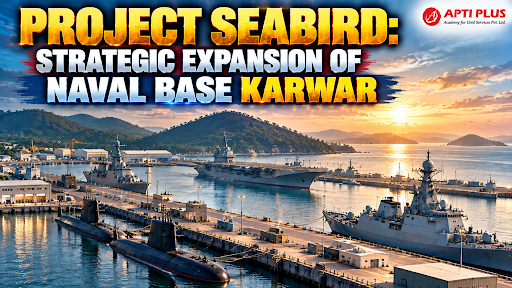
Project Seabird is India’s largest naval infrastructure program, situated at Naval Base Karwar (INS Kadamba) along the coast of Karnataka (approx. 120 km south of Goa).
Spread across over 11,000 acres with a 26 km coastline, it is designed to establish an exclusive, self-sustaining deep-water naval haven for the Indian Navy on the western seaboard.
Origin and Implementation
Post-1971 Indo-Pak War: Following the 1971 Indo-Pakistan War, the Indian Navy recognized the strategic risk of over-concentrating the Western Fleet in commercial harbors like Mumbai Port, which suffered from commercial shipping congestion, shallow waters, and security risks due to nearby urban infrastructure.
Site Selection: Karwar was selected in the early 1980s after hydrographic surveys by the National Institute of Hydrology, Central Water and Power Research Station, and National Institute of Oceanography.
Foundation: Sanctioned in 1985, Prime Minister Rajiv Gandhi laid the foundation stone in October 1986. The project was revived in 1999 under Defence Minister George Fernandes following Pokhran-II.
Phase |
Timeline & Outlay |
Key Infrastructure & Operational Capabilities |
|
Phase I |
Commissioned 31 May 2005; completed 2011 at ₹2,629 crore. |
• Tranquil Deep-Sea Harbor: Protected by 3 breakwaters (1.7 km northern, 3.1 km southern, and 0.34 km spur). • Shiplift System: India's first 10,000-tonne shiplift and transfer system for dry-docking warships and submarines. • Support Assets: Berthing for 10 capital ships, a naval repair yard, and the 141-bed INHS Patanjali hospital. |
|
Phase IIA |
Approved by Cabinet Committee on Security (CCS) in Dec 2012 for ₹13,500 crore, revised to ~₹19,600 crore. |
• Fleet Capacity: Expands berthing for 32 frontline warships and submarines plus 23 yardcraft along 6 km of berthing space. • Covered Dry Berth: 75-meter high Covered Dry Berth spanning 33,000 m² (taller than Delhi's Qutub Minar) for simultaneous enclosed maintenance of 4 capital ships. • Naval Air Station (NAS): Greenfield dual-use airfield with a 2,700 m runway for Short Range Maritime Reconnaissance (SRMR) aircraft, fighter jets, UAVs, and a commercial civil enclave. • Ordnance & Missile Storage: Augments Naval Armament Depot (NAD) and Missile Technical Position (MTP) with 400-ton box igloos and 600-ton double-bunker magazines for SSM and SAM missiles. • Townships: 4 townships providing ~10,000 residential dwelling units for officers, sailors, and civilian staff. |
|
Phase IIB |
Planning stage. |
• Will expand base capacity to host 50 capital warships and 40 auxiliary vessels, making INS Kadamba the largest naval installation in the Eastern Hemisphere east of the Suez Canal. |
Strategic Significance of Project Seabird
Strategic Dispersal and Decongestion: Relocates capital warships away from congested commercial ports (Mumbai, Kochi), eliminating operational bottlenecks and mitigating vulnerabilities from urban proximity and commercial traffic.
Natural Topographical Camouflage: Nestled between the craggy hills of the Western Ghats and the Arabian Sea, the terrain provides natural cover for ground installations against enemy strike aircraft and satellite optical/infrared reconnaissance.
Deep-Water Carrier Homeporting: Offers natural deep-water draft capable of homeporting India's premier aircraft carriers—INS Vikramaditya and INS Vikrant—alongside stealth frigates like INS Tushil and Kalvari-class submarines.
Operational Secrecy During Overhauls: The 75-meter high Covered Dry Berth enables enclosed refits and maintenance, shielding sensitive radar, electronic warfare, and weapon integration from overhead satellite surveillance.
Aatmanirbhar Bharat & Economic Impact: Over 90% of equipment and materials under Phase IIA are procured domestically, targeting an IGBC Gold Rating while creating 7,000 direct and 25,000 indirect jobs. (Source: PIB)
Source: PIB
|
PRACTICE QUESTION Q. With reference to 'Project Seabird' of the Indian Navy, consider the following statements: 1. It is a major naval infrastructure project located at Karwar along the coast of Karnataka. 2. The commissioned naval base is designated as INS Kadamba, named after the ancient Kadamba dynasty. 3. It was constructed exclusively by foreign defense consortia without the utilization of domestic Indian engineering components. Which of the statements given above is/are correct? (a) 1 and 2 only (b) 2 and 3 only (c) 1 and 3 only (d) 1, 2 and 3 Answer: (a) Explanation: Statement 1 is correct: Project Seabird is a major naval infrastructure project of the Indian Navy located at Karwar along the coast of Karnataka. Statement 2 is correct: The commissioned naval base is designated as INS Kadamba, named after the ancient Kadamba dynasty which ruled parts of Karnataka. Statement 3 is incorrect: The project utilized domestic Indian planning, engineering, and construction participation alongside specialized technologies, rather than being built exclusively by foreign consortia without any Indian engineering components. |