Why In News?
The Ministry of Environment, Forest and Climate Change (MoEFCC) has included the pygmy hog in the national Species Recovery Programme under the Centrally Sponsored Scheme for Development of Wildlife Habitats (CSS-DWH).
What is the Pygmy Hog?
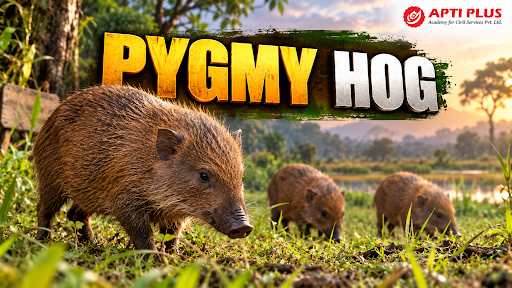
The pygmy hog (Porcula salvania) is the world's smallest and rarest wild pig.
Key Physical Features
-
Size: Adults stand only about 25 cm tall and weigh under 10 kg (typically 6 to 12 kg).
-
Appearance: They have dark brownish-black hair, a short tail, and a small, slender body compared to regular pigs.
Habitat and Distribution
-
Location: Once widespread along the Himalayan foothills in India, Nepal, and Bhutan, they are now almost entirely confined to protected areas and sanctuaries in Assam, India (such as Manas National Park, Orang National Park, and Barnadi Wildlife Sanctuary).
-
Environment: They live in dense, tall riverine grasslands, which serve as an indicator species—meaning their presence reflects a healthy grassland ecosystem.
Behavior and Diet
-
Social Life: They live in small, sociable family groups of up to 20 individuals led by a matriarch, while adult males are often solitary.
-
Nesting: Unlike most other pigs, they build unique daily sleeping nests by digging a shallow depression and piling dry grass over it.
-
Diet: They are omnivores, feeding on roots, tubers, shoots, insects, small reptiles, and ground vegetation.
Conservation Status
-
IUCN Red List: Listed as Endangered.
-
Wild Life (Protection) Act, 1972: Protected under Schedule I, granting the highest legal protection and maximum statutory penalties against poaching and trade.
-
CITES: Listed under Appendix I, prohibiting international commercial trade in the species or its derivatives.
About Species Recovery Programme
It is a targeted sub-component of the Integrated Development of Wildlife Habitats (IDWH) scheme designed to protect and recover critically endangered and vulnerable wildlife populations.
-
Management: Overseen by the Ministry of Environment, Forest and Climate Change (MoEFCC) alongside the Wildlife Institute of India (WII).
-
Methods: Uses captive breeding, habitat restoration, and local community involvement.
-
Funding: Backed by central budgets and the Compensatory Afforestation Fund Management and Planning Advisory Council (CAMPA).
Covered Species
The program prioritizes 22 key species (16 terrestrial and 6 aquatic):
-
Mammals: Snow Leopard, Hangul, Dugong, Asian Wild Buffalo, Manipur Brow-antlered Deer (Sangai), Malabar Civet, Indian Rhinoceros, Asiatic Lion, Swamp Deer, Clouded Leopard, Arabian Sea Humpback Whale, Red Panda, Caracal.
-
Birds: Great Indian Bustard and other bustards including floricans, Edible Nest Swiftlet, Vultures, Jerdon's Courser.
-
Reptiles & Others: Marine turtles, Northern River Terrapin, Nicobar Megapode.
-
Aquatic: Gangetic River Dolphin.
Source: THEHINDU
|
PRACTICE QUESTION Q. With reference to the Pygmy Hog (Porcula salvania), consider the following statements:
Which of the statements given above are correct? (a) 1 and 4 only (b) 2 and 3 only (c) 1, 2 and 3 only (d) 1, 2, 3 and 4 Answer: (b) 2 and 3 only Explanation: Statement 1 is correct: The pygmy hog (Porcula salvania) is the world's smallest wild pig and is treated as Critically Endangered due to its tiny remaining population. Statement 2 is correct: Pygmy hogs build distinct domed grass nests (thatched grass roofs) on the ground using roots and leaves, which they use for shelter and breeding throughout the year. Statement 3 is correct: It receives the highest legal protection in India under Schedule I of the Wild Life (Protection) Act, 1972 and is protected internationally under Appendix I of CITES. Statement 4 is incorrect: The species is endemic to the tall, wet alluvial grasslands of the Himalayan foothills (primarily in Assam, such as Manas National Park), rather than the tropical rainforests of the Western Ghats. |