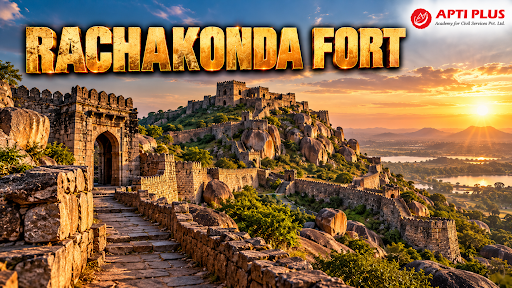
Why In News?
The Telangana Tourism Department invited Expressions of Interest (EoIs) from private investors to conserve, develop, and operate visitor facilities around Rachakonda Fort.
Rachakonda Fort
-
Location: Rachakonda Fort is a 14th-century hill fort in Sansthan Narayanpur mandal, Yadadri Bhuvanagiri district, Telangana. It lies around 60 km southeast of Hyderabad and covers nearly 6 sq. km of rocky Deccan terrain.
-
Origin: Recherla Anapotanayaka, son of Recherla Singamanayaka, built the fort around 1360 CE. The Recherla Nayakas emerged as an independent power after the Kakatiya kingdom collapsed in 1323 CE.
-
Rise as a Capital: Anapotanayaka moved his capital from Anumagallu (Amangal) to Rachakonda. His brother Madanayaka administered the southern territory from Devarakonda, which functioned as another major centre.
-
Kingdom’s Extent: At its height, the Recherla kingdom extended from the Godavari River in the north to Srisailam in the south. The Bahmani Sultanate lay to its west, while the Kondaveedu Reddis controlled areas to the east.
-
Political Conflicts: The Recherla rulers faced repeated conflicts with the Musunuri Nayakas and Kondaveedu Reddis. Their changing relations with the Bahmanis, Vijayanagara rulers and Gajapatis of Odisha shaped the region's political history.
-
End of Recherla Rule: The Bahmani Sultanate, under Nizam Shah, captured Rachakonda around 1475 CE, bringing the fort's role as the centre of the Recherla kingdom to an end.
Architectural Features
-
Cyclopean Construction: The fort is notable for cyclopean masonry, where large and irregular granite stones were carefully placed together without the extensive use of mortar.
-
Defensive Design: The complex contains two concentric stone fortification walls, gateways, massive stone pillars and lintels. Earthen slopes supported the outer defensive structures.
-
Architectural Influences: Rachakonda mainly reflects medieval Hindu fort architecture, while some features, including arched gateways and decorative stone elements, show later Islamic architectural influence.
-
Religious Heritage: The ruins include Sri Rama temples and Shaiva shrines dedicated to Shiva and Veerabhadra, reflecting the religious traditions of the region.
-
Water and Prehistoric Heritage: The fort complex also contains the Anapota Samudra reservoir and prehistoric Deccan cave paintings, adding archaeological significance to the site.
Source: DECCANCHRONICLE
|
PRACTICE QUESTION Q. With reference to the medieval history of Southern India, the Rachakonda Fort was primarily established by which of the following dynasties? (a) Kakatiya Dynasty (b) Bahmani Sultanate (c) Recherla Nayaka (Padmanayaka) Dynasty (d) Qutb Shahi Dynasty Answer: (c) Explanation: The Rachakonda Fort (located in present-day Telangana) was built in the 14th century. Its foundation is traditionally credited to Recherla Singama Nayak, and the capital was later shifted there around 1360 CE by Anapotanayaka from Anumagallu. The Recherla Nayakas (or Padmanayakas) rose to power in the Deccan power vacuum following the fall of the Kakatiyas. |