Why In News?
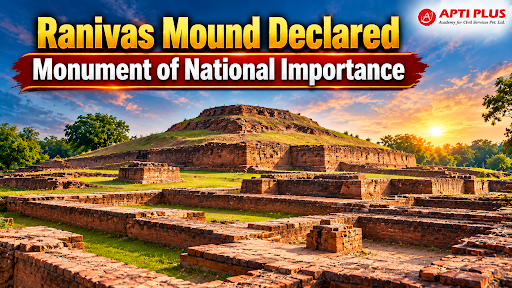
The Ranivas Mound in Bihar declared an archaeological site of national importance through a central government notification under the Ancient Monuments and Archaeological Sites and Remains (AMASR) Act, 1958.
What Is The Ranivas Mound?
Location And Features
-
Near Kesariya: The mound lies close to the Kesariya Stupa in East Champaran district, a major Buddhist site.
-
Name: It takes its name from local legends.
-
Area And Ownership: It covers about 1.63 acres and is owned by the Bihar government.
Historical Record
-
Cunningham's Visit: Alexander Cunningham, the first Director General of the Archaeological Survey of India (ASI), visited and explored the site in 1861.
-
Buddhist Establishment: His report recorded an old Buddhist establishment with a temple enshrining a huge image of the Buddha.
|
What Is Mound In Indian archaeology and history, a mound refers to an elevated, artificial or natural-accumulation hillock formed by the debris, remnants, and successive layers of long-term human habitation, rituals, or burials.
|
What Is The Significance Of Kesariya?
The Kesariya Stupa is recognized as one of the world's largest and tallest ancient Buddhist stupas.
-
Association with Lord Buddha's Final Journey: According to Buddhist tradition and historical accounts, the stupa marks a sacred spot where Lord Buddha rested during his final journey toward Kushinagar before his Mahaparinirvana.
-
The Alms Bowl Gift: It corresponds to the historical site where Buddha presented his personal begging bowl (alms bowl) to the Licchavis of Vaishali as a farewell gift before they turned back.
-
Site of Important Discourses: It is believed to be the place where Buddha foretold his impending passing to his disciples and where he delivered key teachings, including the Kalama Sutta (which encourages critical thinking and personal verification of spiritual truths).
-
Architectural and Scale Grandeur: Standing about 104 feet tall with a 400-foot circumference, it features a unique six-tiered circular mandala design. Scholars note striking architectural similarities to the famous 9th-century Borobudur temple in Indonesia.
-
Archaeological Heritage: Originally dating back to the Mauryan period under Emperor Ashoka (circa 250 BCE) with later Pala-period expansions, the site features recessed niches housing seated Buddha statues in the Bhumisparsha mudra. It is protected as a national monument by the Archaeological Survey of India.
How Are Monuments Of National Importance Declared?
The AMASR Act, 1958
-
Legal Basis: Monuments and sites of national importance are declared under the AMASR Act, 1958.
-
Process: The Centre issues a notification inviting objections, usually allowing two months, before final declaration.
-
Protection: Once declared, the site comes under the protection and maintenance of the ASI.
Protected Zones Under The 2010 Amendment
|
Zone |
Distance From Monument |
Rules |
|
Prohibited area |
Within 100 metres |
No new construction allowed |
|
Regulated area |
200 metres beyond the prohibited area |
Construction only with permission |
- National Monuments Authority (NMA): Created through the 2010 amendment to the AMASR Act, it grades monuments and regulates construction around them.
What Is The Archaeological Survey Of India (ASI)?
ASI is responsible for archaeological research, scientific excavations, and the protection and conservation of cultural heritage and centrally protected monuments of national importance in India.
-
Origin: Founded in 1861 by Sir Alexander Cunningham, who became its first Director-General and is celebrated as the "Father of Indian Archaeology".
-
Headquarters: Located at Dharohar Bhawan, New Delhi.
-
Parent Ministry: Operates under the Ministry of Culture.
-
Scale of Protection: Administers and maintains over 3,650 ancient monuments and archaeological sites of national importance across multiple regional circles and site museums.
Core Functions of the ASI
-
Archaeological Research & Excavations: Conducts scientific explorations, unearths ancient artifacts, and studies historical development across pre-historic and historic eras.
-
Conservation & Preservation: Restores and maintains historical structures, temples, forts, tombs, and rock-cut caves.
-
Epigraphy & Numismatics: Deciphers ancient inscriptions, copper plates, coins, and scripts.
-
Specialized Wings: Operates dedicated branches including epigraphy, science (for chemical preservation), horticulture, temple survey, and an Underwater Archaeology Wing (UAW).
-
Regulatory Role: Governed and empowered by key legislative acts:
-
The Ancient Monuments and Archaeological Sites and Remains Act (AMASR Act), 1958
-
The Antiquities and Art Treasures Act, 1972
Source: THEHINDU
|
PRACTICE QUESTION Q. Consider the following statements: 1. The Ranivas Mound is located in Uttar Pradesh near Kushinagar. 2. It was declared a monument of national importance under the Antiquities and Art Treasures Act, 1972. 3. The Archaeological Survey of India was established in 1902 under Lord Curzon. How many of the statements given above are correct? (a) Only one (b) Only two (c) All three (d) None Answer: (d) Explanation: Statement 1 is incorrect. The Ranivas Mound is located at Kesariya in the East Champaran district of Bihar, not in Uttar Pradesh. It sits near the famous Kesariya Stupa. Statement 2 is incorrect. The Ministry of Culture declared the site to be of national importance under the Ancient Monuments and Archaeological Sites and Remains (AMASR) Act, 1958, rather than the Antiquities and Art Treasures Act, 1972. Statement 3 is incorrect. The Archaeological Survey of India (ASI) was established in 1861 by Alexander Cunningham, who served as its first Director-General. Lord Curzon later reorganized the department in 1902 and appointed John Marshall as Director-General. |