Why In News?
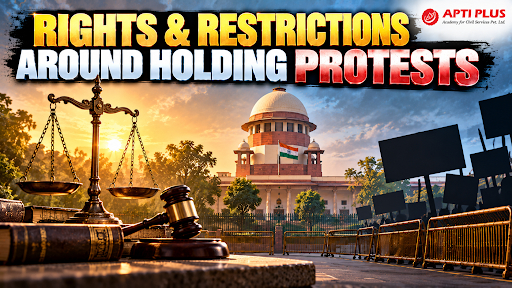
Frequent police denials of assembly permissions and the widespread use of Section 163 of the BNSS, 2023 (formerly Section 144 CrPC) in capitals have reignited debate on whether prior permission is a facilitative process or an executive veto on the right to protest.
What is the Right to Protest?
The right to protest is an indispensable feature of a constitutional democracy that enables citizens to register dissent, voice grievances, criticize government actions, hold the State accountable, and participate directly in public affairs.
-
It aligns with international human rights benchmarks, including Article 20 of the Universal Declaration of Human Rights (UDHR) and Article 21 of the International Covenant on Civil and Political Rights (ICCPR).
-
Recognized Forms of Dissent: Includes peaceful public assemblies, demonstrations, processions, rallies, and peaceful hunger strikes (Satyagraha), which the judiciary has consistently affirmed as protected modes of expression.
Framework under Indian Constitution
Article 19(1)(a): Guarantees the Right to Freedom of Speech and Expression, enabling citizens to publicly articulate opinions, mobilize public support, and express political dissent.
Article 19(1)(b): Guarantees the Right to Assemble Peaceably and Without Arms, providing the constitutional backing for collective gathering and peaceful public demonstrations.
Article 21 (Right to Life and Personal Liberty): Interconnected with fundamental freedoms; state action restricting assembly or personal liberty must meet the test of fairness, justice, and reasonableness (Maneka Gandhi vsUnion of India).
Article 51A (Fundamental Duties): Places a duty on citizens, under Article 51A(i), to safeguard public property and abjure violence, establishing that fundamental rights co-exist with constitutional obligations.
Spatial Right to Public Spaces: In Himat Lal K. Shah vs Commissioner of Police (1973), a Constitution Bench established that public streets, parks, and open spaces are legitimate arenas of democratic assembly and expression, rather than mere conduits for traffic.
Limitations under Indian Constitution
Non-Absolute Nature: Fundamental rights under Article 19 are non-absolute and subject to reasonable regulatory restrictions imposed by law.
Grounds for Restriction under Article 19(2): Freedom of speech and expression can be restricted on grounds of the sovereignty and integrity of India, security of the State, friendly relations with foreign States, public order, decency or morality, contempt of court, defamation, or incitement to an offence.
Grounds for Restriction under Article 19(3): The right to peaceful assembly can be restricted specifically in the interests of public order and the sovereignty and integrity of India.
Prohibition of Indefinite Blockades: In Amit Sahni vs Commissioner of Police (2020) (Shaheen Bagh Case), the Supreme Court ruled that public ways and arterial transit roads cannot be occupied indefinitely for protests, as it violates the fundamental right of movement of other citizens under Article 19(1)(d).
Doctrine of Proportionality & Balancing of Rights:
-
In Mazdoor Kisan Shakti Sangathan (MKSS) vs Union of India (2018), the apex court held that the right to protest must be balanced against the Article 21 rights of nearby residents and commuters.
-
In Anuradha Bhasin vs Union of India (2020), the court mandated that any restriction must satisfy a strict proportionality test—pursuing a legitimate aim, being suitable and necessary, and representing the least restrictive measure available.
Role of Police Permission and Limits
Regulatory Necessity: Associating police authorities for prior permission or a No Objection Certificate (NOC) is constitutionally valid under Articles 19(2) and 19(3) to ensure traffic regulation, public safety, and orderly conduct (Himat Lal K. Shah; Re-Ramlila Maidan Incident).
Facilitative Function: Police permission is legally intended to be a facilitative mechanism to assist demonstrations rather than an administrative device to reject dissent; total prohibition or extinction of assembly is unconstitutional (MKSS v. Union of India).
Key Statutory Provisions:
-
Section 163 of Bharatiya Nagarik Suraksha Sanhita, 2023 (BNSS) [formerly Section 144 of CrPC]: Authorizes Executive Magistrates to issue prohibitory orders restricting public assembly in urgent cases of apprehended danger or nuisance. However, orders must be in writing, state material facts, and be based on an actual, imminent threat to public order rather than speculative fears (Madhu Limaye vs SDM; Re-Ramlila Maidan Incident).
-
Section 148 of BNSS [formerly Section 129 of CrPC]: Empowers police officers and magistrates to order the dispersal of unlawful assemblies.
-
Section 223 of Bharatiya Nyaya Sanhita (BNS) [formerly Section 188 of IPC]: Penalizes the intentional disobedience of a lawful prohibitory order issued by a public servant.
Judicial Limits on Police Powers:
-
Anti-Arbitrariness Standard: Police rules granting unguided, arbitrary discretion to grant or refuse protest permission without clear guidelines violate Article 14 and Article 19(1)(b) (Himat Lal K. Shah).
-
Proportionality in Force: Force can only be used incrementally as a last resort when an assembly refuses to disperse. Excessive or unprovoked police force against peaceful or sleeping gatherings violates fundamental human rights (Anita Thakur vs State of J&K; Re-Ramlila Maidan Incident).
What Legal Remedies Are Available When Permission is Denied?
Administrative Reconsideration: Organizers can re-approach the police authority (e.g., Deputy Commissioner of Police) seeking a review by proposing a smaller crowd size, shorter duration, or an alternative designated site.
Statutory Recourse under BNSS:
-
Under Section 163(5) of BNSS [formerly Section 144(4) of CrPC], an aggrieved party can apply directly to the issuing Magistrate to rescind or modify the prohibitory order.
-
Under Section 163(7) of BNSS, the Magistrate is statutorily required to give the applicant an early opportunity to show cause and must record reasons in writing if the application is rejected.
Constitutional Writ Jurisdiction: Organizers can approach the High Court under Article 226 or the Supreme Court under Article 32 of the Constitution via a writ petition (or habeas corpus in cases of unlawful detention) to quash arbitrary denial orders or seek compensation for fundamental rights violations.
Judicial Review: Prohibitory orders and permission refusals are subject to full judicial review to evaluate whether the restriction satisfies the standards of reasonableness, non-arbitrariness, and minimal impairment. (Babulal Parate vs State of Maharashtra; Anuradha Bhasin)
Way Forward
Codified Protocols for Protest Arenas: Consolidate clear, published guidelines for designated dissent arenas (such as Jantar Mantar and Ramlila Ground) outlining explicit parameters on capacity, sound levels, and timing via single-window digital permissions.
Mandatory Alternative Venues: When permission at a requested central venue is denied, authorities must statutorily offer a viable alternative site within the vicinity of decision-makers rather than imposing blanket central bans.
Graduated Response & Non-Lethal SOPs: Establish uniform Standard Operating Procedures (SOPs) for crowd management based on mandatory verbal warnings, de-escalation communication, and non-lethal crowd control measures paired with mandatory body-worn cameras.
Institutional Police Accountability: Introduce mandatory post-incident judicial or National Human Rights Commission (NHRC) inquiries whenever police force causes physical injuries or property damage.
Prior Stakeholder Dialogue: Institutionalize mandatory consultation meetings between protest organizers and police leadership to agree on routes, security arrangements, and volunteer deployments prior to demonstrations.
Conclusion
The right to protest is a cornerstone of Indian constitutional democracy under Article 19, requiring the State to balance public order with democratic dissent through constitutional morality, procedural fairness, and proportionate regulation.
Source: INDIANEXPRESS
|
PRACTICE QUESTION Q. The right to protest is an indispensable feature of constitutional democracy, yet it cannot become an unrestricted right to block public order and citizen mobility. Critically analyze. 150 words |