Why In News?
An investigation by the Environmental Justice Foundation (EJF) exposes Senegal's Port of Dakar as a major gateway for the illegal shark fin trade.
About Shark Finning
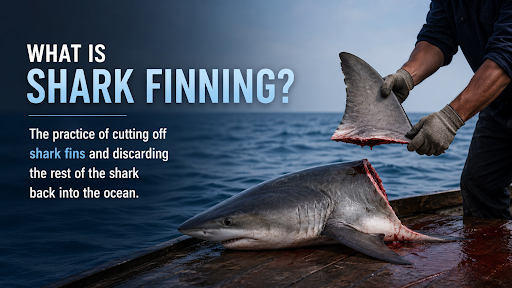
Shark finning is the brutal practice of removing a shark’s fins and discarding the rest of its body back into the ocean, often while the animal is still alive.
-
Unable to swim, the defenseless shark sinks to the bottom and dies from suffocation, blood loss, or predation.

Major Impacts of Shark Finning
Rapid Population Decline: Global shark and ray populations plummet by 71% since 1970 due to intense industrial fishing pressure.
Food Chain Disruption: Eliminating apex predators disrupts nutrient cycling and the "whale pump" mechanism, which suppresses phytoplankton growth and cripples ocean productivity.
Extinction Risks: The International Union for Conservation of Nature (IUCN) warns that 70% of pelagic sharks face extinction, with fishers killing 80 million to 101 million sharks annually.
Biodiversity Loss: Sharks possess a K-selected life history (slow growth, late maturity, low fecundity) and cannot reproduce fast enough to recover, threatening species like the scalloped hammerhead and oceanic whitetip.
Economic Deprivation: Coastal communities lose livelihoods as reef degradation and fish stock collapses damage artisanal fisheries and ecotourism.
IUU Fishing Growth: Shark finning facilitates Illegal, Unreported, and Unregulated (IUU) fishing, allowing tuna longline fleets to conceal bycatch mortalities and bypass international catch quotas.
Organized Crime Escalation: Transnational crime syndicates co-opt the shark fin trade, driving corruption, smuggling, and human rights abuses on unregulated distant-water vessels.
Ecological Importance of Sharks
Apex Predators: Sharks regulate mid-level mesopredator populations, preventing trophic cascades that destabilize the entire marine food web.
Marine Biodiversity: Predators strengthen prey gene pools by targeting sick, weak, and slow-moving individuals, which regulates prey behavior and prevents the overgrazing of vital habitats.
Ocean Health Indicators: Sharks preserve the structural integrity of coral reefs and seagrass beds; for instance, removing sharks in the Caribbean triggered algal blooms that killed healthy coral reefs.
Sustainable Fisheries Support: By balancing the food web, sharks protect commercially important fish stocks, preventing collapses like the century-old scallop fishery collapse on the US East Coast.
Ecotourism Drivers: Live sharks generate substantial long-term revenue through sustainable ecotourism, contributing $38.6 million annually to the Maldives and $42.2 million to Fiji.

Source: THEHINDU
|
PRACTICE QUESTION Q. Consider the following statements regarding the conservation of sharks: 1. The International Plan of Action for Conservation and Management of Sharks (IPOA-Sharks) is a legally binding treaty enforced by the United Nations. 2. The Whale Shark is listed under Schedule I of India's Wildlife (Protection) Act, 1972. 3. CITES Appendix II allows for the commercial trade of listed shark species provided that an exporting country issues a Non-Detrimental Finding (NDF). Which of the statements given above are correct? (a) 1 and 2 only (b) 2 and 3 only (c) 1 and 3 only (d) 1, 2, and 3 Answer: (b) Explanation: Statement 1 is incorrect: The International Plan of Action for Conservation and Management of Sharks (IPOA-Sharks) is a voluntary instrument developed by the Food and Agriculture Organization (FAO) of the United Nations, not a legally binding treaty. It was adopted in 1999 within the framework of the Code of Conduct for Responsible Fisheries and encourages nations to create their own National Plans of Action (NPOAs). Statement 2 is correct: The Whale Shark (Rhincodon typus) was added to Schedule I of India's Wildlife (Protection) Act, 1972. This listing provides it with the highest degree of legal protection in India, making it the first fish species to receive such status in the country. Statement 3 is correct: Species listed in Appendix II of CITES (Convention on International Trade in Endangered Species of Wild Fauna and Flora) are not necessarily threatened with extinction but may become so without trade controls. Commercial trade in these species is permitted, provided the exporting country's scientific authority issues a Non-Detriment Finding (NDF), certifying that the export will not be detrimental to the survival of the species. |