Why In News?
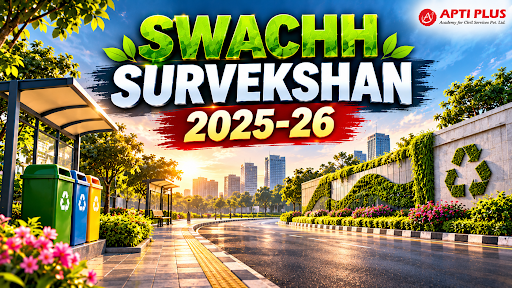
President Droupadi Murmu presented the Swachh Survekshan 2025–26 awards at Vigyan Bhawan, New Delhi.
What Is Swachh Survekshan?
-
Annual Survey: Swachh Survekshan is an annual cleanliness survey of cities under the Swachh Bharat Mission–Urban (SBM-U), described as the world's largest urban cleanliness survey.
-
Origin: It began in 2016 with just 73 Urban Local Bodies (ULBs) and expanded to nearly 4,900 ULBs by 2024.
-
Conducted by: Ministry of Housing and Urban Affairs (MoHUA).
-
Purpose: It encourages competition among cities, improves waste management and sanitation, and promotes citizen participation.
-
More Than A Ranking: MoHUA describes it as a governance and management tool for cities.
Swachh Survekshan 2025-26
Launch And Theme
-
Toolkit Release: Union Minister Manohar Lal released the toolkit in Bhopal on 20 December 2025.
-
Theme: "Swachhata Ki Nayi Pehel – Badhayein Haath, Karein Safai Saath", stressing collective responsibility.
Stronger Citizen Voice
-
Year-Round Feedback: For the first time, citizens could give feedback throughout the year through the Vote For My City app and portal, MyGov, the Swachhata App and QR codes.
-
Higher Weightage: Citizen feedback was given greater weight in scoring.
New Award Categories
|
Category |
Purpose |
|
Swachh Shehar Jodi |
Recognises mentor–mentee city pairs |
|
Swachh River Front Towns |
Cleanliness of riverfronts |
|
Swachh Coastal Towns |
Cleanliness of coastal areas |
|
Clean Himalayan Cities |
Cleanliness in hill cities |
New Indicators
-
Wider Checks: New indicators covered open defecation and open urination, tourist and heritage spots, water bodies and behaviour change in schools.
Rigorous Assessment
-
Field Teams: Over 3,000 trained assessors conducted a 45-day on-ground survey across ULBs, with GPS-enabled real-time monitoring.
-
State-Level Oversight: For the first time, each State/UT had a dedicated single-point-of-contact in charge, alongside a national oversight team.
-
Fully Digital: The process, from evidence submission to verification, was fully digital.
What Are The Key Results?
Super Swachh League
|
Rank |
City |
State |
|
1 |
Navi Mumbai |
Maharashtra |
|
2 |
Surat |
Gujarat |
|
3 |
Vijayawada |
Andhra Pradesh |
- About The League: Introduced in 2024–25, it features cities that ranked in the top three at least once in the previous three years and remain in the top 20% of their population category.
Population-Based Categories
|
Category |
Top City |
|
Million-plus |
Greater Visakhapatnam (followed by Jabalpur and Lucknow) |
|
3–10 lakh |
Ujjain |
|
50,000–3 lakh |
Dewas |
|
20,000–50,000 |
Vita |
Special Categories
|
Category |
Winners |
|
Swachh River Front Town |
Rewa, followed by Bilaspur and Varanasi |
|
Swachh Coastal Town |
Puri, followed by Alappuzha |
|
Clean Himalayan City |
Rudrapur |
|
Swachh Shehar Jodi |
Ahmedabad–Sanand, Indore–Depalpur, Tirupati–Kuppam |
End Of An Era
-
Indore's Streak: Indore had been ranked India's cleanest city for eight consecutive years, up to 2024–25.
-
Navi Mumbai's Rise: Navi Mumbai, which ranked third in 2024–25, moved to the top this year.
What Are The Key Challenges in Cleanliness?
Legacy Waste And Dumpsites
-
Mountains Of Old Waste: Many cities still have huge dumpsites that release methane, catch fire and pollute groundwater.
-
Example: Delhi's Ghazipur landfill, one of the country's largest, has seen repeated fires and remains a symbol of unresolved legacy waste.
Weak Source Segregation
-
Mixed Waste: Many households still do not segregate waste into wet and dry, making processing and recycling harder.
Weak Municipal Finances
-
Limited Resources: Indian municipalities raise very little revenue of their own.
-
Example: The RBI's 2022 report on municipal finances found that municipal revenue in India was only about 1% of GDP, far below many other countries, limiting their ability to invest in waste systems.
Uneven Performance Across Cities
-
Small Towns Lag: Smaller ULBs often lack trained staff, equipment and processing plants, creating a gap with top performers.
"Survey-Season" Cleanliness
-
Window Dressing: Critics argue some cities focus on visible cleanliness during survey periods, rather than lasting systemic change.
Safety Of Sanitation Workers
-
Hazardous Work: Deaths of workers cleaning sewers and septic tanks continue despite the Prohibition of Employment as Manual Scavengers and their Rehabilitation Act, 2013.
Plastic And Informal Sector Issues
-
Plastic Waste: Single-use plastics and multi-layered packaging remain hard to recycle.
-
Informal Waste Pickers: Lakhs of waste pickers who do much of India's recycling often work without recognition, social security or protective gear.
What Is The Way Forward?
Shift From Visible Cleanliness To Circular Systems
-
Zero-Waste Cities: Focus on reducing, reusing and recycling waste, not just keeping streets clean.
-
Learn From Global Models: Pricing waste can change behaviour.
-
Example: South Korea's volume-based waste fee, introduced in 1995, requires households to buy official bags for non-recyclable waste, which sharply cut waste generation and boosted recycling.
Clear Legacy Dumpsites
-
Bio-Mining And Remediation: Speed up bio-mining of old dumpsites and reclaim land for public use.
Strengthen Municipal Capacity
-
Better Finances: Improve property tax collection and user charges, and support ULBs through municipal bonds.
-
Skilled Staff: Train municipal staff in modern waste management and data systems.
Integrate Waste Pickers
-
Formal Recognition: Register waste pickers, provide ID cards, safety gear and social security, and link them to recycling value chains
-
Example: Pune's SWaCH cooperative, owned by waste pickers, provides door-to-door collection in partnership with the city corporation, showing how informal workers can be integrated into city systems.
Mechanise Sanitation Work
-
End Manual Cleaning: Use robots and machines for sewer cleaning, and enforce strict penalties for hazardous manual work.
Make Surveys More Robust
-
Year-Round Assessment: Continue moving from one-time checks to continuous, data-based monitoring to prevent "survey-season" cleanliness.
-
Independent Audits: Use third-party audits and satellite data to verify claims.
Spread Learning Across Cities
-
Replicate Best Practices: Document and share successful models from top cities such as Navi Mumbai, Surat and Vijayawada with smaller towns.
Conclusion
Swachh Survekshan 2025–26 marks a decade of India's urban cleanliness drive, with Navi Mumbai unseating Indore after eight years. Its expanded focus on citizen feedback, riverfronts, coasts, and hill cities broadens the concept of urban sanitation.
Source: PIB
|
PRACTICE QUESTION Q. Clean cities need lasting systems, not just high rankings. Examine the challenges in urban solid waste management in India and suggest measures. (15 Marks, 250 Words) |