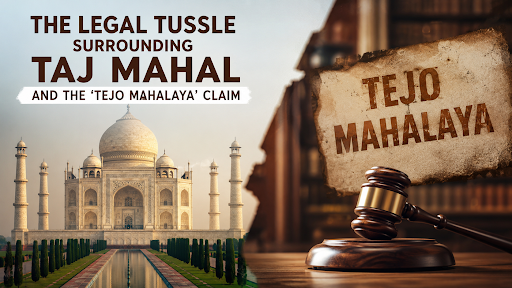
Why In News?
The Allahabad High Court seeks responses from the Centre and the Archaeological Survey of India (ASI) regarding a fresh plea challenging an Agra trial court order that refused to appoint an Advocate Commissioner to survey the Taj Mahal.
What is the Taj Mahal?
Mughal Emperor Shah Jahan constructed the Taj Mahal between 1631 and 1653 as a mausoleum for his wife, Arjumand Bano (Mumtaz Mahal).
Shah Jahan acquired the riverfront land from the Kachhwaha Rajput ruler Mirza Raja Jai Singh of Amber, compensating him with four havelis from imperial properties as documented in the Royal Mughal Farmans of 1633.
Architectural Design: Chief architect Ustad Ahmed Lahori leads a team of architects to design the structure.
Indo-Islamic Synthesis: The monument represents the zenith of Indo-Islamic architecture, synthesizing indigenous Hindu architectural traditions (such as the lotus dome and finial) with Islamic design.
Pietra Dura Technique: Artisans utilize the exquisite Pietra Dura inlay technique, a decorative method absent in India during pre-medieval times.
What is the 'Tejo Mahalaya' Claim?
Origin of Dispute: Writer P.N. Oak originates in 1989, asserting that the monument is a 12th-century Shiva temple built by Raja Paramardi Dev.
Etymological Claim: Conspiracy theorists argue that the name "Taj Mahal" represents a corrupted form of "Tejo Mahalaya", an abode of Agreshwar Mahadev.
Locked Rooms Allegation: Petitioners allege that 22 permanently locked rooms within the monument basement house ancient Hindu idols, demanding a court-ordered videographic survey.
Scientific Rejection: Professional historians and the ASI uniformly reject these claims as speculative pseudo-history lacking empirical evidence.
Documentary Evidence: Primary historical texts, including the Padshahnama, confirm that the Kachhwaha family owned the property and willingly transferred it for the tomb's construction.
Absence of Records: No archaeological study or contemporary European traveler account mentions any temple existing beneath the mausoleum.
What is the Role of the Archaeological Survey of India (ASI)?
It is an attached office under the Ministry of Culture, and serves as the premier national organization for archaeological research, scientific excavation, and the conservation of protected monuments.
Founding Year: It was established in 1861 under the statute of the Viceroy, Lord Canning.
Founder: Sir Alexander Cunningham, a British Army engineer, served as its first Director-General and is revered as the "Father of Indian Archaeology".
Headquarters: Located at Dharohar Bhawan, New Delhi.
Legal & Statutory Framework
Post-independence, the ASI transformed into a robust legal entity. It draws its regulatory and enforcement powers primarily from two major parliamentary acts:
-
Ancient Monuments and Archaeological Sites and Remains (AMASR) Act, 1958: Governs the declaration, preservation, and maintenance of ancient monuments and archaeological sites deemed to be of national importance.
-
Antiquities and Art Treasure Act, 1972: Regulates the domestic trade of antiquities, prevents illicit trafficking, and manages the export of non-antiquities.
Major Functions & Core Responsibilities
-
Monument Maintenance: Manages and protects over 3,690 centrally protected monuments and archaeological sites across India.
-
Archaeological Fieldwork: Directs land and underwater explorations to map India's prehistoric and historical landscapes. (e.g., historical role in unearthing the Indus Valley Civilization).
-
Specialised Research Wings: Employs institutional branches dedicated to Epigraphy (inscriptions), Numismatics (coins), Chemical Preservation, Science, Horticulture, and Underwater Archaeology (UAW).
-
Museum Administration: Operates more than 50 site museums nationwide located in immediate proximity to iconic historical excavations.
Source: THEHINDU
|
PRACTICE QUESTION Q. With reference to the construction of the Taj Mahal, consider the following statements:
Which of the statements given above is/are correct? A) 1 and 2 only B) 2 only C) 2 and 3 only D) 1, 2, and 3 Answer: B Explanation: Statement 1 is incorrect. The Taj Mahal is a quintessential example of Indo-Islamic architecture, which synthesizes Persian, Islamic, and indigenous Indian styles. It does not exclusively feature Islamic elements; rather, it incorporates indigenous design features. For instance, scholars note the use of "Indian architectural styles" alongside Islamic and Persian influences. Statement 2 is correct. Historical records, including court chronicles like the Badshahnama and royal farmans (decrees), confirm that the land chosen for the Taj Mahal originally belonged to Mirza Raja Jai Singh, the ruler of Amber (Jaipur). Emperor Shah Jahan acquired this land from him in exchange for four havelis (mansions) in Agra. The land was previously the site of a mansion belonging to Jai Singh's grandfather, Raja Man Singh. Statement 3 is incorrect. The Pietra Dura (or Parchin Kari) inlay technique, characterized by embedding semi-precious stones into marble, is not of pre-medieval Indian origin. It is an art form that originated in Renaissance Italy (Florence) and was introduced to India in the 16th and 17th centuries. It became a prominent feature of Mughal architecture specifically during the reign of Shah Jahan and was not a feature of pre-medieval Indian temples. |