Why In News?
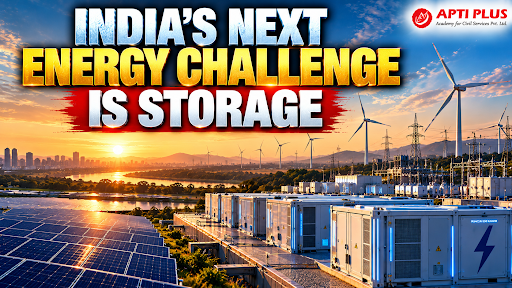
India’s energy transition is entering a new phase, where storing renewable electricity and supplying it when needed will be as important as expanding generation capacity.
What Is The Status Of India's Renewable Energy Expansion?
-
Non-Fossil Capacity Share: India's non-fossil fuel installed capacity has crossed 50% of the national grid capacity (283 GW of solar, wind, and hydro generation), reaching 52% as of January 2026.
-
Solar and Wind Dominance: As of July 2026, solar PV and wind power together account for 31% of India's total installed power capacity, with solar playing the primary driving role.
Official Climate & Capacity Targets
-
2030 NDC Commitments: Under its updated Nationally Determined Contributions (NDCs), India is committed to obtaining 50% of its cumulative electric power installed capacity from non-fossil sources by 2030 and reducing the emissions intensity of its GDP by 45% from 2005 levels.
-
500 GW Non-Fossil Target: India aims to reach 500 GW of installed non-fossil capacity by 2030.
Central Electricity Authority (CEA) Future Projections
-
2029–30 Capacity Mix: The CEA’s Optimal Generation Capacity Mix Report projects total installed capacity reaching 777.1 GW by 2029–30, with non-fossil sources providing 500.6 GW (64.4%). Key components include:
-
Solar PV: 292.6 GW (37.7%)
-
Wind Power: 99.9 GW (12.85%)
-
Large Hydropower: 53.9 GW (6.93%)
-
Pumped Storage Hydropower (PSH): 19.0 GW
-
Nuclear Power: 15.5 GW
-
2035–36 Horizon: The CEA's National Generation Adequacy Plan (2026–2036) envisages national installed capacity growing to 1,121 GW by 2035–36, with non-fossil sources expanding to 70% of the total energy mix.
The Storage & Grid Integration Challenge
-
Firming Green Generation: Because solar and wind are inherently variable and peak during non-evening demand hours, the core challenge has pivoted from expanding generation capacity to storing and firming clean energy for peak load dispatch.
-
Storage Capacity Roadmap: To maintain grid stability and prevent renewable curtailment, the CEA projects a national storage requirement of 60.63 GW / 336.4 GWh by 2029–30 (comprising 41.65 GW / 208.25 GWh of BESS and 18.98 GW / 128.15 GWh of Pumped Storage), scaling up to 174 GW / 888 GWh by 2035–36.
-
Implementation Pipeline: As of July 2026, India has commissioned 7.5 GWh of utility-scale storage, with 140 GWh currently under construction, tendering, or awarded.
Why Does India Need Energy Storage For Variable Renewable Energy Integration?
Mitigating Solar And Wind Intermittency: Solar PV and wind generation are inherently variable, fluctuating across diurnal and seasonal weather patterns.
-
Storage absorbs surplus generation during high-yield solar hours (10:00 AM – 2:00 PM) and dispatches power during non-generating evening hours.
Diurnal Demand Mismatch and Evening Peak Load: India’s national load peaks between 7:00 PM and 10:00 PM, coinciding with sunset when solar output drops to zero.
-
Co-located BESS stores afternoon solar power and discharges during evening peaks, preventing grid deficits.
Displacing Coal Peaking Plants and Reducing Ramping Stress: Without energy storage, utilities operate inefficient thermal plants at low Plant Load Factors (PLF) to cover evening ramps.
-
Deploying 63 GW (252 GWh) of battery storage by 2030 reduces thermal ramping stress and prevents building 30 GW of unviable coal baseload capacity (Source: LBNL Report).
Enhancing Grid Frequency and Voltage Stability: Injected non-synchronous solar energy reduces grid inertia; fast-responding BESS delivers sub-second Ancillary Services, frequency regulation, and voltage support.
What Are The Major Types Of Energy Storage Technologies
Battery Energy Storage System (BESS) |
Pumped Storage Hydropower (PSH) |
|
Technology & Chemistry: Electrochemical storage utilizing Lithium Iron Phosphate (LFP), Sodium-Ion, or Flow Batteries.
Operational Lifespan: Asset technical life is 15 Years with battery pack replacement required around year 10.
Response Time & Efficiency: Sub-second fast response for frequency regulation; Round Trip Efficiency (RTE) ranges from 85 Per Cent to 95 Per Cent (Source: CEEW Report).
Deployment Timelines & Space: Construction period is short (6 Months to 1 Year); minimal land footprint required.
Statutory & Environmental Focus: Governed by the Battery Waste Management Rules 2022; faces 128 GWh end-of-life battery recycling burden by 2030. |
Technology & Mechanism: Mechanical potential energy storage pumping water between upper and lower reservoirs (Source: NITI Aayog Report).
Operational Lifespan: Asset operational life spans 70 to 100 Years with lower long-term degradation.
Response Time & Efficiency: Minutes-level response time; Round Trip Efficiency (RTE) ranges from 70 Per Cent to 80 Per Cent.
Deployment Timelines & Space: Long gestation period (3 to 10 Years); requires specific topography and 2 to 5 Acres/MW land.
Statutory & Environmental Focus: Mandated under the National Electricity Plan (NEP); requires environmental clearances for reservoir construction. |
What Government Policies Promote Energy Storage In India?
National Energy Storage Framework and Viability Gap Funding (VGF): Under the National Framework for Promoting Energy Storage Systems 2023, grid-scale BESS projects receive up to 40 Per Cent VGF support, reducing composite tariffs from INR 9/unit to INR 6.6/unit.
Green Energy Corridor Phase III (GEC-III): Approved with an outlay of INR 1.86 Lakh Crore (US$ 19.3 Billion), GEC-III allocates US$ 5.2 Billion for 50 GWh of BESS alongside inter-state transmission lines.
Production Linked Incentive (PLI) Scheme for Advanced Chemistry Cells: The Ministry of Heavy Industries operates an INR 18,100 Crore PLI Scheme to build 50 GWh of domestic Advanced Chemistry Cell (ACC) manufacturing capacity.
Mandatory Energy Storage Obligations (ESO): The Ministry of Power enforces a 4 Per Cent Energy Storage Obligation (ESO) on distribution utilities by 2030, mandating minimum storage procurement.
What Are The Challenges in India's Energy Storage Sector?
High Capital Upfront Costs and DISCOM Tariff Vulnerability: High taxation and raw material costs keep Levelized Cost of Storage (LCoS) between INR 7/kWh and INR 8/kWh (0.08–0.09/kWh), making unassisted battery tariffs unaffordable for financially stressed Distribution Companies (DISCOMs)
-
Example: NTPC Vidyut Vyapar Nigam Ltd (NVVN) Uttar Pradesh Composite Tender, where 4-hour peak battery supply reached INR 6.6/unit with 30 Per Cent Viability Gap Funding (VGF), but escalated to an uncompetitive INR 9/unit without VGF, illustrating DISCOM tariff resistance.
Critical Mineral Import Reliance and Upstream Supply Chain Vulnerabilities: India imports 100 Per Cent of its raw lithium compounds, with 68 Per Cent sourced from China and 24 Per Cent from Chile, exposing cell manufacturers to geopolitical disruptions.
-
Example: IEEFA Critical Mineral Refining Report 2025, revealing China controls 74 per cent of global lithium refining, 80 per cent of cobalt refining, and 98 per cent of LFP cathode production, while India’s domestic lithium refining capacity stands at zero.
Absence of Tropical Thermal Safety Standards: Utility-scale battery packs operating in tropical climatic conditions risk thermal runaway and capacity degradation without localized safety norms.
-
Example: EPRI Utility BESS Incident Database Analysis 2024, showing that international safety standards like UL 9540A lack ambient humidity and extreme summer heat testing protocols required for Indian grid installations.
Looming End-of-Life E-Waste and Recycling Deficits: Rapid adoption of electric vehicles and BESS is creating a massive battery disposal bottleneck without adequate collection networks.
-
Example: NITI Aayog Battery Reuse and Recycling Report 2022, projecting 128 GWh of end-of-life lithium batteries available for recycling in India by 2030 (with 59 GWh originating from EVs alone), while formal domestic recycling capacity remains severely underdeveloped.
Way Forward
Institutionalizing Viability Gap Funding and Multi-Revenue Stacking: The Central Electricity Regulatory Commission (CERC) must formulate regulatory frameworks enabling BESS operators to stack revenues across time-of-day arbitrage, spinning reserves, and voltage support.
-
Example: National Framework for Promoting Energy Storage Systems 2023, offering 40 Per Cent Viability Gap Funding (VGF) while permitting developers to participate in ancillary service markets to improve bankability.
Domesticating Upstream Critical Mineral Refining and Component Manufacturing: The Ministry of Mines and Ministry of Heavy Industries must roll out targeted incentives for domestic refining of lithium, nickel, and cobalt.
-
Example: National Critical Minerals Mission (NCMM) Refinement Model, proposing dedicated PLI schemes for cathode active materials (CAM) and anode processing to reduce foreign supply chain dependencies.
Streamlining Approvals for Pumped Storage Hydro Projects: The Ministry of Power and CEA must fast-track concurrence timelines for off-river closed-loop PSP detailed project reports.
-
Example: CEA Fast-Track Single-Window Clearance Portal, which reduced Detailed Project Report (DPR) concurrence timelines for Pumped Storage Projects from 4 months down to 1–2 weeks.
Enforcing Closed-Loop Circular Economy and Second-Life Reuse Standards: The Ministry of Environment, Forest and Climate Change (MoEFCC) must strictly enforce recycling targets on battery producers.
-
Example: Battery Waste Management Rules 2022 & Extended Producer Responsibility (EPR) Mandate, establishing mandatory minimum recovery rates for lithium, cobalt, and nickel from spent utility and EV batteries.
Conclusion
Expanding energy storage is essential for meeting India’s 2030 500 GW non-fossil goal and the CEA’s 2035–36 target of 174 GW (888 GWh). Aligning Viability Gap Funding, mineral refining, and recycling will ensure grid stability and energy security.
Source: DOWNTOEARTH
|
PRACTICE QUESTION Q. India’s renewable energy transition will remain incomplete without rapid expansion of energy storage infrastructure. Examine. 150 words |